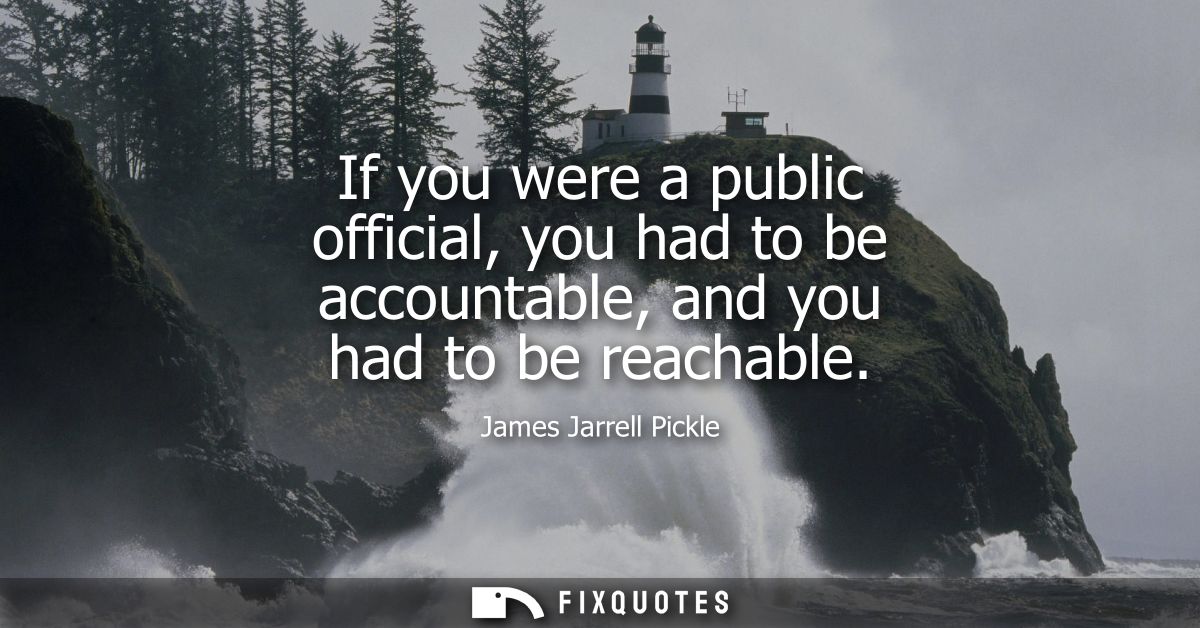
"If you were a public official, you had to be accountable, and you had to be reachable"
About this Quote
The intent is disciplinary. “Had to” isn’t aspirational; it’s a requirement, a moral minimum. Pickle frames accountability not as an abstract principle (“transparency”) but as a daily practice: people can find you, confront you, and force you to answer. Reachability becomes the mechanism that makes accountability real. Without it, “accountability” collapses into performance - hearings, statements, carefully managed appearances - while the official remains insulated from the lived consequences of policy.
The subtext is a critique of professionalized politics: the rise of gatekeepers, media-trained messaging, and the slow conversion of representatives into brand managers. In that world, access becomes a privilege, not a right, and distance is mistaken for dignity. Pickle’s line insists the opposite: legitimacy comes from proximity, from the discomfort of being interruptible.
Context matters. Pickle served through the postwar expansion of federal power and into the late-20th-century cynicism about Washington. His standard answers that cynicism with an older democratic bargain: you may not like my decisions, but you can reach me, and I can’t pretend I never heard you. That’s not nostalgia; it’s an operating system for trust.
Quote Details
| Topic | Leadership |
|---|---|
| Source | Help us find the source |
| Cite |
Citation Formats
APA Style (7th ed.)
Pickle, James Jarrell. (2026, January 15). If you were a public official, you had to be accountable, and you had to be reachable. FixQuotes. https://fixquotes.com/quotes/if-you-were-a-public-official-you-had-to-be-51419/
Chicago Style
Pickle, James Jarrell. "If you were a public official, you had to be accountable, and you had to be reachable." FixQuotes. January 15, 2026. https://fixquotes.com/quotes/if-you-were-a-public-official-you-had-to-be-51419/.
MLA Style (9th ed.)
"If you were a public official, you had to be accountable, and you had to be reachable." FixQuotes, 15 Jan. 2026, https://fixquotes.com/quotes/if-you-were-a-public-official-you-had-to-be-51419/. Accessed 5 Apr. 2026.