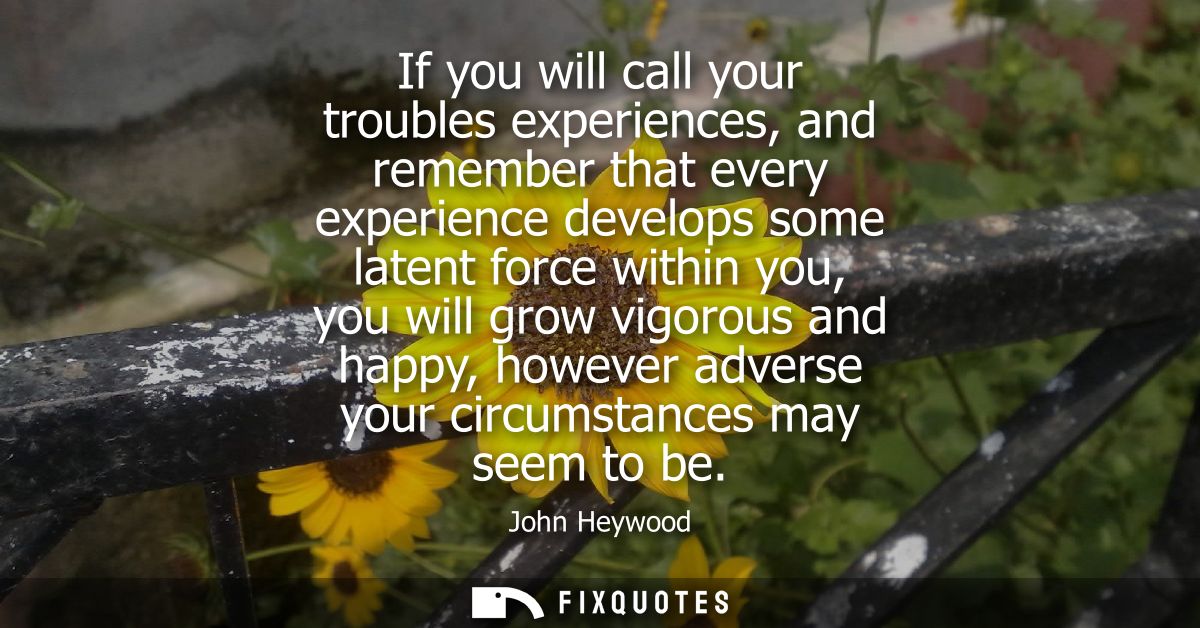
"If you will call your troubles experiences, and remember that every experience develops some latent force within you, you will grow vigorous and happy, however adverse your circumstances may seem to be"
About this Quote
The engine of the line is an early-modern belief in the self as improvable, almost athletic. “Latent force” suggests strength waiting backstage, not a fixed moral character but a capacity that can be trained. Coming from a Tudor dramatist, it also reads as craft advice in disguise. Comedy and tragedy both rely on adversity; the trick is whether you let hardship stay chaos or turn it into usable substance. Heywood’s audience lived with plague cycles, political volatility, and precarious livelihoods. In that context, telling people they can become “vigorous and happy” isn’t naive optimism so much as a survival technology: a psychological reframing that keeps you functional.
The subtext has a hint of stoic discipline and a hint of social compliance. By promising happiness “however adverse your circumstances may seem to be,” he shifts the battleground from external conditions to internal interpretation. That empowers the individual, but it also conveniently lets unjust circumstances off the hook. Still, the line works because it recognizes a harsh truth without luxuriating in it: you may not control the era you’re born into, but you can control what you do with its material, and the story you tell yourself about it.
Quote Details
| Topic | Resilience |
|---|---|
| Source | Help us find the source |
| Cite |
Citation Formats
APA Style (7th ed.)
Heywood, John. (2026, January 17). If you will call your troubles experiences, and remember that every experience develops some latent force within you, you will grow vigorous and happy, however adverse your circumstances may seem to be. FixQuotes. https://fixquotes.com/quotes/if-you-will-call-your-troubles-experiences-and-57056/
Chicago Style
Heywood, John. "If you will call your troubles experiences, and remember that every experience develops some latent force within you, you will grow vigorous and happy, however adverse your circumstances may seem to be." FixQuotes. January 17, 2026. https://fixquotes.com/quotes/if-you-will-call-your-troubles-experiences-and-57056/.
MLA Style (9th ed.)
"If you will call your troubles experiences, and remember that every experience develops some latent force within you, you will grow vigorous and happy, however adverse your circumstances may seem to be." FixQuotes, 17 Jan. 2026, https://fixquotes.com/quotes/if-you-will-call-your-troubles-experiences-and-57056/. Accessed 26 Mar. 2026.