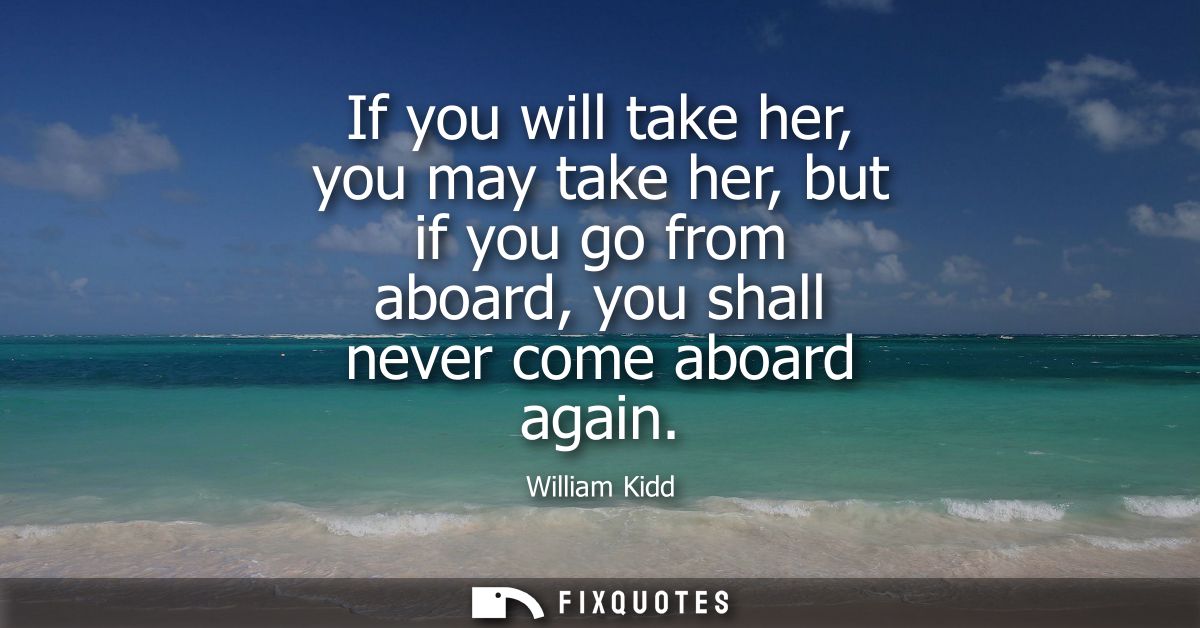
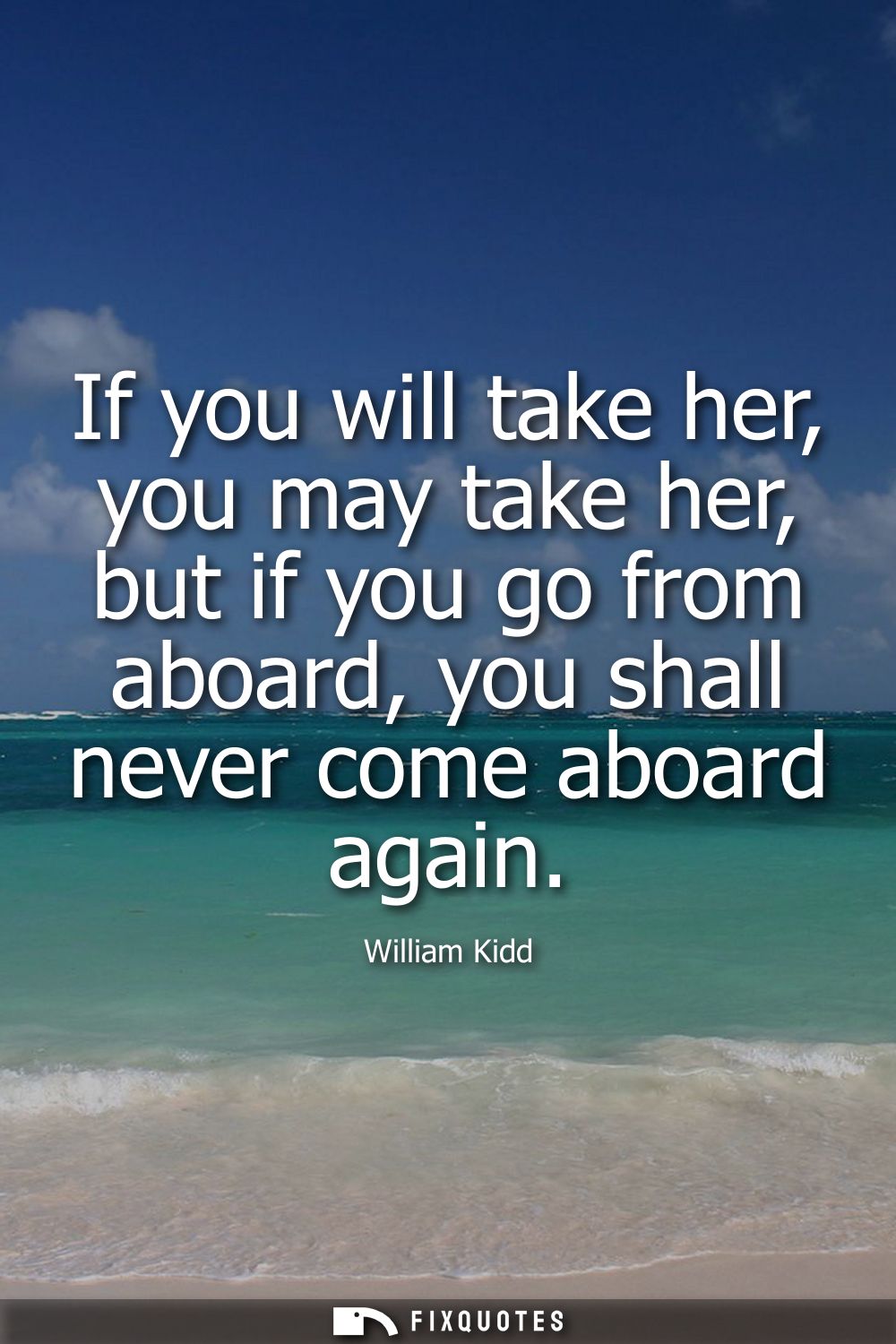
"If you will take her, you may take her, but if you go from aboard, you shall never come aboard again"
About this Quote
The “her” does a lot of work. Whether it’s a woman, a captured prize, a small boat, even an object of private desire, the grammar turns her into cargo - something transferable, claimable. That’s the subtext: the ship is the real sovereign territory, and Kidd is its law. He isn’t merely protecting discipline; he’s policing belonging. Step off the floating state, and you’re stateless.
Context matters because life at sea was a closed ecosystem where social order doubled as survival strategy. On an expedition - and especially in the pirate-adjacent world Kidd inhabited - loyalty isn’t sentimental; it’s logistical. This isn’t a jealous lover’s ultimatum so much as an operational boundary: no divided commitments, no uncertainty about who’s in the crew, no one bringing trouble back aboard.
The sentence also betrays anxiety. Absolute rules usually show up when authority feels fragile. Kidd’s insistence on a one-way exit reads like a captain shoring up control in a world where desertion, mutiny, and shifting allegiances were constant temptations. The threat isn’t just punishment; it’s a reminder that the ship, not the shore, is where power lives.
Quote Details
| Topic | Marriage |
|---|---|
| Source | Help us find the source |
| Cite |
Citation Formats
APA Style (7th ed.)
Kidd, William. (2026, January 16). If you will take her, you may take her, but if you go from aboard, you shall never come aboard again. FixQuotes. https://fixquotes.com/quotes/if-you-will-take-her-you-may-take-her-but-if-you-117898/
Chicago Style
Kidd, William. "If you will take her, you may take her, but if you go from aboard, you shall never come aboard again." FixQuotes. January 16, 2026. https://fixquotes.com/quotes/if-you-will-take-her-you-may-take-her-but-if-you-117898/.
MLA Style (9th ed.)
"If you will take her, you may take her, but if you go from aboard, you shall never come aboard again." FixQuotes, 16 Jan. 2026, https://fixquotes.com/quotes/if-you-will-take-her-you-may-take-her-but-if-you-117898/. Accessed 17 Mar. 2026.