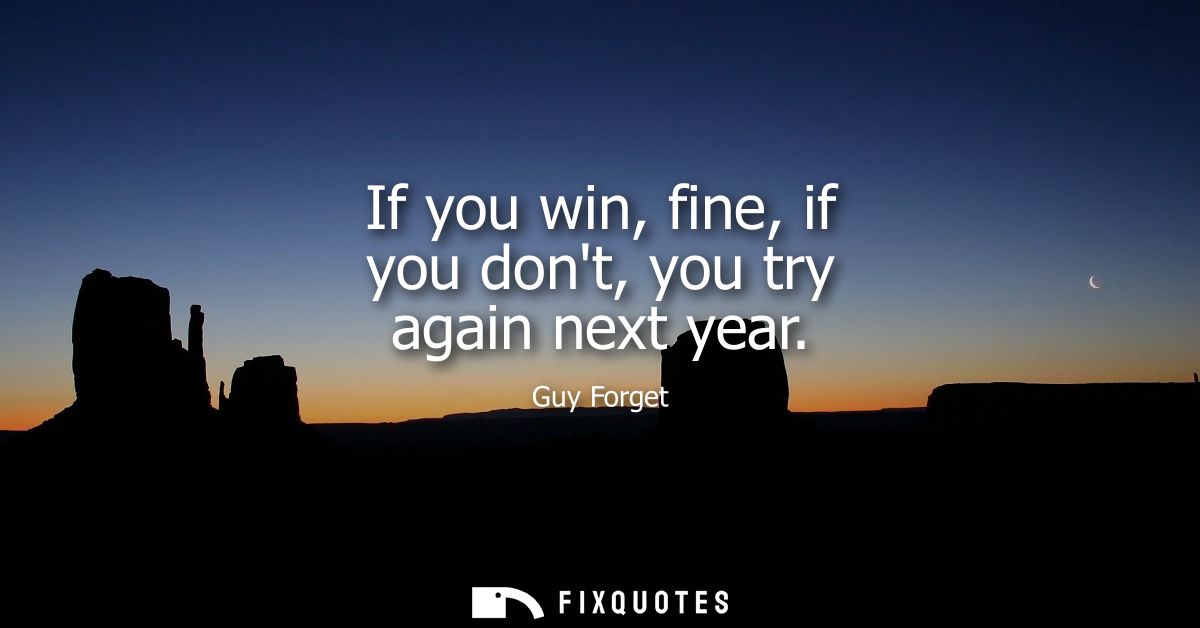
"If you win, fine, if you don't, you try again next year"
About this Quote
The line lands with the blunt, locker-room clarity of someone who’s lived inside the seasonal churn of professional sport. Guy Forget isn’t selling poetry; he’s offering a survival protocol. “If you win, fine” deliberately shrinks victory down to a passing condition, not a life-defining coronation. That casual “fine” is the tell: the real point is emotional containment. Enjoy it, sure, but don’t build your identity on it, because the calendar will take it away.
The second half does the heavier work. “If you don’t, you try again next year” frames failure as logistical, not existential. It’s a statement designed to short-circuit the melodrama fans and media love to attach to losses. In tennis especially, where one player wins the tournament and everyone else exits with a fresh bruise to their narrative, the phrase refuses the idea that defeat demands a grand moral lesson. The lesson is repetition.
Context matters: Forget came up in an era when French tennis carried both pride and pressure, expected to produce moments on home soil without always having the depth of the dominant nations. His sentence reads like a veteran’s way of managing that expectation: you can’t control the mythology, but you can control the next training block. Subtextually it’s also a quiet rebuke to entitlement. Winning isn’t owed, losing isn’t catastrophic. The sport moves on; so do you.
The second half does the heavier work. “If you don’t, you try again next year” frames failure as logistical, not existential. It’s a statement designed to short-circuit the melodrama fans and media love to attach to losses. In tennis especially, where one player wins the tournament and everyone else exits with a fresh bruise to their narrative, the phrase refuses the idea that defeat demands a grand moral lesson. The lesson is repetition.
Context matters: Forget came up in an era when French tennis carried both pride and pressure, expected to produce moments on home soil without always having the depth of the dominant nations. His sentence reads like a veteran’s way of managing that expectation: you can’t control the mythology, but you can control the next training block. Subtextually it’s also a quiet rebuke to entitlement. Winning isn’t owed, losing isn’t catastrophic. The sport moves on; so do you.
Quote Details
| Topic | Never Give Up |
|---|---|
| Source | Help us find the source |
| Cite | Cite this Quote |
Citation Formats
APA Style (7th ed.)
Forget, Guy. (n.d.). If you win, fine, if you don't, you try again next year. FixQuotes. https://fixquotes.com/quotes/if-you-win-fine-if-you-dont-you-try-again-next-105321/
Chicago Style
Forget, Guy. "If you win, fine, if you don't, you try again next year." FixQuotes. Accessed February 2, 2026. https://fixquotes.com/quotes/if-you-win-fine-if-you-dont-you-try-again-next-105321/.
MLA Style (9th ed.)
"If you win, fine, if you don't, you try again next year." FixQuotes, https://fixquotes.com/quotes/if-you-win-fine-if-you-dont-you-try-again-next-105321/. Accessed 2 Feb. 2026.
More Quotes by Guy
Add to List