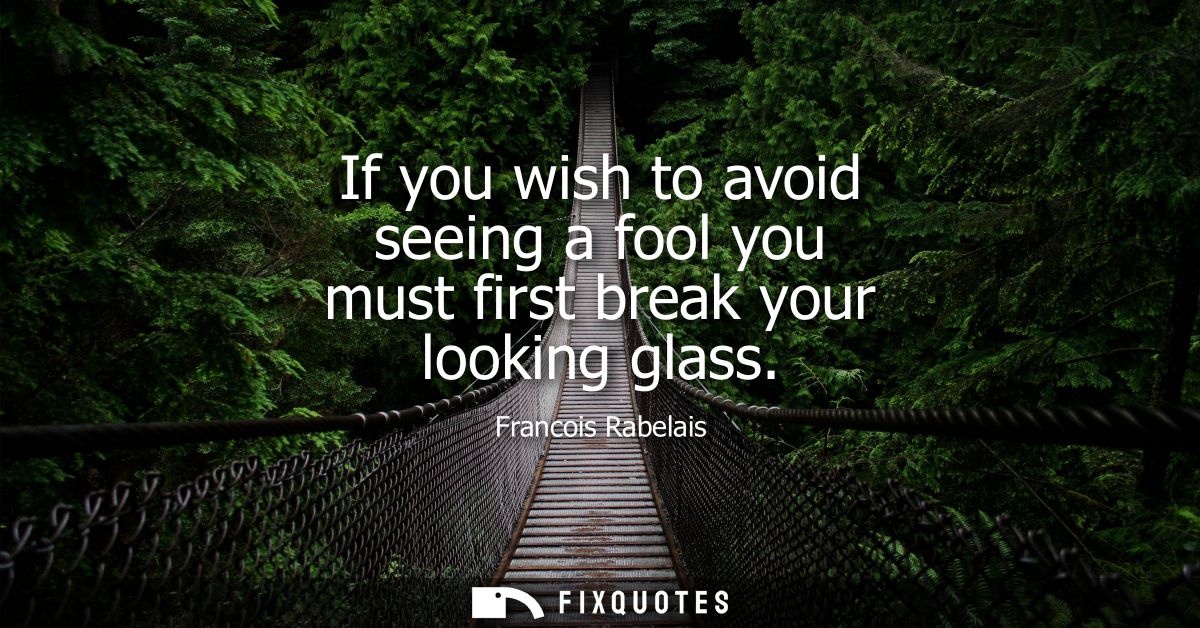
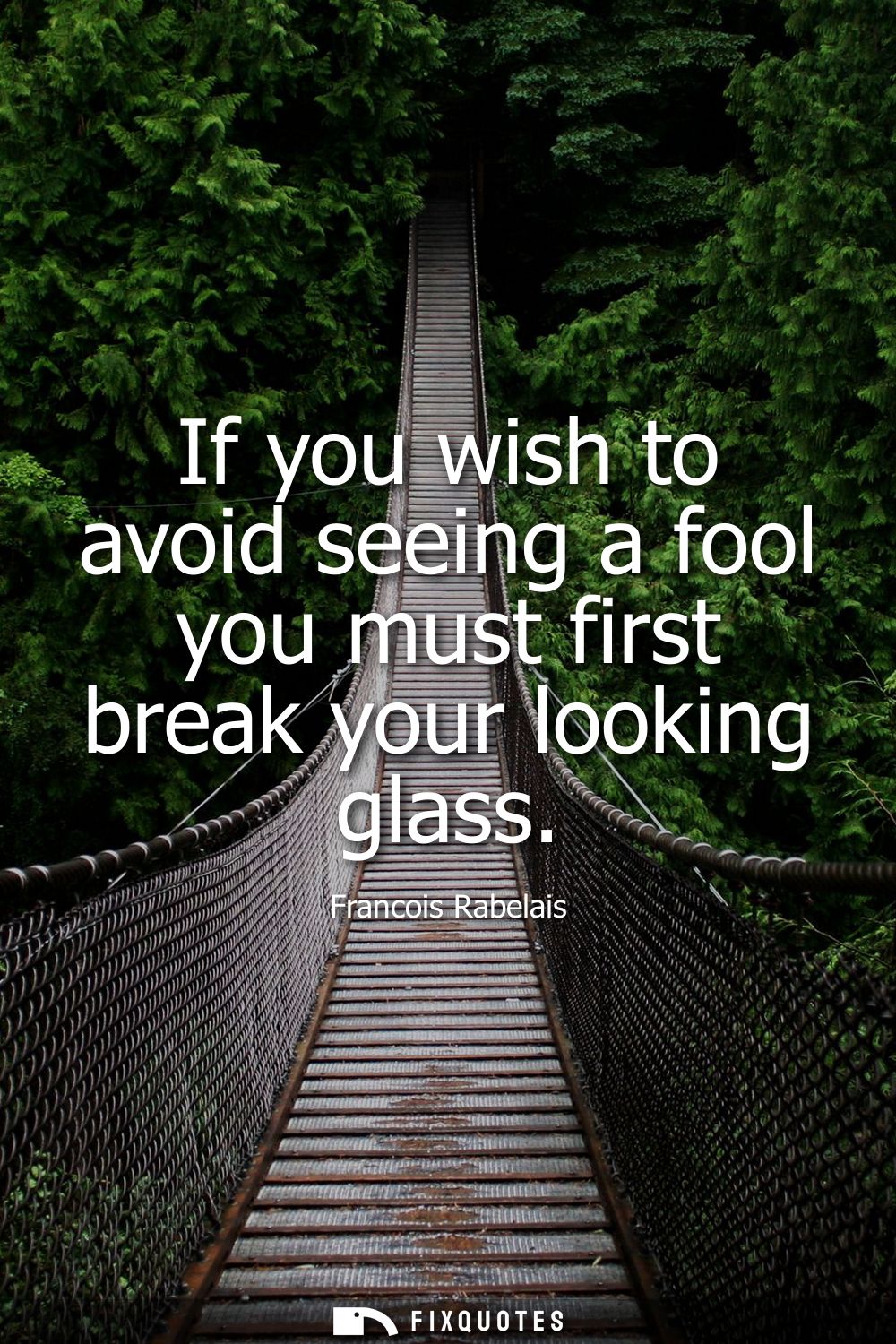
"If you wish to avoid seeing a fool, you must first break your looking glass"
About this Quote
Rabelais, a Renaissance cleric who wrote with the appetite of a carnival barker, aims this at a culture newly intoxicated by learning, argument, and status. His era had plenty of “wise” men eager to spot heresy, ignorance, or bad taste in others. The subtext is a warning about that reflex: the more aggressively you hunt for folly, the more likely you’re performing it. Ridicule becomes a mirror in reverse, a way to avoid the harder work of examining your own blind spots.
The intent is not soft humility for its own sake. It’s a defense against sanctimony. As a clergyman writing in a religiously tense Europe, Rabelais knew how quickly certainty hardens into cruelty. The wit works because it’s economical and irreversible: you can’t unsee the implication. Once you accept that your gaze is part of the problem, “the fool” stops being a convenient outsider and becomes a condition of being human, especially when you’re convinced you’re not one.
Quote Details
| Topic | Wisdom |
|---|---|
| Source | Help us find the source |
| Cite |
Citation Formats
APA Style (7th ed.)
Rabelais, Francois. (2026, February 18). If you wish to avoid seeing a fool, you must first break your looking glass. FixQuotes. https://fixquotes.com/quotes/if-you-wish-to-avoid-seeing-a-fool-you-must-first-78745/
Chicago Style
Rabelais, Francois. "If you wish to avoid seeing a fool, you must first break your looking glass." FixQuotes. February 18, 2026. https://fixquotes.com/quotes/if-you-wish-to-avoid-seeing-a-fool-you-must-first-78745/.
MLA Style (9th ed.)
"If you wish to avoid seeing a fool, you must first break your looking glass." FixQuotes, 18 Feb. 2026, https://fixquotes.com/quotes/if-you-wish-to-avoid-seeing-a-fool-you-must-first-78745/. Accessed 27 Mar. 2026.