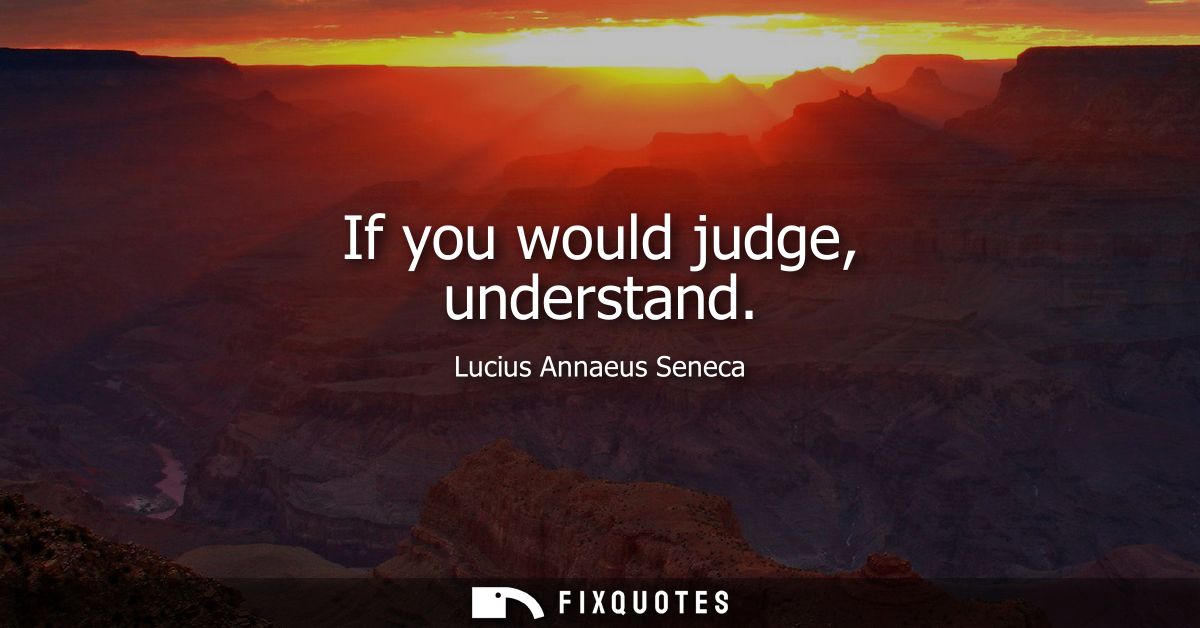
"If you would judge, understand"
About this Quote
Judgment is easy; understanding is labor. Seneca’s line refuses to let you have the first without paying for the second. Coming from a Roman statesman steeped in Stoicism, it’s less a plea for softness than a demand for intellectual discipline: before you pronounce a verdict on someone’s choices, you owe the work of reconstructing their pressures, incentives, fears, and blind spots. The sentence is built like a gate. “If” makes judging conditional, not a right. “Would” hints at desire - you want to judge because it flatters your clarity. “Understand” is the toll.
The subtext is political as much as personal. Seneca served in a court culture that ran on suspicion, gossip, and lethal snap decisions; he also tutored Nero, a living case study in what happens when power meets impulsive certainty. In that environment, “judge” isn’t just moral critique; it can be exile, confiscation, execution. So the admonition functions as a check on the civic habit of moral theater: condemning others to prove your own purity.
It also carries a Stoic psychological barb. People judge to stabilize themselves - to turn messy human behavior into a tidy story where they’re the reasonable one. Seneca punctures that comfort. Understanding requires admitting contingency: that you, with a different temperament or a worse day or the wrong patron, might have done the same. The line works because it reframes judgment as a failure of imagination, and it makes empathy not a mood but a standard of evidence.
The subtext is political as much as personal. Seneca served in a court culture that ran on suspicion, gossip, and lethal snap decisions; he also tutored Nero, a living case study in what happens when power meets impulsive certainty. In that environment, “judge” isn’t just moral critique; it can be exile, confiscation, execution. So the admonition functions as a check on the civic habit of moral theater: condemning others to prove your own purity.
It also carries a Stoic psychological barb. People judge to stabilize themselves - to turn messy human behavior into a tidy story where they’re the reasonable one. Seneca punctures that comfort. Understanding requires admitting contingency: that you, with a different temperament or a worse day or the wrong patron, might have done the same. The line works because it reframes judgment as a failure of imagination, and it makes empathy not a mood but a standard of evidence.
Quote Details
| Topic | Wisdom |
|---|---|
| Source | Help us find the source |
| Cite |
Citation Formats
APA Style (7th ed.)
Younger, Seneca the. (2026, January 18). If you would judge, understand. FixQuotes. https://fixquotes.com/quotes/if-you-would-judge-understand-15837/
Chicago Style
Younger, Seneca the. "If you would judge, understand." FixQuotes. January 18, 2026. https://fixquotes.com/quotes/if-you-would-judge-understand-15837/.
MLA Style (9th ed.)
"If you would judge, understand." FixQuotes, 18 Jan. 2026, https://fixquotes.com/quotes/if-you-would-judge-understand-15837/. Accessed 30 Mar. 2026.
More Quotes by Seneca
Add to List