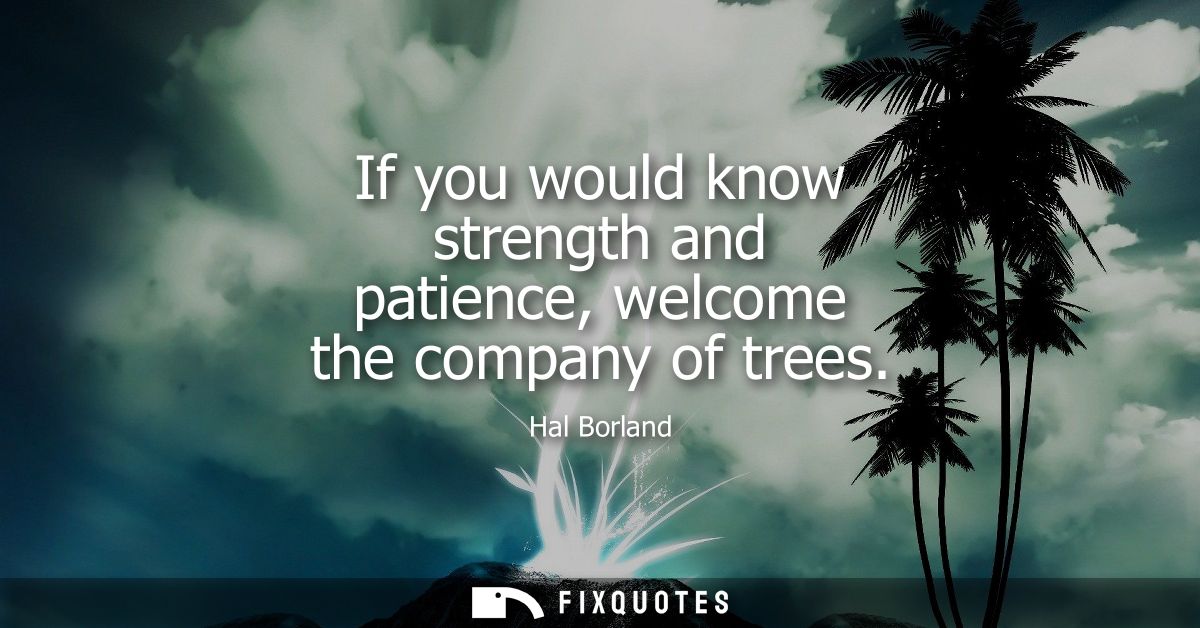
"If you would know strength and patience, welcome the company of trees"
About this Quote
Strength and patience aren’t taught here as virtues you can willpower your way into; they’re absorbed by proximity. Borland’s line works because it’s less a slogan than an instruction for re-scaling your nervous system. “Welcome the company of trees” implies choice and humility: you don’t conquer nature for wisdom, you consent to its pace. The verb “welcome” also turns trees into companions rather than scenery, nudging the reader away from extraction and toward relationship.
The subtext is a quiet indictment of modern impatience. Trees embody strength without spectacle: they don’t hustle, argue, or announce progress, yet they endure storms, drought, rot, and seasons that erase the very idea of instant results. Borland pairs “strength” with “patience” to puncture a cultural misconception that strength is loud, forceful, and immediate. In a tree’s timeline, strength is what patience looks like after years of staying put.
Context matters: Borland wrote as a mid-century American nature writer, a period when postwar acceleration, suburban expansion, and consumer confidence were remaking landscapes and attention spans alike. His sentence reads like a small act of resistance against that tempo. It suggests that the antidote to human agitation isn’t another technique or self-help framework, but an older teacher: the living world that outlasts our deadlines.
It’s also emotionally practical. Spend time among trees and you’re confronted with slow growth, quiet persistence, and non-negotiable cycles. You don’t just learn patience; you feel how unnecessary your panic is.
The subtext is a quiet indictment of modern impatience. Trees embody strength without spectacle: they don’t hustle, argue, or announce progress, yet they endure storms, drought, rot, and seasons that erase the very idea of instant results. Borland pairs “strength” with “patience” to puncture a cultural misconception that strength is loud, forceful, and immediate. In a tree’s timeline, strength is what patience looks like after years of staying put.
Context matters: Borland wrote as a mid-century American nature writer, a period when postwar acceleration, suburban expansion, and consumer confidence were remaking landscapes and attention spans alike. His sentence reads like a small act of resistance against that tempo. It suggests that the antidote to human agitation isn’t another technique or self-help framework, but an older teacher: the living world that outlasts our deadlines.
It’s also emotionally practical. Spend time among trees and you’re confronted with slow growth, quiet persistence, and non-negotiable cycles. You don’t just learn patience; you feel how unnecessary your panic is.
Quote Details
| Topic | Nature |
|---|---|
| Source | Verified source: Beyond Your Doorstep: A Handbook to the Country (Hal Borland, 1962)ISBN: 9781453232378
Evidence: Only the unobservant sees nothing but trees in a forest. Any woodland is a complex community of plants and animal life with its own laws of growth and survival. But if you would know strength and majesty and patience, welcome the company of trees. (Chapter 4 (The Woodlands), p. 75). This is a longer, sourced form of the widely-circulated shorter quote (often missing the word “majesty” and the preceding sentences). Multiple secondary quote sites point to Beyond Your Doorstep and give a page in the mid-70s, and independent bibliographic info indicates the original work was first published in 1962 by Alfred A. Knopf. However, I did not access a page image scan of the 1962 Knopf first edition in this search session, so the page number cannot be independently confirmed from a primary-page view here. Other candidates (1) The Sacred Healing Alchemy of Flowers (Barbara Starflower, 2022) compilation95.0% ... If you would know strength and patience, welcome the company of trees. – Hal Borland By understanding that our ec... |
| Cite |
Citation Formats
APA Style (7th ed.)
Borland, Hal. (2026, February 8). If you would know strength and patience, welcome the company of trees. FixQuotes. https://fixquotes.com/quotes/if-you-would-know-strength-and-patience-welcome-142459/
Chicago Style
Borland, Hal. "If you would know strength and patience, welcome the company of trees." FixQuotes. February 8, 2026. https://fixquotes.com/quotes/if-you-would-know-strength-and-patience-welcome-142459/.
MLA Style (9th ed.)
"If you would know strength and patience, welcome the company of trees." FixQuotes, 8 Feb. 2026, https://fixquotes.com/quotes/if-you-would-know-strength-and-patience-welcome-142459/. Accessed 4 Apr. 2026.
More Quotes by Hal
Add to List