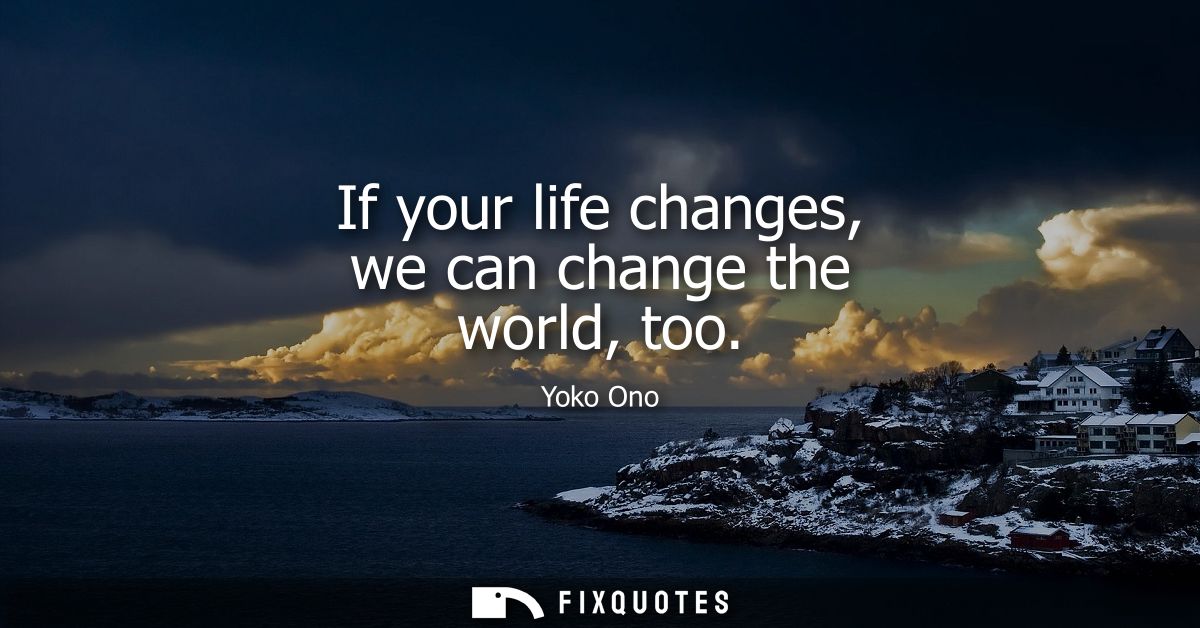
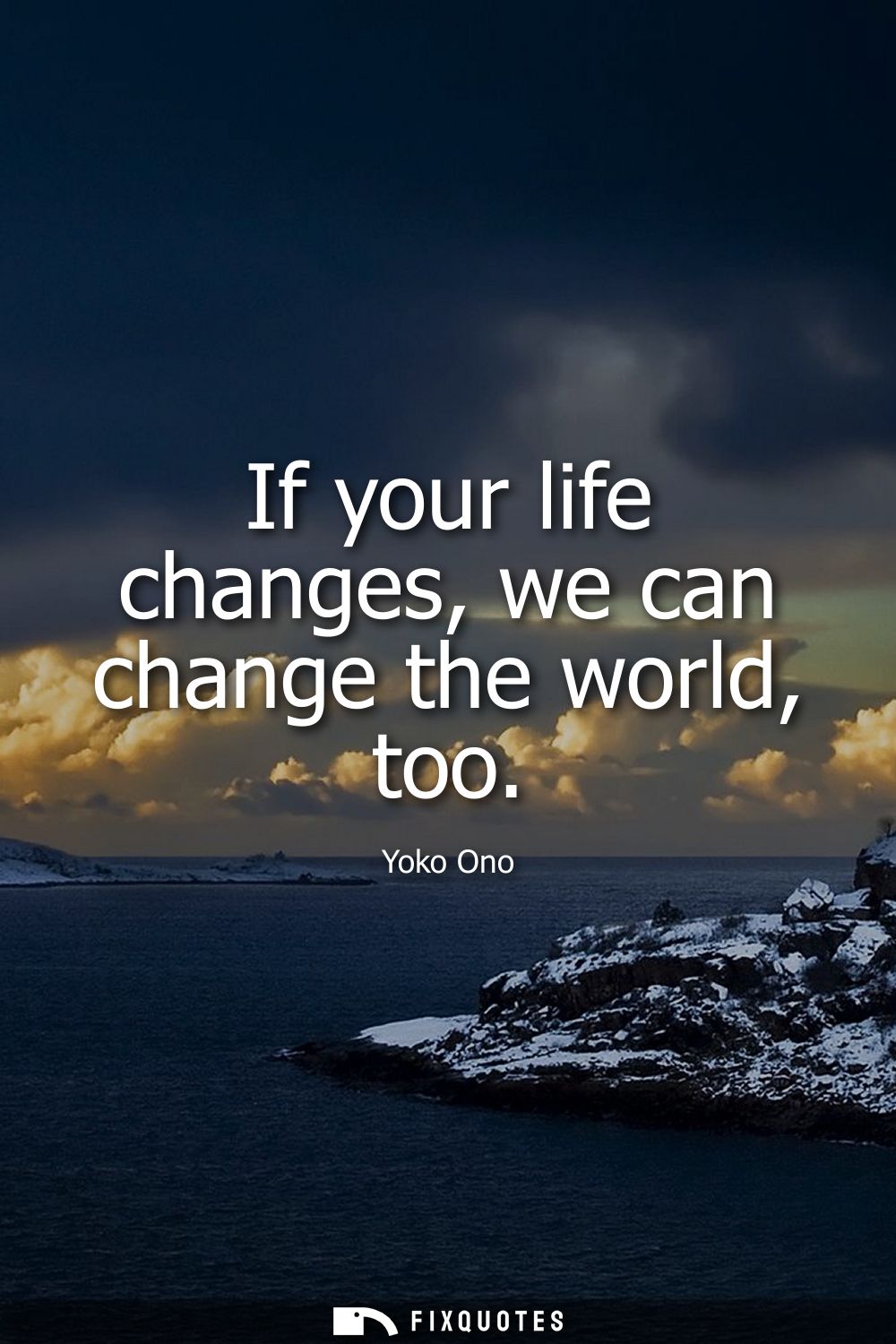
"If your life changes, we can change the world, too"
About this Quote
The line lands like a dare disguised as a lullaby: start with your own life, and the world might follow. Yoko Ono’s genius has always been to make the personal feel like a switch you can actually flip. “If your life changes” isn’t mystical self-help; it’s an insistence that politics begins in habit, perception, and courage. The conditional “if” matters. It refuses the easy fantasy that history improves on its own, or that “the world” is something managed by distant grown-ups. Change is offered as a collaboration, not a miracle.
The subtext is classic Ono: intimate, disarmingly simple, and quietly accusatory. If you’re waiting for the revolution to arrive like a package, you’re part of the delay. She collapses the scale difference between inner life and public life, not by pretending they’re the same, but by arguing they’re wired together. Your relationships, your attention span, your willingness to be odd in public, your capacity to imagine alternatives - these are political resources. A changed life produces changed behavior; changed behavior, at mass, becomes culture; culture becomes policy. That’s the chain she’s compressing into one sentence.
Context sharpens it. Ono emerged from Fluxus and conceptual art, where instructions and small gestures were the artwork, and from late-60s peace activism, where spectacle and sincerity had to coexist. The phrase echoes the ethos of her “instruction pieces” and “Imagine”-era idealism: not naive, but strategic. It’s a call to stop outsourcing agency, delivered in the soft voice of someone who knows softness can be a form of force.
The subtext is classic Ono: intimate, disarmingly simple, and quietly accusatory. If you’re waiting for the revolution to arrive like a package, you’re part of the delay. She collapses the scale difference between inner life and public life, not by pretending they’re the same, but by arguing they’re wired together. Your relationships, your attention span, your willingness to be odd in public, your capacity to imagine alternatives - these are political resources. A changed life produces changed behavior; changed behavior, at mass, becomes culture; culture becomes policy. That’s the chain she’s compressing into one sentence.
Context sharpens it. Ono emerged from Fluxus and conceptual art, where instructions and small gestures were the artwork, and from late-60s peace activism, where spectacle and sincerity had to coexist. The phrase echoes the ethos of her “instruction pieces” and “Imagine”-era idealism: not naive, but strategic. It’s a call to stop outsourcing agency, delivered in the soft voice of someone who knows softness can be a form of force.
Quote Details
| Topic | Embrace Change |
|---|
More Quotes by Yoko
Add to List