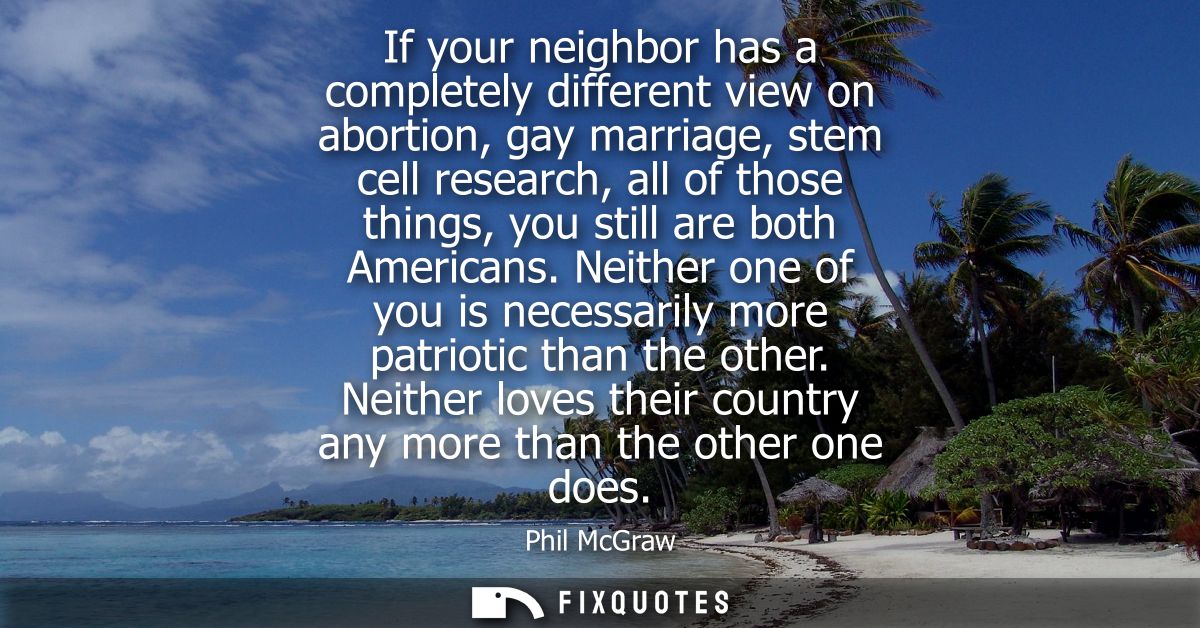
"If your neighbor has a completely different view on abortion, gay marriage, stem cell research, all of those things, you still are both Americans. Neither one of you is necessarily more patriotic than the other. Neither loves their country any more than the other one does!"
About this Quote
The subtext pushes against a very American temptation: turning patriotism into a weaponized credential. “Neither one of you is necessarily more patriotic” is careful phrasing, leaving room for extremes while rejecting the common move of branding opponents as traitors. He swaps ideological purity for belonging. That’s not neutral in effect; it’s an intervention against the emotional economy of cable news and social media, where outrage is rewarded and “real American” becomes a gatekeeping slogan.
Context matters: McGraw rose as a mass-media psychologist, translating conflict resolution into daytime-TV language. The tone is plain, almost parental, because the target isn’t policy nuance; it’s the performative moral superiority that makes neighbors into enemies. The rhetorical power comes from its modesty: he’s not asking you to change your mind, just to stop mistaking disagreement for disloyalty. In a polarized moment, that’s a political act disguised as a therapeutic one.
Quote Details
| Topic | Equality |
|---|---|
| Source | Help us find the source |
| Cite |
Citation Formats
APA Style (7th ed.)
McGraw, Phil. (2026, February 18). If your neighbor has a completely different view on abortion, gay marriage, stem cell research, all of those things, you still are both Americans. Neither one of you is necessarily more patriotic than the other. Neither loves their country any more than the other one does! FixQuotes. https://fixquotes.com/quotes/if-your-neighbor-has-a-completely-different-view-71799/
Chicago Style
McGraw, Phil. "If your neighbor has a completely different view on abortion, gay marriage, stem cell research, all of those things, you still are both Americans. Neither one of you is necessarily more patriotic than the other. Neither loves their country any more than the other one does!" FixQuotes. February 18, 2026. https://fixquotes.com/quotes/if-your-neighbor-has-a-completely-different-view-71799/.
MLA Style (9th ed.)
"If your neighbor has a completely different view on abortion, gay marriage, stem cell research, all of those things, you still are both Americans. Neither one of you is necessarily more patriotic than the other. Neither loves their country any more than the other one does!" FixQuotes, 18 Feb. 2026, https://fixquotes.com/quotes/if-your-neighbor-has-a-completely-different-view-71799/. Accessed 7 Apr. 2026.