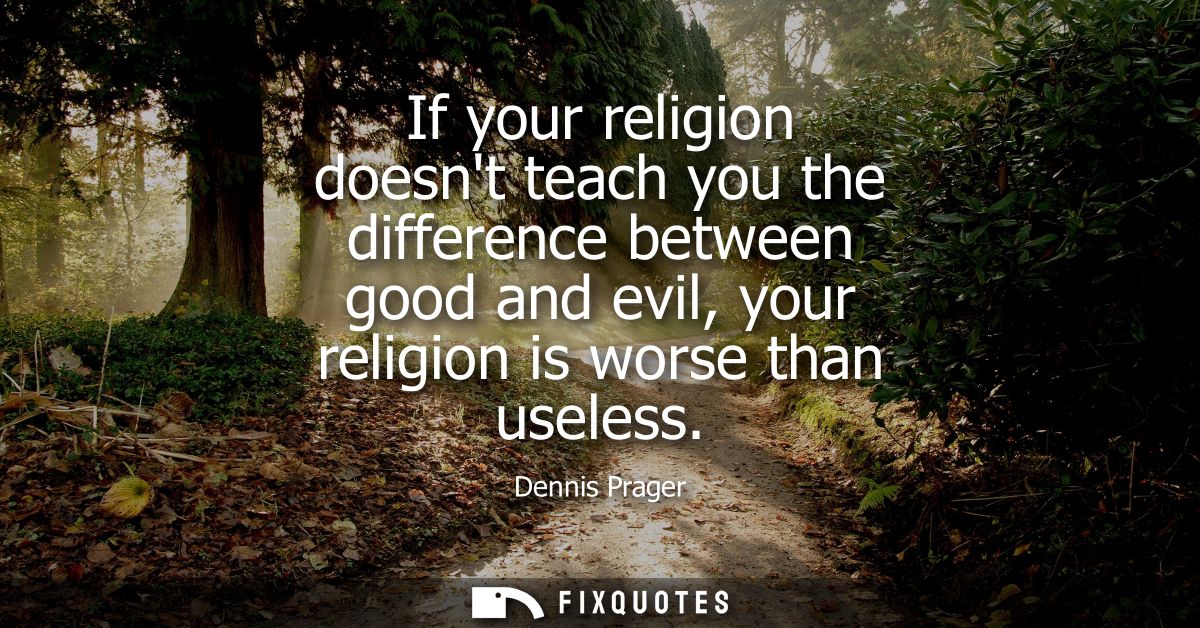
"If your religion doesn't teach you the difference between good and evil, your religion is worse than useless"
About this Quote
The rhetorical move is strategic: he reframes religion’s legitimacy around outcomes rather than heritage. If a tradition can’t produce moral clarity, it forfeits its social contract. “Worse than useless” is the knife twist; uselessness is neutral, but “worse” suggests a sedative effect. A religion that avoids good-and-evil language can anesthetize conscience, offering absolution without responsibility and community without standards.
Subtextually, it’s a critique of moral relativism and “nonjudgmental” piety, often associated with liberal, pluralist cultures where defining evil feels impolite or politically suspect. It also functions as a boundary marker: real religion, in this framing, is the kind that draws lines, disciplines desire, and is willing to condemn. That can read as bracing - a call for seriousness in an age of performative values - or as a warning sign of its own, since absolute moral binaries have historically justified cruelty as easily as they’ve restrained it.
Context matters: Prager’s broader project is cultural combat over moral authority. The quote is a claim to the high ground, and an attempt to make “moral clarity” the price of admission.
Quote Details
| Topic | Ethics & Morality |
|---|---|
| Source | Help us find the source |
| Cite |
Citation Formats
APA Style (7th ed.)
Prager, Dennis. (2026, January 17). If your religion doesn't teach you the difference between good and evil, your religion is worse than useless. FixQuotes. https://fixquotes.com/quotes/if-your-religion-doesnt-teach-you-the-difference-52562/
Chicago Style
Prager, Dennis. "If your religion doesn't teach you the difference between good and evil, your religion is worse than useless." FixQuotes. January 17, 2026. https://fixquotes.com/quotes/if-your-religion-doesnt-teach-you-the-difference-52562/.
MLA Style (9th ed.)
"If your religion doesn't teach you the difference between good and evil, your religion is worse than useless." FixQuotes, 17 Jan. 2026, https://fixquotes.com/quotes/if-your-religion-doesnt-teach-you-the-difference-52562/. Accessed 12 Feb. 2026.