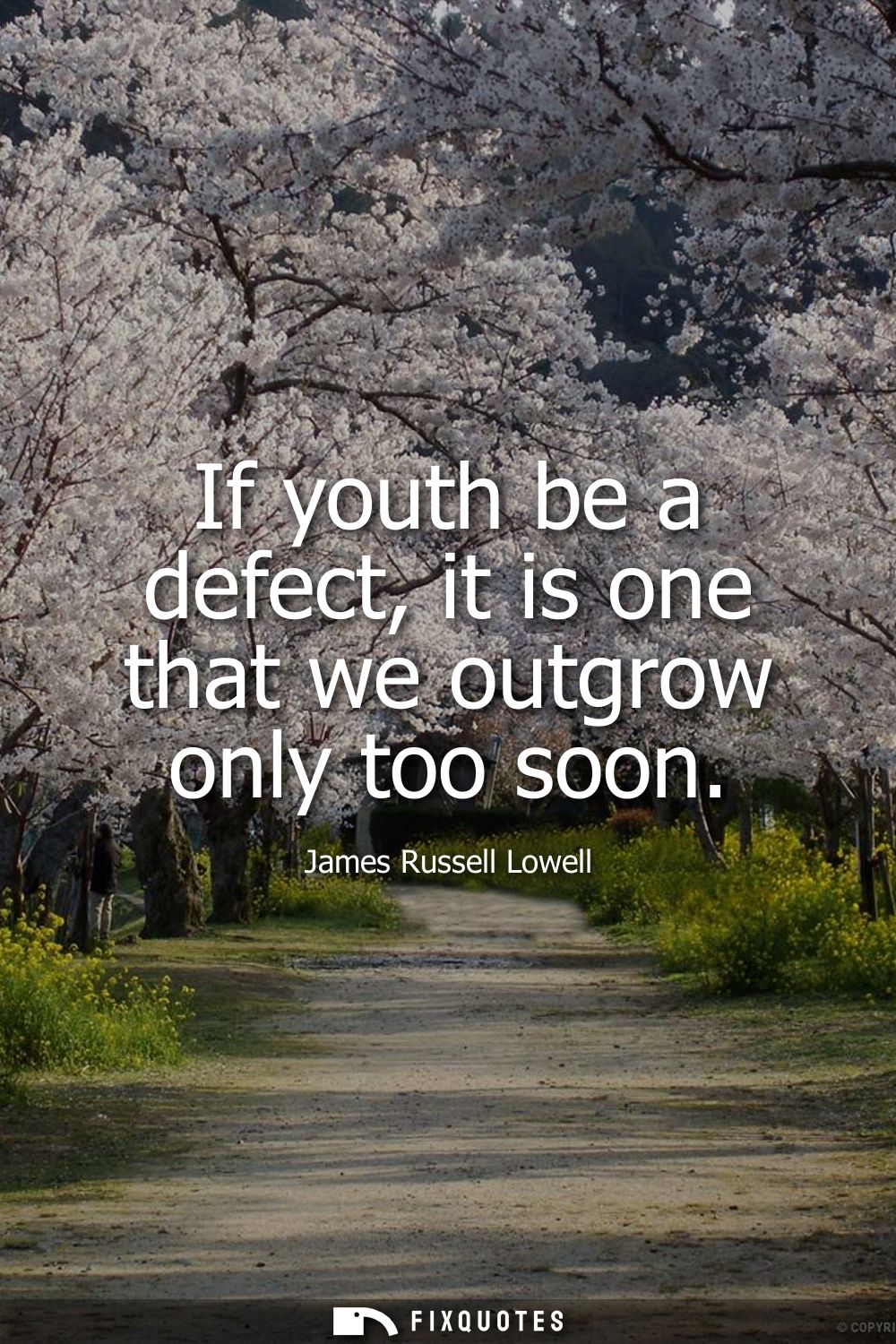
"If youth be a defect, it is one that we outgrow only too soon"
About this Quote
Youth is framed here as a “defect” only to booby-trap the reader into rejecting the premise. Lowell’s line works because it borrows the voice of the scold - the adult world that treats inexperience, volatility, idealism, even joy, as character flaws - and then flips it with a quiet sting: if youth is a problem, time will “fix” it brutally fast. The punch isn’t sentimental; it’s procedural. Aging arrives as an inevitability, and the speed of “only too soon” makes the supposed cure feel like a loss, not a victory.
Lowell, a 19th-century American poet and public intellectual, lived in a culture that prized self-mastery and respectability while watching the country churn through reform movements, war, and industrial acceleration. In that setting, youth wasn’t just an age category; it was a political and moral stereotype: reckless, impatient, naive. The quote needles that stereotype by implying that society’s impatience with youth is really impatience with possibility. Young people still have time to believe change is plausible; older institutions don’t love that.
The subtext is a critique of grown-up condescension. Calling youth a defect is the kind of language used to discipline newcomers into conformity: wait your turn, temper your ideals, learn the “real” world. Lowell’s rejoinder is that the real world’s triumph is pyrrhic. We outgrow youth the way we outgrow openness: not through wisdom alone, but through weathering.
Lowell, a 19th-century American poet and public intellectual, lived in a culture that prized self-mastery and respectability while watching the country churn through reform movements, war, and industrial acceleration. In that setting, youth wasn’t just an age category; it was a political and moral stereotype: reckless, impatient, naive. The quote needles that stereotype by implying that society’s impatience with youth is really impatience with possibility. Young people still have time to believe change is plausible; older institutions don’t love that.
The subtext is a critique of grown-up condescension. Calling youth a defect is the kind of language used to discipline newcomers into conformity: wait your turn, temper your ideals, learn the “real” world. Lowell’s rejoinder is that the real world’s triumph is pyrrhic. We outgrow youth the way we outgrow openness: not through wisdom alone, but through weathering.
Quote Details
| Topic | Youth |
|---|---|
| Source | Help us find the source |
| Cite |
Citation Formats
APA Style (7th ed.)
Lowell, James Russell. (2026, January 17). If youth be a defect, it is one that we outgrow only too soon. FixQuotes. https://fixquotes.com/quotes/if-youth-be-a-defect-it-is-one-that-we-outgrow-28959/
Chicago Style
Lowell, James Russell. "If youth be a defect, it is one that we outgrow only too soon." FixQuotes. January 17, 2026. https://fixquotes.com/quotes/if-youth-be-a-defect-it-is-one-that-we-outgrow-28959/.
MLA Style (9th ed.)
"If youth be a defect, it is one that we outgrow only too soon." FixQuotes, 17 Jan. 2026, https://fixquotes.com/quotes/if-youth-be-a-defect-it-is-one-that-we-outgrow-28959/. Accessed 5 Mar. 2026.
More Quotes by James
Add to List