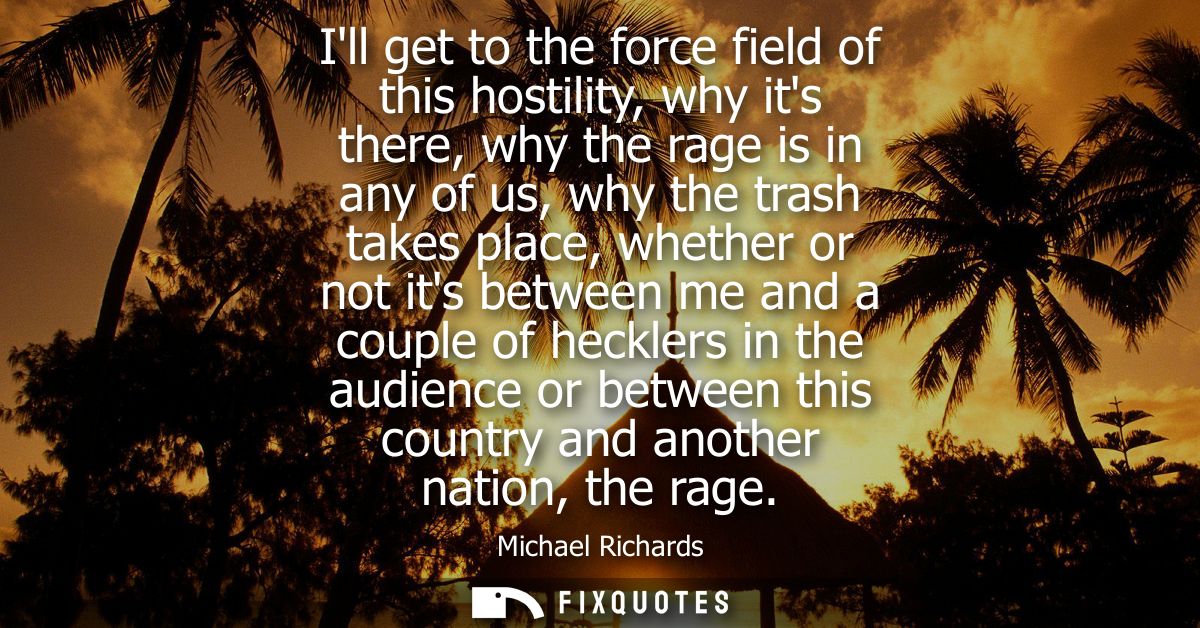
"I'll get to the force field of this hostility, why it's there, why the rage is in any of us, why the trash takes place, whether or not it's between me and a couple of hecklers in the audience or between this country and another nation, the rage"
About this Quote
The quote is also doing a kind of scale-hopping meant to dignify the incident. Richards telescopes from "a couple of hecklers" to "this country and another nation" as if the same rage animates both, and as if his outburst belongs in the same tragic category as geopolitical hatred. That move isn't accidental; it's an appeal for interpretive charity. If rage is a national condition, then a performer losing control can be framed as a symptom, not a perpetrator.
The repetition of "why" sounds like curiosity, but it functions as a stall. Inquiry becomes a rhetorical holding pattern that postpones the more pointed question: why those particular words, with that particular history, in that particular room. Even "trash" is telling - a euphemism that tries to downshift racist violence into mere bad behavior. The intent is to universalize anger so the specifics blur; the subtext is a plea to be seen as fallible and swept up, rather than responsible and deliberate.
Quote Details
| Topic | Anger |
|---|---|
| Source | Help us find the source |
| Cite |
Citation Formats
APA Style (7th ed.)
Richards, Michael. (2026, January 15). I'll get to the force field of this hostility, why it's there, why the rage is in any of us, why the trash takes place, whether or not it's between me and a couple of hecklers in the audience or between this country and another nation, the rage. FixQuotes. https://fixquotes.com/quotes/ill-get-to-the-force-field-of-this-hostility-why-64178/
Chicago Style
Richards, Michael. "I'll get to the force field of this hostility, why it's there, why the rage is in any of us, why the trash takes place, whether or not it's between me and a couple of hecklers in the audience or between this country and another nation, the rage." FixQuotes. January 15, 2026. https://fixquotes.com/quotes/ill-get-to-the-force-field-of-this-hostility-why-64178/.
MLA Style (9th ed.)
"I'll get to the force field of this hostility, why it's there, why the rage is in any of us, why the trash takes place, whether or not it's between me and a couple of hecklers in the audience or between this country and another nation, the rage." FixQuotes, 15 Jan. 2026, https://fixquotes.com/quotes/ill-get-to-the-force-field-of-this-hostility-why-64178/. Accessed 5 Apr. 2026.