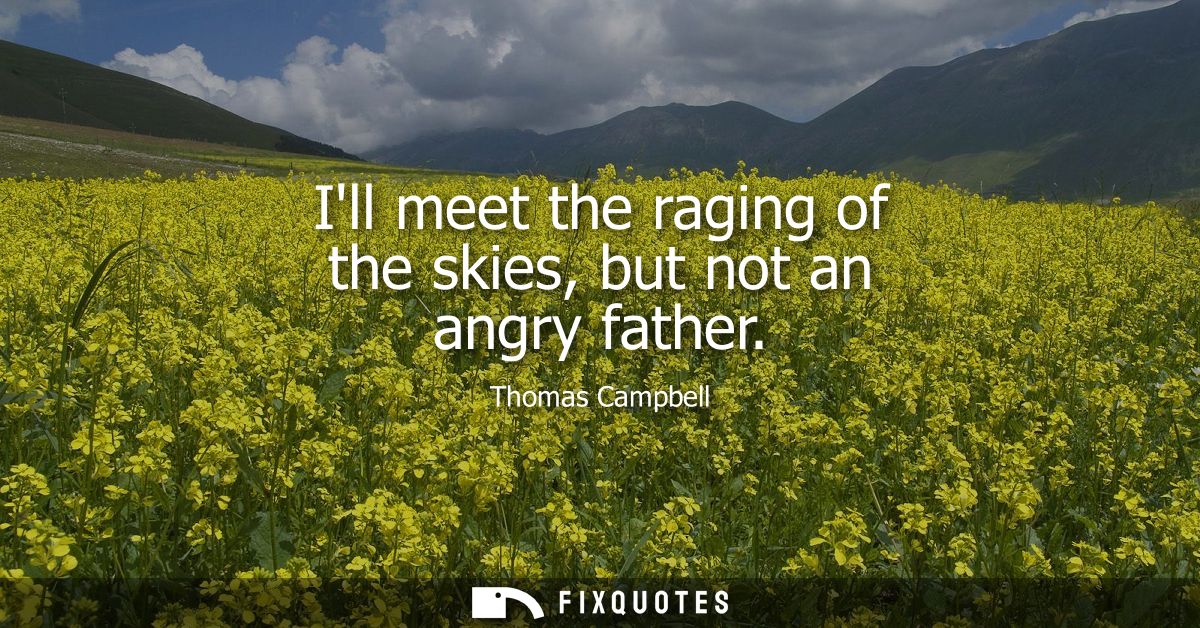
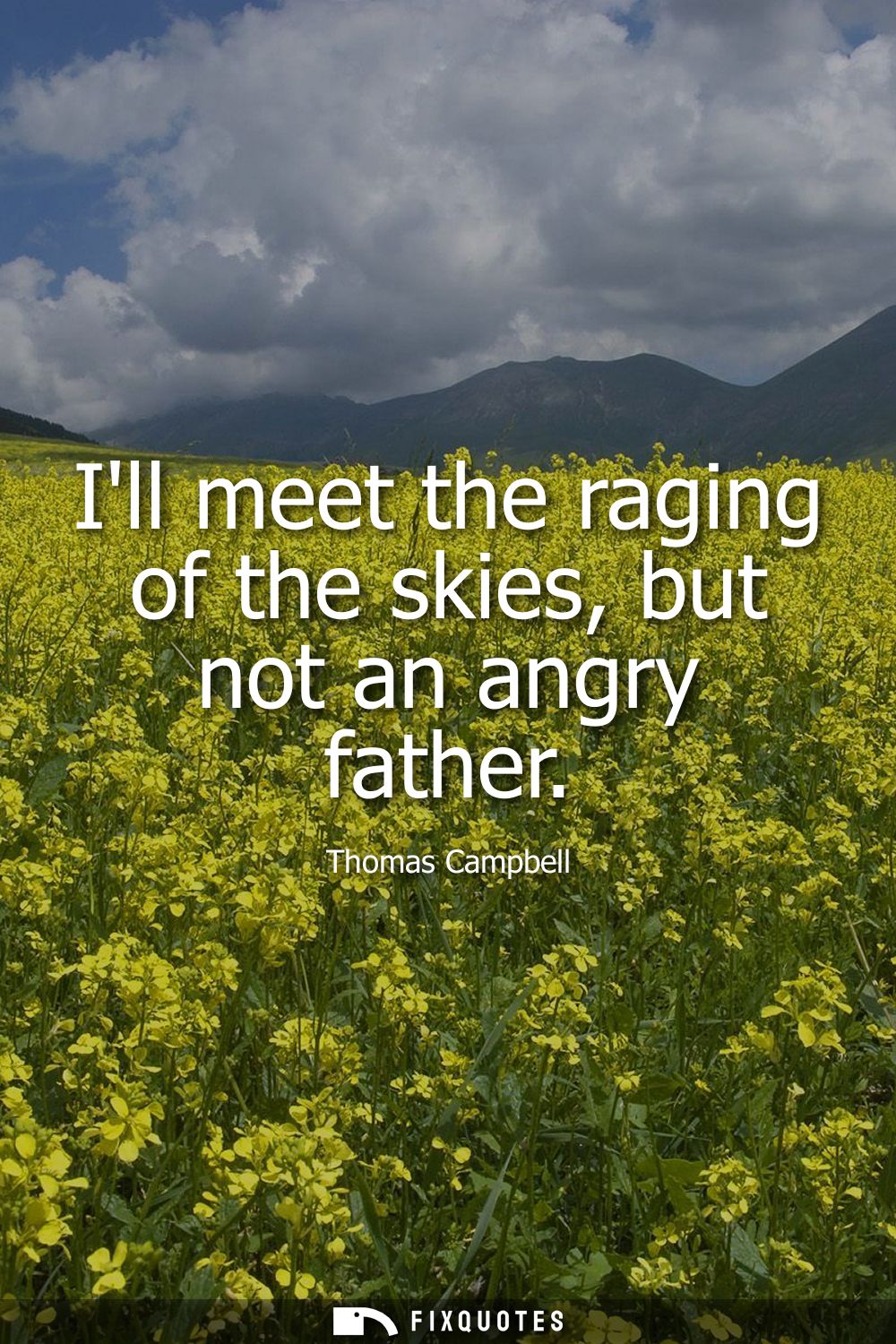
"I'll meet the raging of the skies, but not an angry father"
About this Quote
Campbell pits weather against kinship and makes the storm look merciful. “Raging of the skies” is grand, impersonal violence - the sort of danger Romantic poetry loved because it’s sublime, knowable in its unpredictability, even cleansing. You can brace yourself against wind and lightning; you can at least pretend it’s just physics and fate. An “angry father,” though, is intimate power. It isn’t random. It’s judgment with a memory.
The line works because it reverses the expected hierarchy of fear. Nature is supposed to be the big antagonist, the thing that humbles humans. Campbell makes paternal anger the real terror: moral, domestic, inescapable. The subtext is a whole economy of shame. A father’s rage carries social consequences - inheritance, reputation, belonging - in a way the sky never can. If you survive a storm, you’re unlucky or lucky; if you face down a father, you’re guilty or defiant, and the family ledger keeps score.
Context matters: Campbell writes in a period when “father” also reads as authority itself - not just a parent but a household sovereign, a miniature monarch. Against that backdrop, the speaker’s courage is complicated. He’s brave enough for external catastrophe, yet he flinches at a private tribunal. The line captures a psychological truth Romanticism often circled: the most paralyzing forces aren’t the spectacular ones outside us, but the punitive voices we’re raised under, whose anger can feel like weather you somehow deserve.
The line works because it reverses the expected hierarchy of fear. Nature is supposed to be the big antagonist, the thing that humbles humans. Campbell makes paternal anger the real terror: moral, domestic, inescapable. The subtext is a whole economy of shame. A father’s rage carries social consequences - inheritance, reputation, belonging - in a way the sky never can. If you survive a storm, you’re unlucky or lucky; if you face down a father, you’re guilty or defiant, and the family ledger keeps score.
Context matters: Campbell writes in a period when “father” also reads as authority itself - not just a parent but a household sovereign, a miniature monarch. Against that backdrop, the speaker’s courage is complicated. He’s brave enough for external catastrophe, yet he flinches at a private tribunal. The line captures a psychological truth Romanticism often circled: the most paralyzing forces aren’t the spectacular ones outside us, but the punitive voices we’re raised under, whose anger can feel like weather you somehow deserve.
Quote Details
| Topic | Father |
|---|---|
| Source | Verified source: Gertrude of Wyoming; A Pennsylvanian Tale. And Other Poems (Thomas Campbell, 1809)
Evidence: I'll meet the raging of the skies, But not an angry father.', . The line is from Thomas Campbell’s ballad/poem "Lord Ullin’s Daughter" (the quote is spoken by the daughter in the poem). A scholarly secondary source notes Campbell sketched the ballad earlier, reworked it in 1804, and "finally published" it in 1809; the 1809 publication is in his volume titled "Gertrude of Wyoming; A Pennsylvanian Tale. And Other Poems" (London: Longman, Hurst, Rees, and Orme). I was able to verify the exact wording from a contemporaneous reciter anthology scan ("The Elocutionist") but I could not, within this search session, open a scanned copy of the 1809 first edition to extract a page number from that specific primary volume. So: primary-work identification + first-publication year are strong; page number in the 1809 book remains unverified here. Supporting references: the poem text appears in "The Elocutionist" excerpt shown at the linked Wikisource page; and a literary-journal preview explicitly states the 1809 final publication date for the ballad. Other candidates (1) From Thomas Campbell to Marquis of Lorne (James Grant Wilson, 1876) compilation95.0% ... I'll meet the raging of the skies , But not an angry father . " The boat has left a stormy land , A'stormy sea be... |
| Cite |
Citation Formats
APA Style (7th ed.)
Campbell, Thomas. (2026, February 28). I'll meet the raging of the skies, but not an angry father. FixQuotes. https://fixquotes.com/quotes/ill-meet-the-raging-of-the-skies-but-not-an-angry-21008/
Chicago Style
Campbell, Thomas. "I'll meet the raging of the skies, but not an angry father." FixQuotes. February 28, 2026. https://fixquotes.com/quotes/ill-meet-the-raging-of-the-skies-but-not-an-angry-21008/.
MLA Style (9th ed.)
"I'll meet the raging of the skies, but not an angry father." FixQuotes, 28 Feb. 2026, https://fixquotes.com/quotes/ill-meet-the-raging-of-the-skies-but-not-an-angry-21008/. Accessed 5 Apr. 2026.
More Quotes by Thomas
Add to List