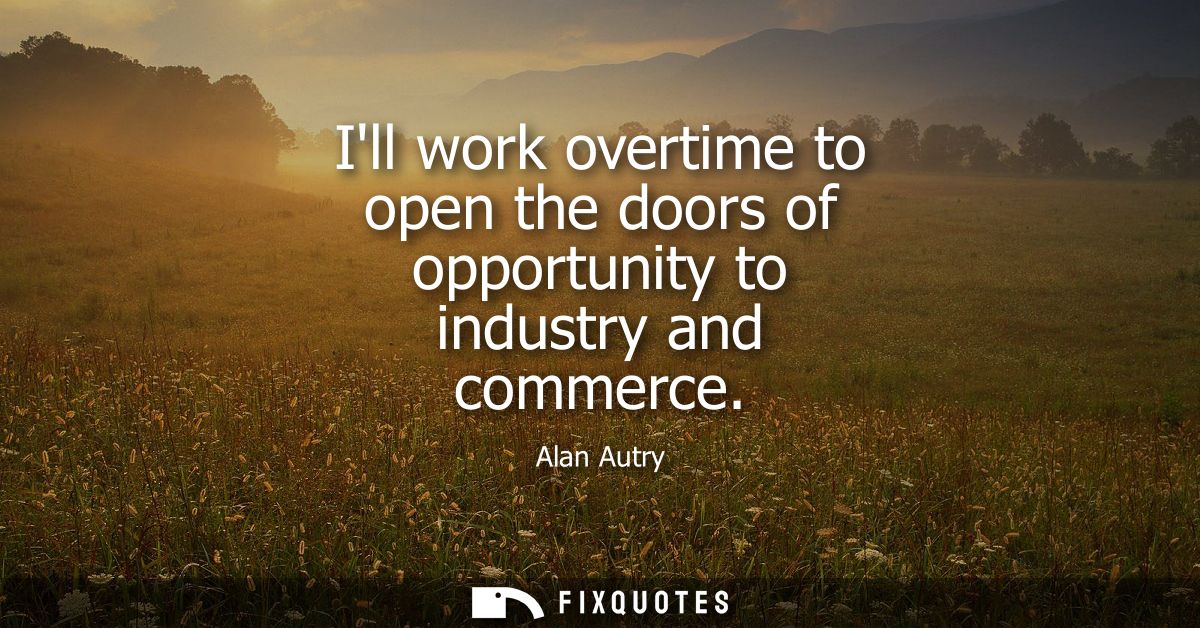
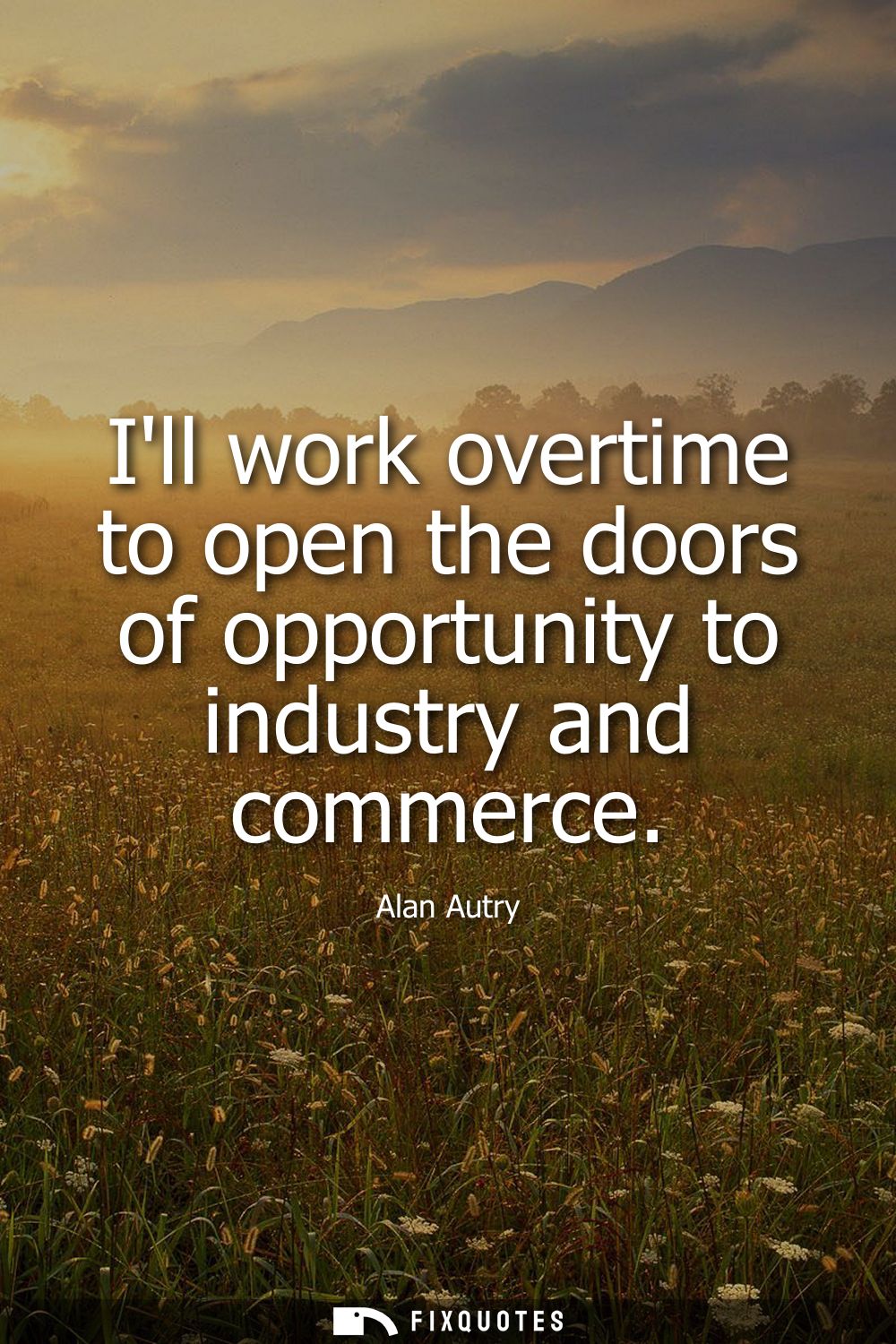
"I'll work overtime to open the doors of opportunity to industry and commerce"
About this Quote
It’s the kind of line that sounds like a pep talk until you notice the quiet trade being offered: more access for “industry and commerce,” in exchange for faith in the speaker’s hustle. Coming from Alan Autry - best known to many as an actor before he became a public official - the phrasing leans hard on performance virtues: effort, grit, overtime. It’s a promise to grind, not a promise to govern. That matters, because “I’ll work overtime” frames political power as personal labor, a relatable posture that conveniently sidesteps harder questions about whose doors get opened, and at what cost.
The key move is the metaphor of doors. Opportunity isn’t built, regulated, or redistributed; it’s unlocked. That implies the opportunities already exist, just stuck behind bureaucratic obstruction. The subtext flatters business leaders as job-creators waiting to be unleashed, while casting government as the doorman who’s been asleep on the job. “Industry and commerce” also functions as a velvet-rope euphemism: it sounds broad and civic-minded, but it’s really a signal to employers, developers, and chambers of commerce that they’ll have a friend at City Hall.
In context, this reads like a campaign-era line aimed at a post-industrial anxiety: growth as reassurance. It’s aspirational, but also carefully noncommittal. No mention of workers, wages, or safeguards - just a promise of access. The rhetorical trick is that “opportunity” feels moral, while “commerce” feels practical, and the sentence asks you to treat them as the same thing.
The key move is the metaphor of doors. Opportunity isn’t built, regulated, or redistributed; it’s unlocked. That implies the opportunities already exist, just stuck behind bureaucratic obstruction. The subtext flatters business leaders as job-creators waiting to be unleashed, while casting government as the doorman who’s been asleep on the job. “Industry and commerce” also functions as a velvet-rope euphemism: it sounds broad and civic-minded, but it’s really a signal to employers, developers, and chambers of commerce that they’ll have a friend at City Hall.
In context, this reads like a campaign-era line aimed at a post-industrial anxiety: growth as reassurance. It’s aspirational, but also carefully noncommittal. No mention of workers, wages, or safeguards - just a promise of access. The rhetorical trick is that “opportunity” feels moral, while “commerce” feels practical, and the sentence asks you to treat them as the same thing.
Quote Details
| Topic | Work Ethic |
|---|---|
| Source | Help us find the source |
| Cite |
Citation Formats
APA Style (7th ed.)
Autry, Alan. (2026, January 15). I'll work overtime to open the doors of opportunity to industry and commerce. FixQuotes. https://fixquotes.com/quotes/ill-work-overtime-to-open-the-doors-of-61630/
Chicago Style
Autry, Alan. "I'll work overtime to open the doors of opportunity to industry and commerce." FixQuotes. January 15, 2026. https://fixquotes.com/quotes/ill-work-overtime-to-open-the-doors-of-61630/.
MLA Style (9th ed.)
"I'll work overtime to open the doors of opportunity to industry and commerce." FixQuotes, 15 Jan. 2026, https://fixquotes.com/quotes/ill-work-overtime-to-open-the-doors-of-61630/. Accessed 12 Feb. 2026.
More Quotes by Alan
Add to List