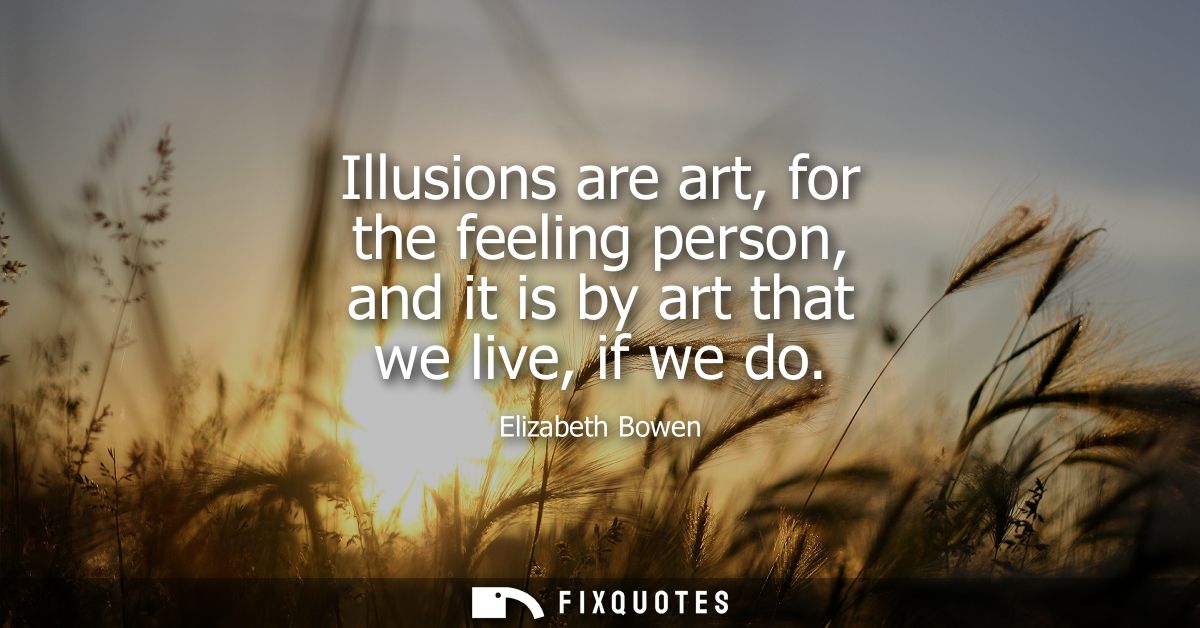
"Illusions are art, for the feeling person, and it is by art that we live, if we do"
About this Quote
Bowen turns “illusions” from a cheap synonym for self-deception into a survival technology. The provocation is in the grammar: illusions are not merely like art, they are art - shaped, chosen, composed. For “the feeling person,” reality isn’t a stable platform; it’s raw material that needs form before it can be endured. Bowen’s line suggests that sensitivity, often treated as a private temperament, is actually a political and social condition: the more you feel, the more you require aesthetic mediation just to keep moving.
The subtext is bracingly unsentimental. This isn’t a Hallmark defense of daydreaming; it’s a cool admission that the narratives we build - about love, home, nation, even our own coherence - are partly fabricated, and that fabrication is not an optional luxury. “It is by art that we live” elevates art from entertainment to infrastructure. Then she undercuts the elevation with a knife twist: “if we do.” The clause carries wartime bleakness and modernist doubt, the sense that living isn’t guaranteed and may not be fully distinguishable from merely persisting.
Context matters: Bowen wrote through the shockwaves of two world wars and the psychic dislocations of Anglo-Irish identity, class drift, damaged houses, damaged intimacies. Her novels often track people improvising poise amid collapse. This sentence is her aesthetic manifesto in miniature: when the world won’t supply meaning, you manufacture it - not to escape truth, but to make truth bearable enough to face.
The subtext is bracingly unsentimental. This isn’t a Hallmark defense of daydreaming; it’s a cool admission that the narratives we build - about love, home, nation, even our own coherence - are partly fabricated, and that fabrication is not an optional luxury. “It is by art that we live” elevates art from entertainment to infrastructure. Then she undercuts the elevation with a knife twist: “if we do.” The clause carries wartime bleakness and modernist doubt, the sense that living isn’t guaranteed and may not be fully distinguishable from merely persisting.
Context matters: Bowen wrote through the shockwaves of two world wars and the psychic dislocations of Anglo-Irish identity, class drift, damaged houses, damaged intimacies. Her novels often track people improvising poise amid collapse. This sentence is her aesthetic manifesto in miniature: when the world won’t supply meaning, you manufacture it - not to escape truth, but to make truth bearable enough to face.
Quote Details
| Topic | Art |
|---|
More Quotes by Elizabeth
Add to List