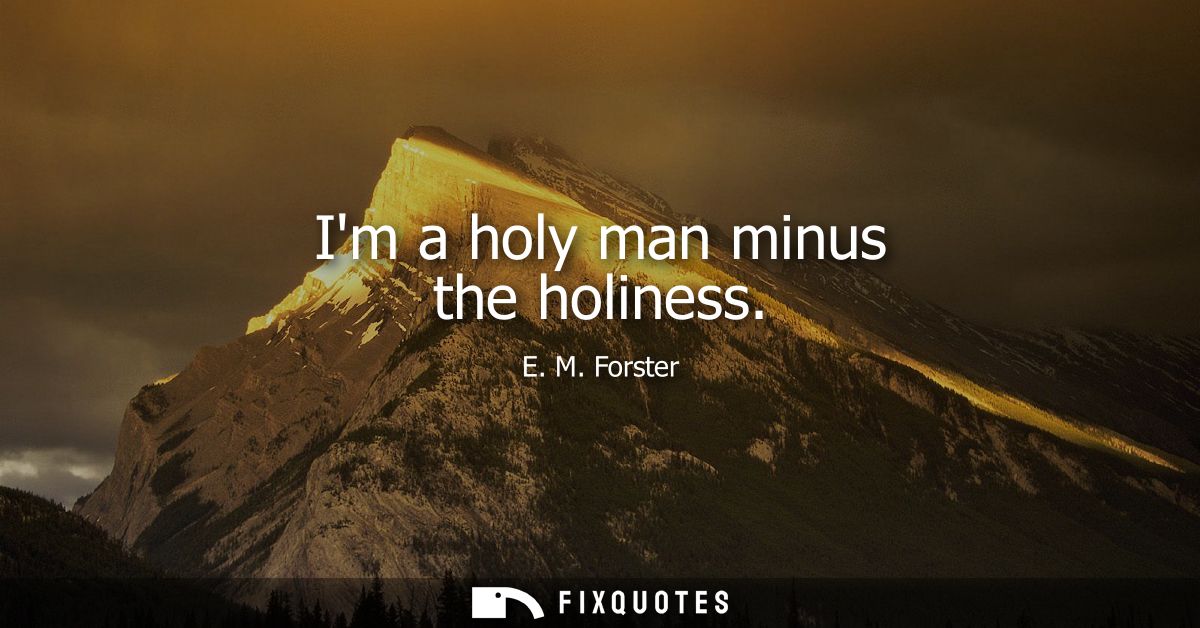
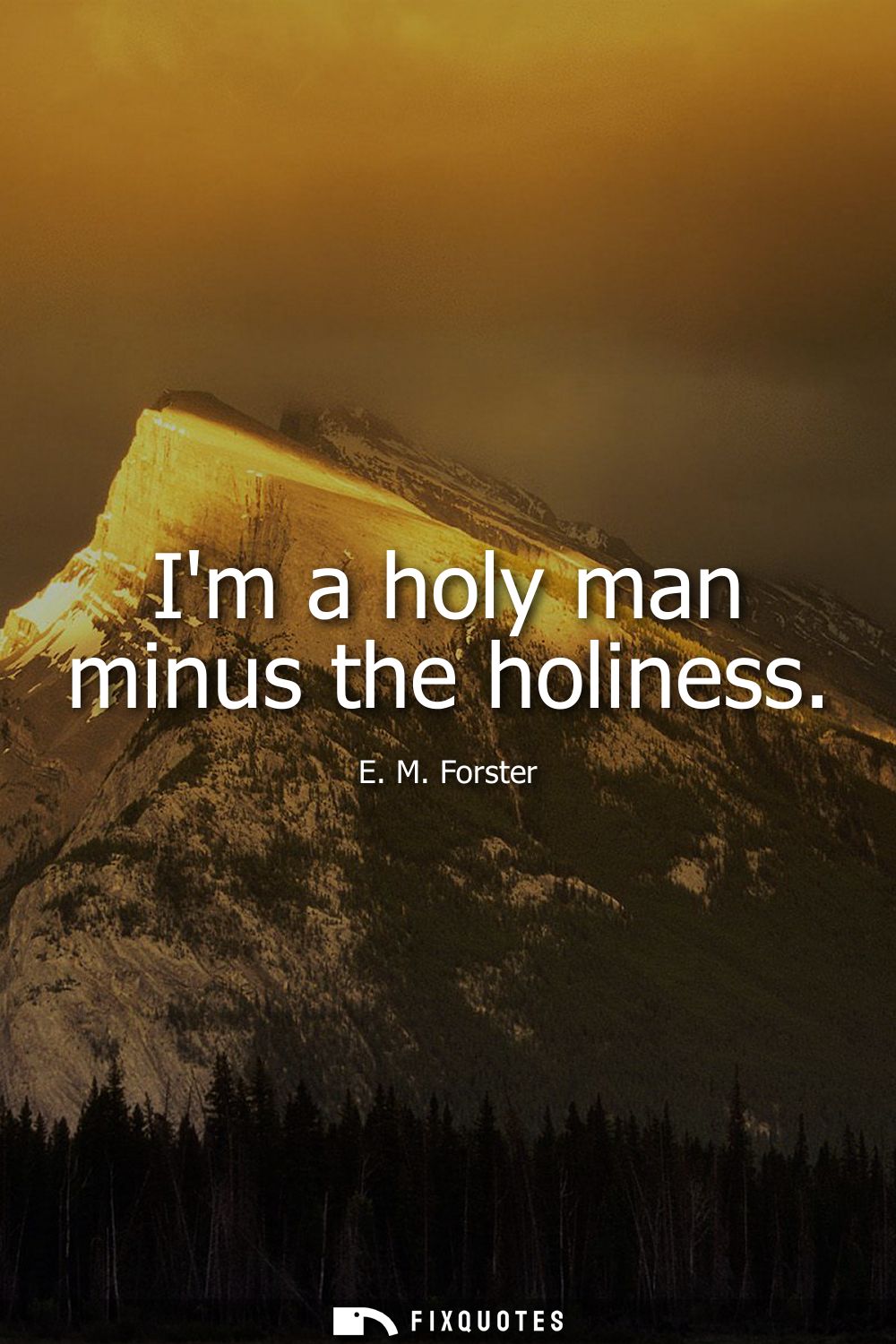
"I'm a holy man minus the holiness"
About this Quote
A holy man minus the holiness is Forster at his most elegantly disarming: a confession that dodges piety while still wanting the moral authority that piety implies. The line works because it’s a self-portrait built on subtraction. Instead of claiming virtue, he admits the craving to be seen as virtuous, then undercuts it in the same breath. That quick twist is pure Forster: sincerity with a wry eyebrow raised, ethical longing paired with distrust of ethical performance.
The intent isn’t nihilism; it’s an argument for decency without sanctimony. Forster’s fiction repeatedly tests the gap between public righteousness and private feeling, especially in a society that equated “goodness” with correct manners, correct desires, correct silences. To call oneself “holy” is to invoke a whole apparatus of judgment and purity. To remove “holiness” is to reject the apparatus while keeping the hunger for meaning. He’s admitting he wants moral clarity but can’t honestly sign on to the metaphysical or institutional claims that usually deliver it.
The subtext is also queer, if you read it against Forster’s life: the pressure to be “good” while living in a world that defines your deepest attachments as improper. Holiness becomes a costume one is asked to wear; minus the holiness is the exposed, uncostumed self. It’s a line that punctures the Edwardian obsession with respectability and proposes a more modern ethic: integrity without halos, conscience without church.
The intent isn’t nihilism; it’s an argument for decency without sanctimony. Forster’s fiction repeatedly tests the gap between public righteousness and private feeling, especially in a society that equated “goodness” with correct manners, correct desires, correct silences. To call oneself “holy” is to invoke a whole apparatus of judgment and purity. To remove “holiness” is to reject the apparatus while keeping the hunger for meaning. He’s admitting he wants moral clarity but can’t honestly sign on to the metaphysical or institutional claims that usually deliver it.
The subtext is also queer, if you read it against Forster’s life: the pressure to be “good” while living in a world that defines your deepest attachments as improper. Holiness becomes a costume one is asked to wear; minus the holiness is the exposed, uncostumed self. It’s a line that punctures the Edwardian obsession with respectability and proposes a more modern ethic: integrity without halos, conscience without church.
Quote Details
| Topic | Witty One-Liners |
|---|---|
| Source | Help us find the source |
| Cite |
Citation Formats
APA Style (7th ed.)
Forster, E. M. (2026, January 15). I'm a holy man minus the holiness. FixQuotes. https://fixquotes.com/quotes/im-a-holy-man-minus-the-holiness-11404/
Chicago Style
Forster, E. M. "I'm a holy man minus the holiness." FixQuotes. January 15, 2026. https://fixquotes.com/quotes/im-a-holy-man-minus-the-holiness-11404/.
MLA Style (9th ed.)
"I'm a holy man minus the holiness." FixQuotes, 15 Jan. 2026, https://fixquotes.com/quotes/im-a-holy-man-minus-the-holiness-11404/. Accessed 31 Mar. 2026.
More Quotes by M. Forster
Add to List