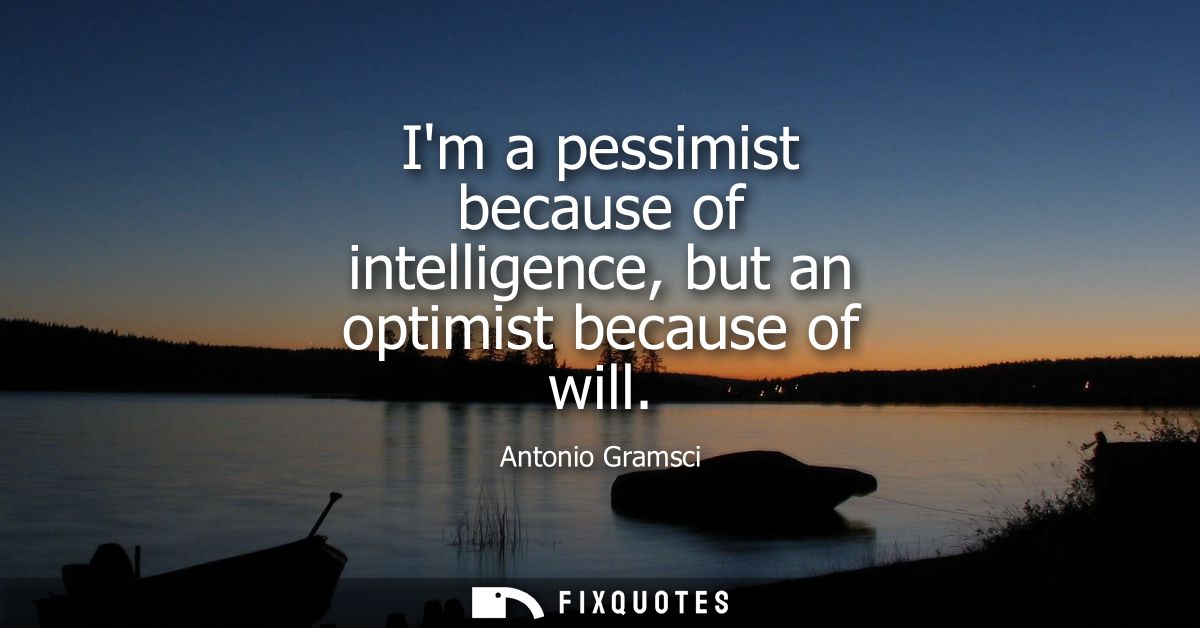
"I'm a pessimist because of intelligence, but an optimist because of will"
About this Quote
Then comes the pivot that keeps the sentence from collapsing into despair: “optimist because of will.” Will isn’t naive positivity; it’s discipline, organization, the deliberate choice to act even when the odds are mathematically insulting. Gramsci was a Marxist theorist who understood that history doesn’t auto-correct. Change requires infrastructure: parties, unions, education, counter-hegemonic culture. Optimism here is not a forecast but a posture, closer to endurance than hope.
The context matters: Gramsci wrote under the shadow of Italian Fascism and spent his final years in prison, where the state aimed, famously, to “stop this brain from functioning.” That biography turns the aphorism into a survival tactic. It also smuggles a rebuke to two common political poses: the armchair realist who confuses cynicism with sophistication, and the feel-good activist who treats belief as a substitute for strategy. Gramsci insists you can be unsparing about what you see and still refuse to surrender your capacity to intervene. That tension is the engine of serious politics.
Quote Details
| Topic | Optimism |
|---|---|
| Source | Help us find the source |
| Cite |
Citation Formats
APA Style (7th ed.)
Gramsci, Antonio. (2026, January 14). I'm a pessimist because of intelligence, but an optimist because of will. FixQuotes. https://fixquotes.com/quotes/im-a-pessimist-because-of-intelligence-but-an-18593/
Chicago Style
Gramsci, Antonio. "I'm a pessimist because of intelligence, but an optimist because of will." FixQuotes. January 14, 2026. https://fixquotes.com/quotes/im-a-pessimist-because-of-intelligence-but-an-18593/.
MLA Style (9th ed.)
"I'm a pessimist because of intelligence, but an optimist because of will." FixQuotes, 14 Jan. 2026, https://fixquotes.com/quotes/im-a-pessimist-because-of-intelligence-but-an-18593/. Accessed 24 Mar. 2026.