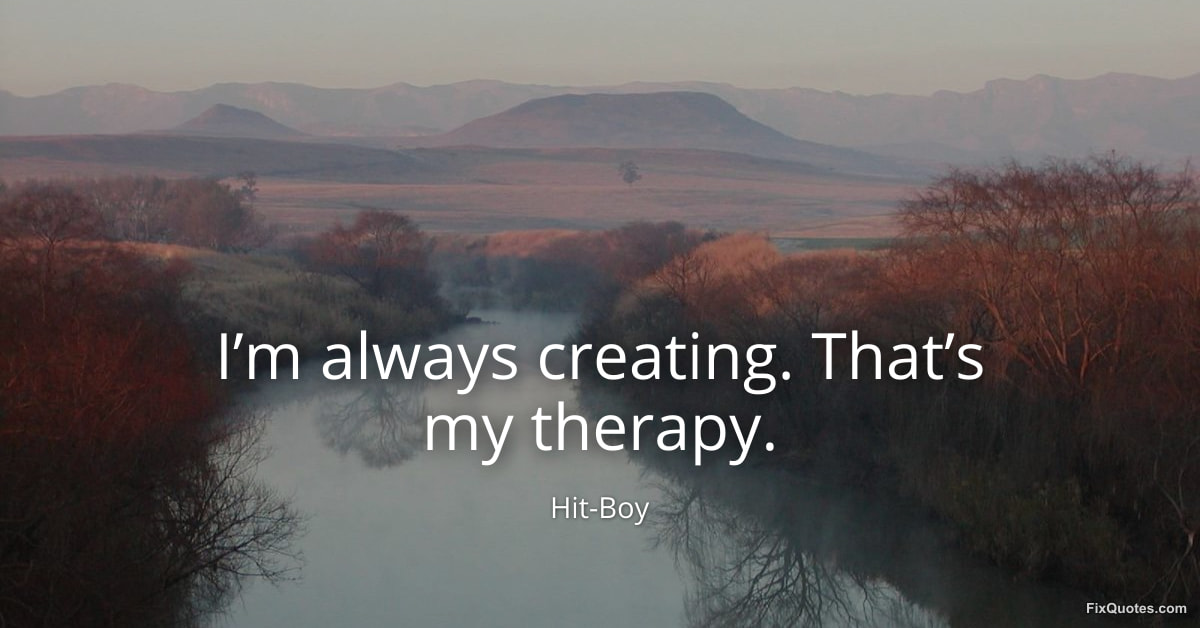
"I'm always creating. That's my therapy"
About this Quote
Creativity isn’t framed here as a luxury or a brand; it’s framed as a coping mechanism. When Hit-Boy says, "I’m always creating. That’s my therapy", he’s flattening the distance between art and survival. The line is blunt on purpose: no mystique, no tortured-genius cosplay, just a working professional describing what keeps him steady.
The intent feels twofold. First, it’s a credo for his pace. Hit-Boy’s catalog is built on relentlessness: beats that land on major albums, tight turnarounds, constant reinvention. "Always creating" is a boundary and a discipline. Second, it’s a quiet admission that stillness can be dangerous. Therapy, in this framing, isn’t necessarily a clinician’s office; it’s the act of staying in motion, translating pressure into pattern, turning noise into something structured. That matters in a music economy that rewards output but punishes vulnerability. Calling creation "therapy" lets him name the need without surrendering the persona.
The subtext also nudges at a wider cultural shift: mental health language has entered pop and hip-hop, but often through terms that can be safely generalized. Hit-Boy’s phrasing is careful and practical. He isn’t claiming art replaces treatment; he’s describing what regulates him day to day. In a world that sees producers as invisible labor, this is also a reclaiming: the work isn’t just product, it’s process, and the process is how he stays alive to himself.
The intent feels twofold. First, it’s a credo for his pace. Hit-Boy’s catalog is built on relentlessness: beats that land on major albums, tight turnarounds, constant reinvention. "Always creating" is a boundary and a discipline. Second, it’s a quiet admission that stillness can be dangerous. Therapy, in this framing, isn’t necessarily a clinician’s office; it’s the act of staying in motion, translating pressure into pattern, turning noise into something structured. That matters in a music economy that rewards output but punishes vulnerability. Calling creation "therapy" lets him name the need without surrendering the persona.
The subtext also nudges at a wider cultural shift: mental health language has entered pop and hip-hop, but often through terms that can be safely generalized. Hit-Boy’s phrasing is careful and practical. He isn’t claiming art replaces treatment; he’s describing what regulates him day to day. In a world that sees producers as invisible labor, this is also a reclaiming: the work isn’t just product, it’s process, and the process is how he stays alive to himself.
Quote Details
| Topic | Mental Health |
|---|---|
| Source | Interview: Complex, “Hit-Boy Talks Producing ‘N****s in Paris,’ Working With Kanye West, and More” (2013) |
| Cite |
Citation Formats
APA Style (7th ed.)
Hit-Boy. (2026, February 16). I'm always creating. That's my therapy. FixQuotes. https://fixquotes.com/quotes/im-always-creating-thats-my-therapy-184634/
Chicago Style
Hit-Boy. "I'm always creating. That's my therapy." FixQuotes. February 16, 2026. https://fixquotes.com/quotes/im-always-creating-thats-my-therapy-184634/.
MLA Style (9th ed.)
"I'm always creating. That's my therapy." FixQuotes, 16 Feb. 2026, https://fixquotes.com/quotes/im-always-creating-thats-my-therapy-184634/. Accessed 20 Mar. 2026.
More Quotes by Hit-Boy
Add to List