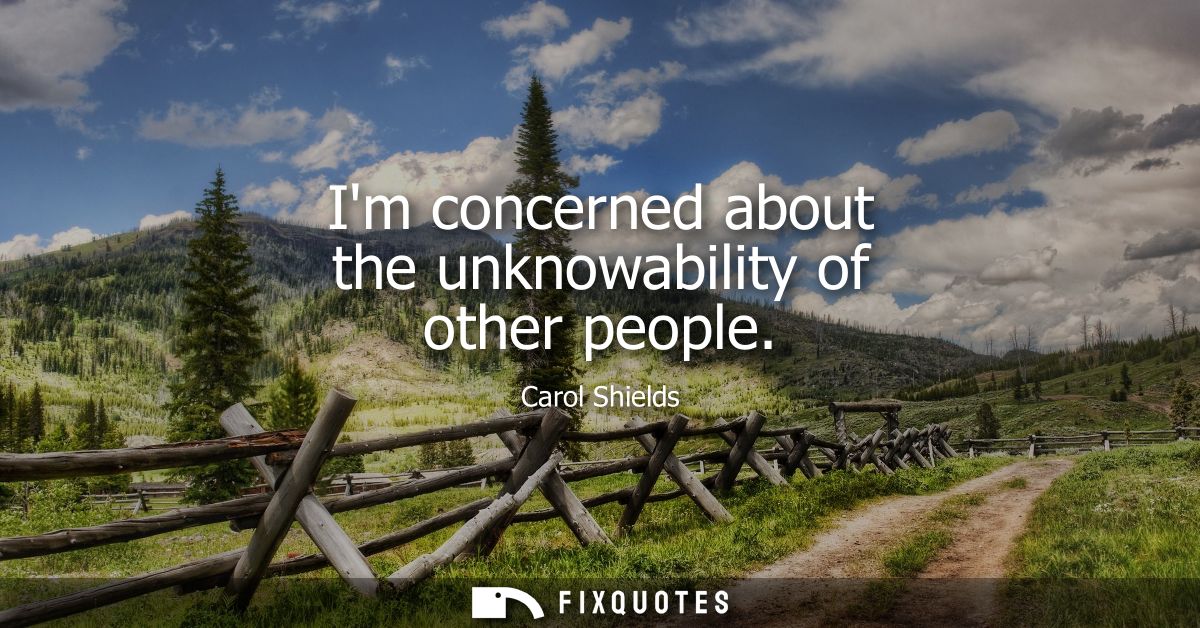
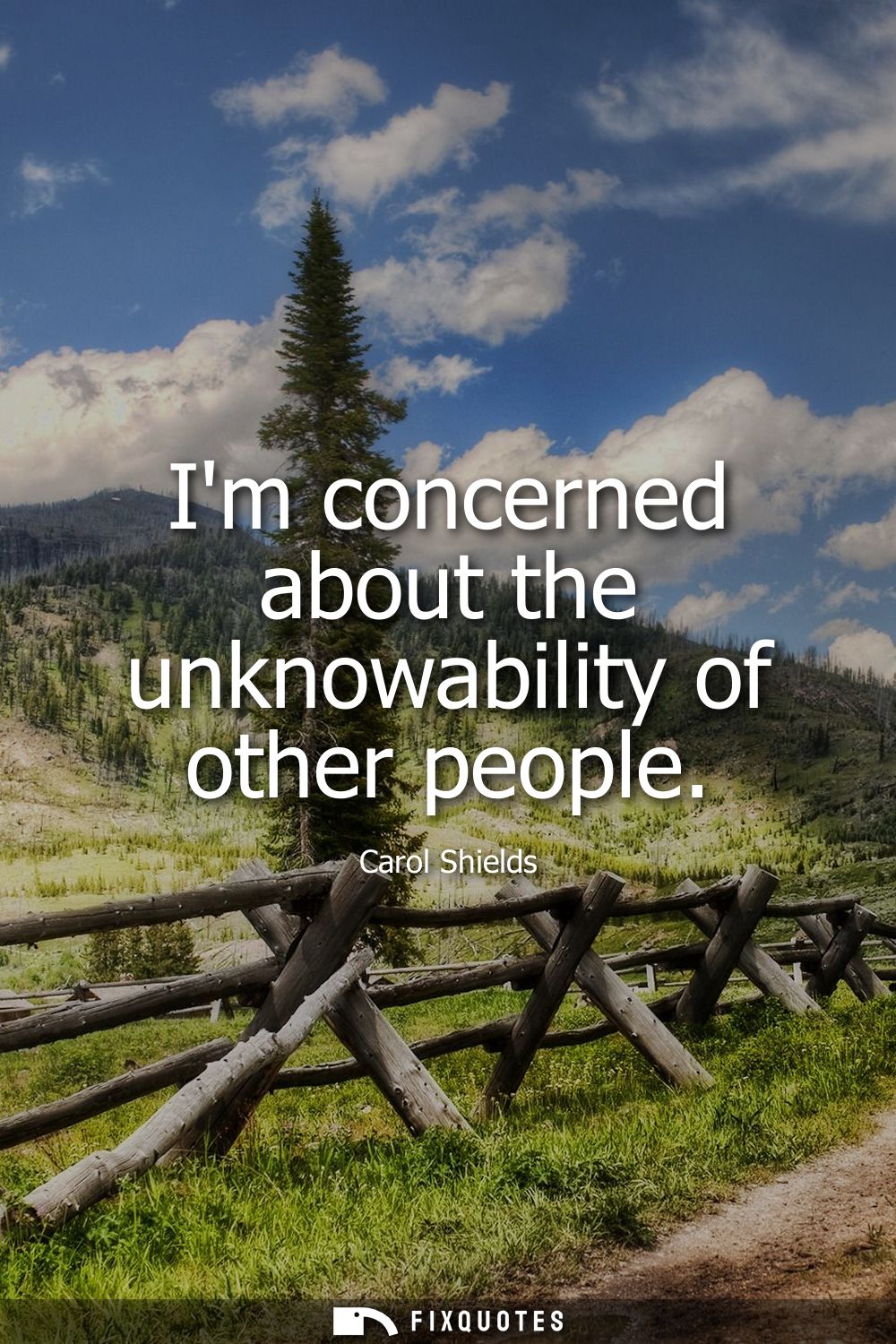
"I'm concerned about the unknowability of other people"
About this Quote
The line lands with the quiet force of a confession: not fear of being alone, but fear of never really getting in. Shields frames "unknowability" as a daily, intimate problem rather than a philosophical puzzle. The word is clinical, almost bureaucratic, which is part of its sting; it suggests the speaker has tried to solve people the way you might solve a plot or a pattern, only to discover the limits of observation.
Shields, an author of domestic interiors and the hidden weather of ordinary lives, is staking out her real subject here: the gap between what we perform and what we are. "Concerned" is deliberately modest. It's not "terrified" or "obsessed". That restraint reads as moral seriousness, a recognition that wanting to know another person can slip into entitlement. The sentence quietly indicts both sides of intimacy: we conceal, we misread, we translate each other through our own needs. Even love becomes an interpretive act, vulnerable to bad data.
Contextually, it echoes a late-20th-century literary preoccupation with interiority and fractured narration, but Shields makes it social rather than stylistic. She points to the everyday consequences of opacity: marriages that run on assumptions, friendships built on partial disclosures, families that mistake proximity for understanding. For a novelist, this "unknowability" is also professional fuel. Characters are compelling precisely because they resist total access; the page offers an illusion of omniscience while reminding you that real people never come with footnotes.
Shields, an author of domestic interiors and the hidden weather of ordinary lives, is staking out her real subject here: the gap between what we perform and what we are. "Concerned" is deliberately modest. It's not "terrified" or "obsessed". That restraint reads as moral seriousness, a recognition that wanting to know another person can slip into entitlement. The sentence quietly indicts both sides of intimacy: we conceal, we misread, we translate each other through our own needs. Even love becomes an interpretive act, vulnerable to bad data.
Contextually, it echoes a late-20th-century literary preoccupation with interiority and fractured narration, but Shields makes it social rather than stylistic. She points to the everyday consequences of opacity: marriages that run on assumptions, friendships built on partial disclosures, families that mistake proximity for understanding. For a novelist, this "unknowability" is also professional fuel. Characters are compelling precisely because they resist total access; the page offers an illusion of omniscience while reminding you that real people never come with footnotes.
Quote Details
| Topic | Deep |
|---|---|
| Source | Help us find the source |
| Cite |
Citation Formats
APA Style (7th ed.)
Shields, Carol. (2026, January 15). I'm concerned about the unknowability of other people. FixQuotes. https://fixquotes.com/quotes/im-concerned-about-the-unknowability-of-other-139064/
Chicago Style
Shields, Carol. "I'm concerned about the unknowability of other people." FixQuotes. January 15, 2026. https://fixquotes.com/quotes/im-concerned-about-the-unknowability-of-other-139064/.
MLA Style (9th ed.)
"I'm concerned about the unknowability of other people." FixQuotes, 15 Jan. 2026, https://fixquotes.com/quotes/im-concerned-about-the-unknowability-of-other-139064/. Accessed 31 Mar. 2026.
More Quotes by Carol
Add to List