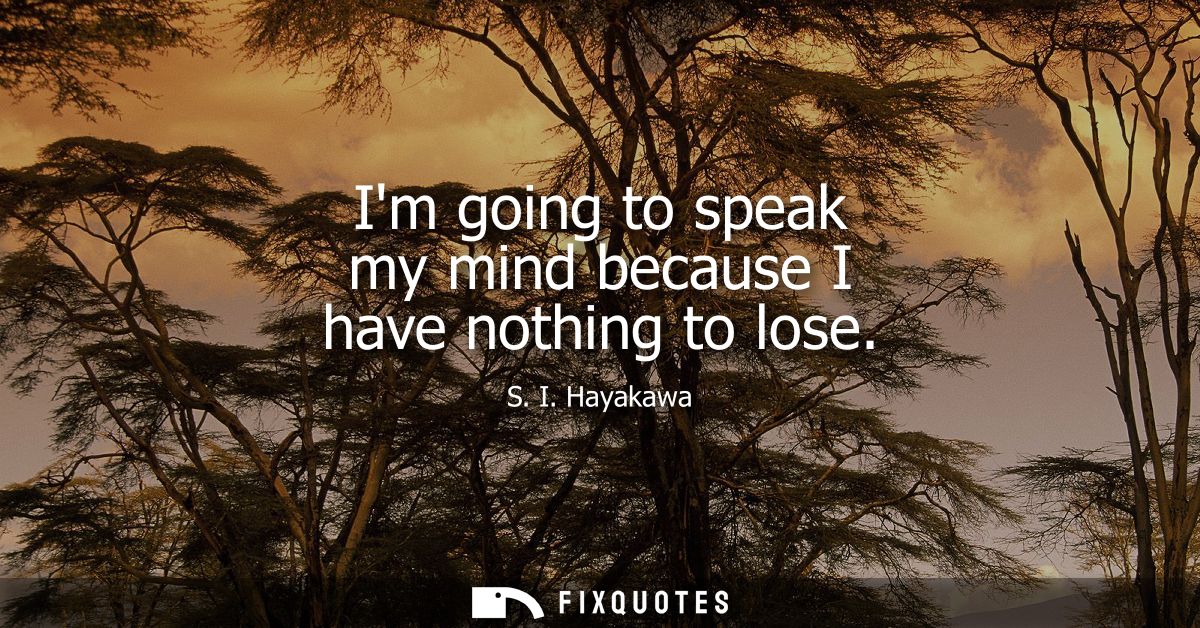
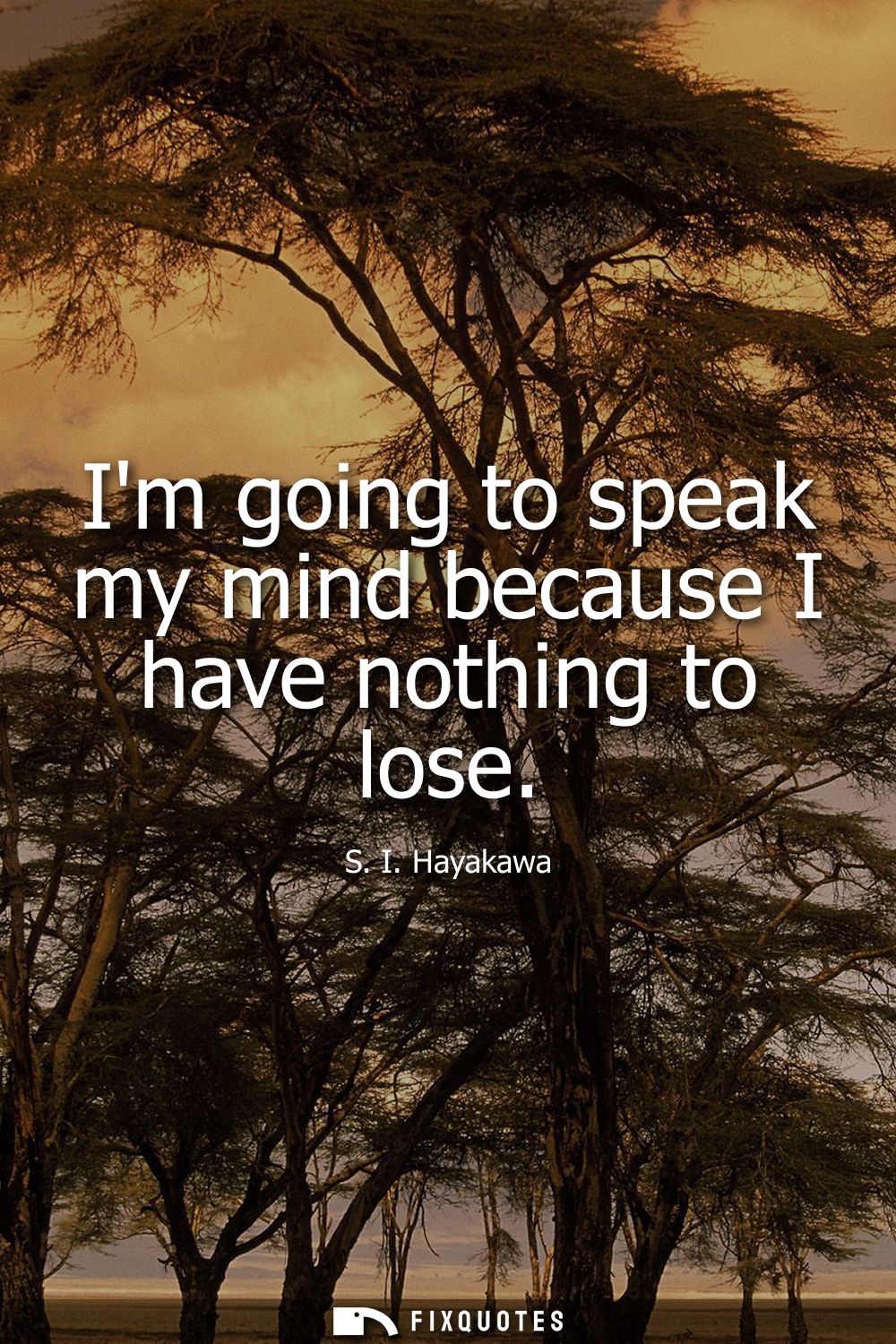
"I'm going to speak my mind because I have nothing to lose"
About this Quote
There is a special kind of candor that only shows up when someone thinks the usual penalties no longer apply. "I'm going to speak my mind because I have nothing to lose" isn’t bravery in the cinematic sense; it’s a cold statement about leverage. Hayakawa frames truth-telling not as a moral duty but as a rational move once the cost-benefit math flips. The line quietly admits what polite politics normally hides: most public speech is managed under threat - of voters, donors, party discipline, social standing. Take away the stakes, and the muzzle comes off.
The intent is strategic. By declaring "nothing to lose", the speaker tries to inoculate himself against accusations of opportunism while also daring opponents to respond: if he’s already beyond punishment, what can you do to him? It’s a posture that converts vulnerability into authority. Listeners are meant to think, He’s not auditioning. He’s not negotiating. That can read as authenticity, even if it’s also a performance.
Hayakawa, a semanticist turned politician and famously combative public figure, understood that politics is as much about controlling frames as passing bills. The subtext is meta-communication: he’s telling you how to hear him. Don’t treat this as messaging; treat it as unfiltered signal. Of course, "speaking my mind" is never pure; it’s still selective, still shaped by ego and grievance. The line works because it captures a cynical truth about public life: honesty often arrives late, when the career incentives are already gone.
The intent is strategic. By declaring "nothing to lose", the speaker tries to inoculate himself against accusations of opportunism while also daring opponents to respond: if he’s already beyond punishment, what can you do to him? It’s a posture that converts vulnerability into authority. Listeners are meant to think, He’s not auditioning. He’s not negotiating. That can read as authenticity, even if it’s also a performance.
Hayakawa, a semanticist turned politician and famously combative public figure, understood that politics is as much about controlling frames as passing bills. The subtext is meta-communication: he’s telling you how to hear him. Don’t treat this as messaging; treat it as unfiltered signal. Of course, "speaking my mind" is never pure; it’s still selective, still shaped by ego and grievance. The line works because it captures a cynical truth about public life: honesty often arrives late, when the career incentives are already gone.
Quote Details
| Topic | Confidence |
|---|---|
| Source | Later attribution: Statesmen and Mischief Makers: (Scott Crass, 2015) modern compilationISBN: 9781503587625 · ID: U7OGCgAAQBAJ
Evidence:
... Hayakawa Brought Eccentricity to World's Greatest Deliberative Body Historic Quote : " I'm going to speak my mind because I have nothing to lose . " - California Senator S.I. Hayakawa , who had a reputation for dozing off at hearings . |
| Cite |
Citation Formats
APA Style (7th ed.)
Hayakawa, S. I. (2026, March 9). I'm going to speak my mind because I have nothing to lose. FixQuotes. https://fixquotes.com/quotes/im-going-to-speak-my-mind-because-i-have-nothing-154101/
Chicago Style
Hayakawa, S. I. "I'm going to speak my mind because I have nothing to lose." FixQuotes. March 9, 2026. https://fixquotes.com/quotes/im-going-to-speak-my-mind-because-i-have-nothing-154101/.
MLA Style (9th ed.)
"I'm going to speak my mind because I have nothing to lose." FixQuotes, 9 Mar. 2026, https://fixquotes.com/quotes/im-going-to-speak-my-mind-because-i-have-nothing-154101/. Accessed 27 Mar. 2026.
More Quotes by I. Hayakawa
Add to List