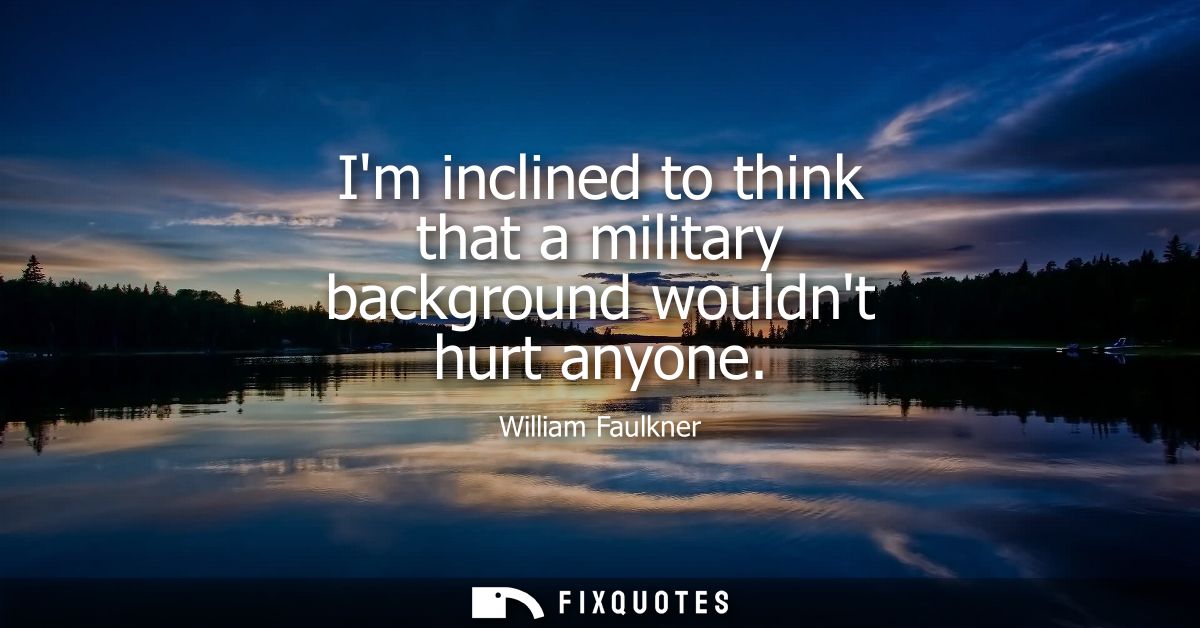
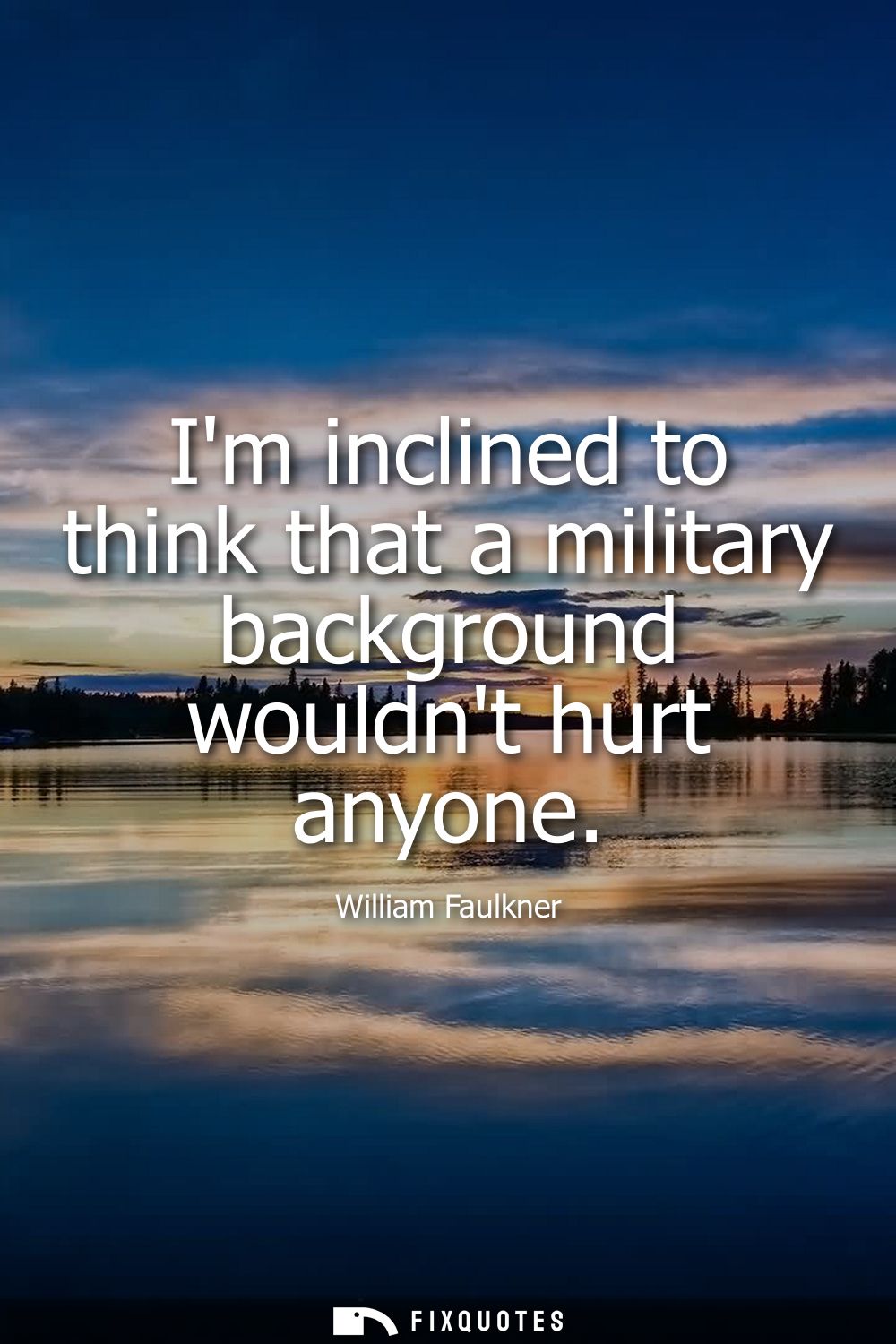
"I'm inclined to think that a military background wouldn't hurt anyone"
About this Quote
The intent is slippery on purpose. Faulkner isn’t praising war; he’s flirting with the idea that the military’s structure might counterbalance the slackness, drift, and romantic self-indulgence he often skewers in Southern masculinity. That’s the subtext: a region raised on martial mythologies (Confederate memory, inherited honor codes) but frequently short on the unglamorous habits that actually build responsibility. “Background” is the key dodge. He’s talking about formation, not combat - training as character carpentry.
Context matters because Faulkner’s own relationship to soldiering was famously complicated: he cultivated an airman persona after World War I without seeing combat, a self-mythologizing gesture that mirrors the South’s talent for turning defeat into romance. Against that backdrop, the quote can be read as self-correction, even self-mockery: perhaps a real military background, not the costume version, might have disciplined both personal fantasy and cultural nostalgia.
It works because it’s small and pragmatic, the opposite of heroic rhetoric. Faulkner compresses a big national argument - about citizenship, duty, and the seductions of violence - into a sentence that sounds like someone weighing a bitter medicine: not pleasant, maybe necessary, probably not lethal.
Quote Details
| Topic | Military & Soldier |
|---|---|
| Source | Help us find the source |
| Cite |
Citation Formats
APA Style (7th ed.)
Faulkner, William. (2026, January 18). I'm inclined to think that a military background wouldn't hurt anyone. FixQuotes. https://fixquotes.com/quotes/im-inclined-to-think-that-a-military-background-11186/
Chicago Style
Faulkner, William. "I'm inclined to think that a military background wouldn't hurt anyone." FixQuotes. January 18, 2026. https://fixquotes.com/quotes/im-inclined-to-think-that-a-military-background-11186/.
MLA Style (9th ed.)
"I'm inclined to think that a military background wouldn't hurt anyone." FixQuotes, 18 Jan. 2026, https://fixquotes.com/quotes/im-inclined-to-think-that-a-military-background-11186/. Accessed 5 Apr. 2026.