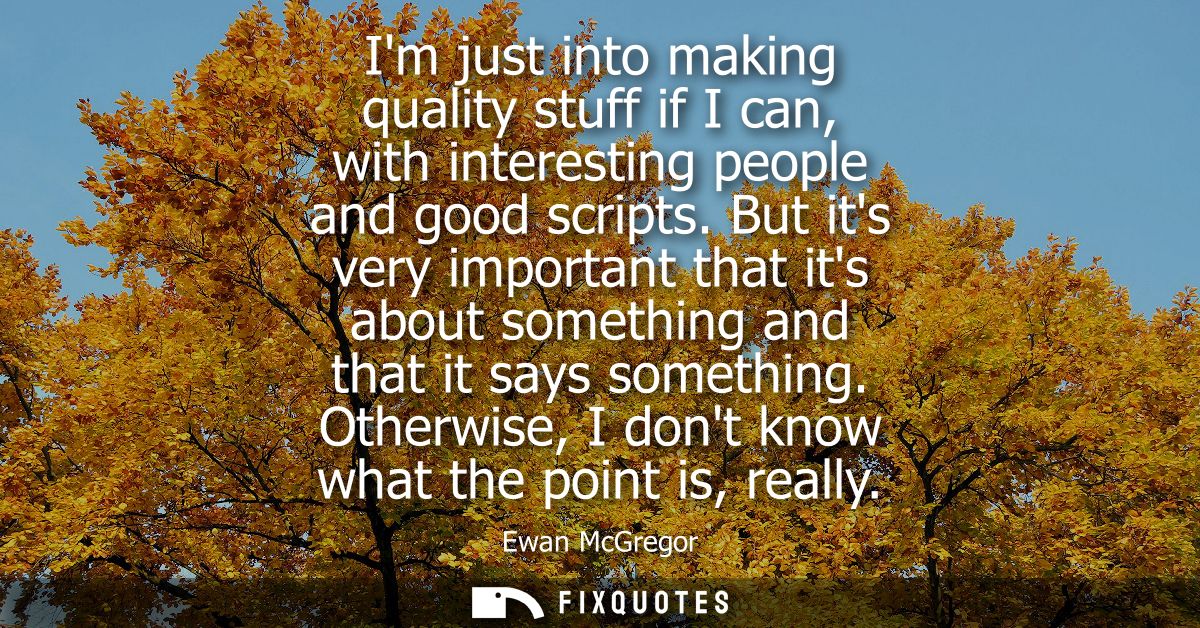
"I'm just into making quality stuff if I can, with interesting people and good scripts. But it's very important that it's about something and that it says something. Otherwise, I don't know what the point is, really"
About this Quote
The phrasing matters. “If I can” signals humility but also scarcity: quality is contingent in an industry engineered for throughput. “Interesting people” sits beside “good scripts,” implying that collaboration and writing are the real special effects. For an actor known for moving between franchise machinery (Star Wars, big studio fare) and more intimate projects (Trainspotting, smaller dramas), this reads like a self-justification and a boundary. He’s telling you he’ll do spectacle, but he won’t pretend spectacle is enough.
The subtext is a weariness with content-for-content’s-sake, the kind of streaming-era glut where “watchable” becomes the highest compliment. “Otherwise, I don’t know what the point is” isn’t moralizing; it’s existential. Acting, for him, isn’t just performance, it’s participation. He wants to feel implicated in what the work is doing in the world: shaping empathy, challenging power, or at least leaving an aftertaste stronger than plot.
Quote Details
| Topic | Movie |
|---|---|
| Source | Help us find the source |
| Cite |
Citation Formats
APA Style (7th ed.)
McGregor, Ewan. (2026, January 16). I'm just into making quality stuff if I can, with interesting people and good scripts. But it's very important that it's about something and that it says something. Otherwise, I don't know what the point is, really. FixQuotes. https://fixquotes.com/quotes/im-just-into-making-quality-stuff-if-i-can-with-84062/
Chicago Style
McGregor, Ewan. "I'm just into making quality stuff if I can, with interesting people and good scripts. But it's very important that it's about something and that it says something. Otherwise, I don't know what the point is, really." FixQuotes. January 16, 2026. https://fixquotes.com/quotes/im-just-into-making-quality-stuff-if-i-can-with-84062/.
MLA Style (9th ed.)
"I'm just into making quality stuff if I can, with interesting people and good scripts. But it's very important that it's about something and that it says something. Otherwise, I don't know what the point is, really." FixQuotes, 16 Jan. 2026, https://fixquotes.com/quotes/im-just-into-making-quality-stuff-if-i-can-with-84062/. Accessed 6 Apr. 2026.