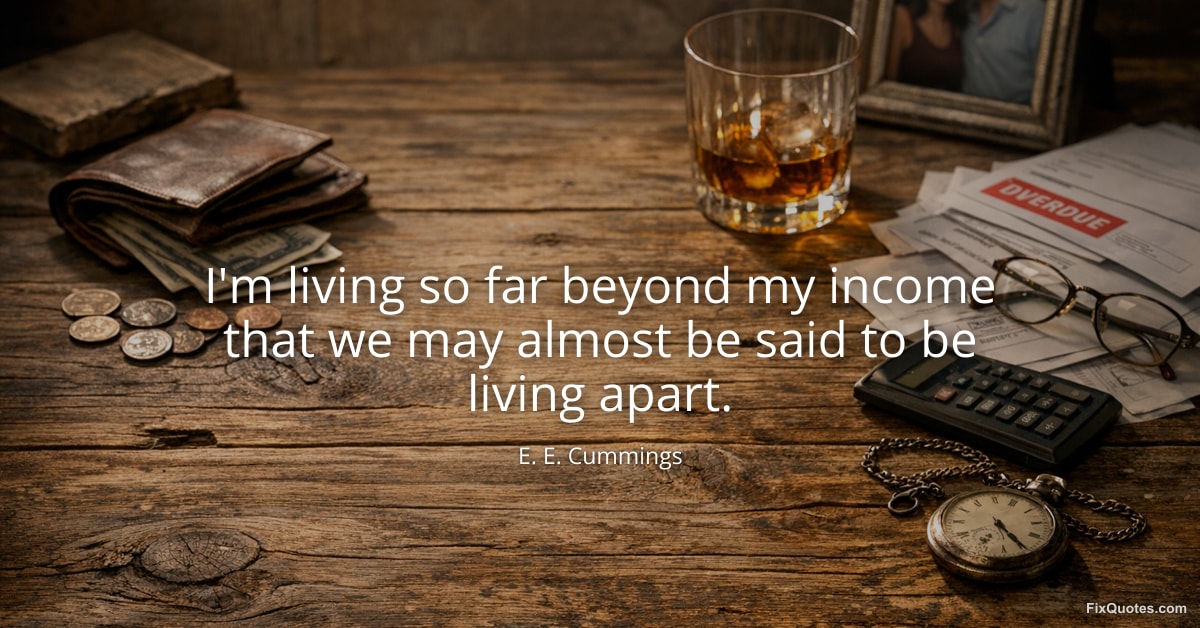
"I'm living so far beyond my income that we may almost be said to be living apart"
About this Quote
The intent is less moral lecture than social x-ray. In the early 20th-century churn of advertising, installment plans, and status consumption, money started behaving like narrative: you could project a lifestyle and let the numbers catch up later. Cummings compresses that whole cultural permission slip into one absurd, elegant sentence. Its not just that the speaker is broke; its that the speaker has successfully romanticized being broke. The humor is a mask for anxiety, and the casual "we" implicates anyone who has ever mistaken aspiration for solvency.
Subtextually, it also pokes at the idea of authenticity, a recurring Cummings preoccupation. If your life is financed by future promises, who are you in the present? The line snickers at the gap between identity (how you live) and material reality (what you earn), then leaves you with the uneasy aftertaste: living apart is how relationships end. Here, the relationship is with consequence.
Quote Details
| Topic | Witty One-Liners |
|---|---|
| Source | Help us find the source |
| Cite |
Citation Formats
APA Style (7th ed.)
Cummings, E. E. (2026, January 15). I'm living so far beyond my income that we may almost be said to be living apart. FixQuotes. https://fixquotes.com/quotes/im-living-so-far-beyond-my-income-that-we-may-13961/
Chicago Style
Cummings, E. E. "I'm living so far beyond my income that we may almost be said to be living apart." FixQuotes. January 15, 2026. https://fixquotes.com/quotes/im-living-so-far-beyond-my-income-that-we-may-13961/.
MLA Style (9th ed.)
"I'm living so far beyond my income that we may almost be said to be living apart." FixQuotes, 15 Jan. 2026, https://fixquotes.com/quotes/im-living-so-far-beyond-my-income-that-we-may-13961/. Accessed 17 Feb. 2026.