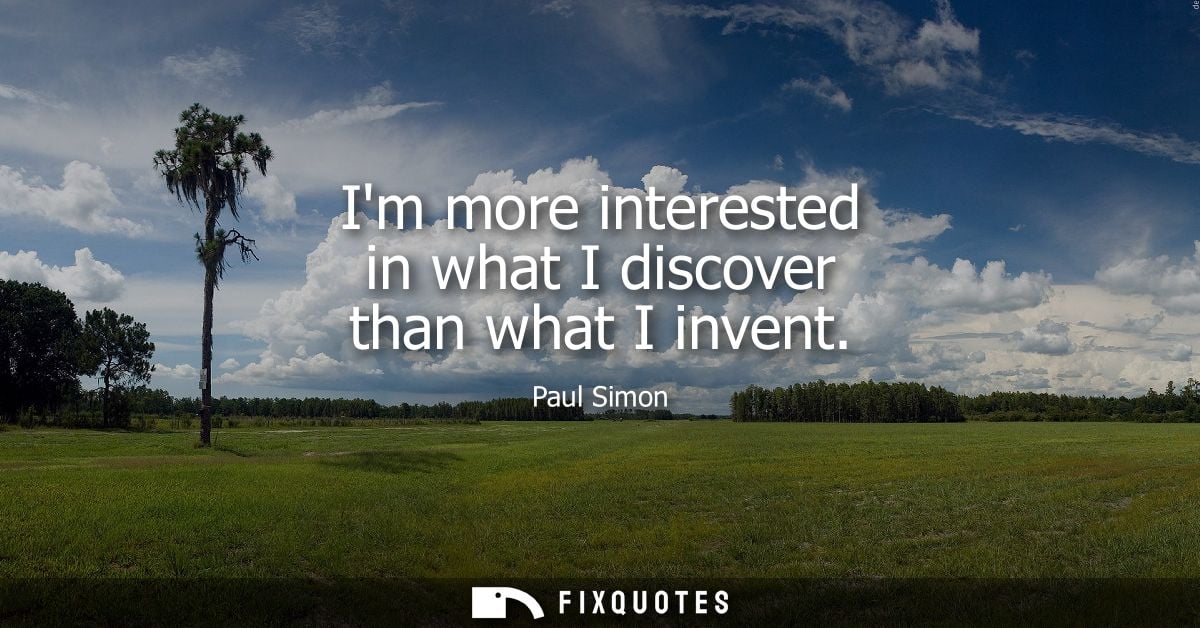
"I'm more interested in what I discover than what I invent"
About this Quote
Paul Simon’s line reads like a quiet manifesto against the myth of the lone genius. In pop culture, “inventing” carries the swagger of originality: the bold new sound, the self-made icon. Simon flips that prestige. He frames his best work not as raw creation ex nihilo but as attention, curiosity, and craft - the willingness to go out into the world and come back changed.
The intent is practical and slightly disarming: don’t romanticize inspiration; chase encounters. “Discover” suggests listening before speaking, collecting before declaring. That’s Simon’s songwriting persona at its most honest: a meticulous arranger of lived details, overheard rhythms, and borrowed textures. It’s also a defensive move against the purist critique that has followed him, especially since Graceland: if music is something you “discover,” then influence isn’t a theft so much as a relationship - messy, negotiated, sometimes controversial.
Subtextually, he’s demoting the ego. “Invent” is private; it happens in your head. “Discover” is relational; it requires other people, places, histories. It casts the artist less as a prophet than as a reporter with a melody, someone whose job is to notice what’s already there and translate it with precision.
Context matters because Simon’s career has been defined by synthesis: doo-wop and folk, gospel and rock, South African township grooves and New York neurosis. The quote works because it tells you the secret: his innovation is rarely a laboratory experiment. It’s an ear pointed outward, turning cultural crosscurrents into songs that feel both specific and strangely inevitable.
The intent is practical and slightly disarming: don’t romanticize inspiration; chase encounters. “Discover” suggests listening before speaking, collecting before declaring. That’s Simon’s songwriting persona at its most honest: a meticulous arranger of lived details, overheard rhythms, and borrowed textures. It’s also a defensive move against the purist critique that has followed him, especially since Graceland: if music is something you “discover,” then influence isn’t a theft so much as a relationship - messy, negotiated, sometimes controversial.
Subtextually, he’s demoting the ego. “Invent” is private; it happens in your head. “Discover” is relational; it requires other people, places, histories. It casts the artist less as a prophet than as a reporter with a melody, someone whose job is to notice what’s already there and translate it with precision.
Context matters because Simon’s career has been defined by synthesis: doo-wop and folk, gospel and rock, South African township grooves and New York neurosis. The quote works because it tells you the secret: his innovation is rarely a laboratory experiment. It’s an ear pointed outward, turning cultural crosscurrents into songs that feel both specific and strangely inevitable.
Quote Details
| Topic | Knowledge |
|---|---|
| Source | Help us find the source |
| Cite |
Citation Formats
APA Style (7th ed.)
Simon, Paul. (2026, January 16). I'm more interested in what I discover than what I invent. FixQuotes. https://fixquotes.com/quotes/im-more-interested-in-what-i-discover-than-what-i-108911/
Chicago Style
Simon, Paul. "I'm more interested in what I discover than what I invent." FixQuotes. January 16, 2026. https://fixquotes.com/quotes/im-more-interested-in-what-i-discover-than-what-i-108911/.
MLA Style (9th ed.)
"I'm more interested in what I discover than what I invent." FixQuotes, 16 Jan. 2026, https://fixquotes.com/quotes/im-more-interested-in-what-i-discover-than-what-i-108911/. Accessed 3 Apr. 2026.
More Quotes by Paul
Add to List