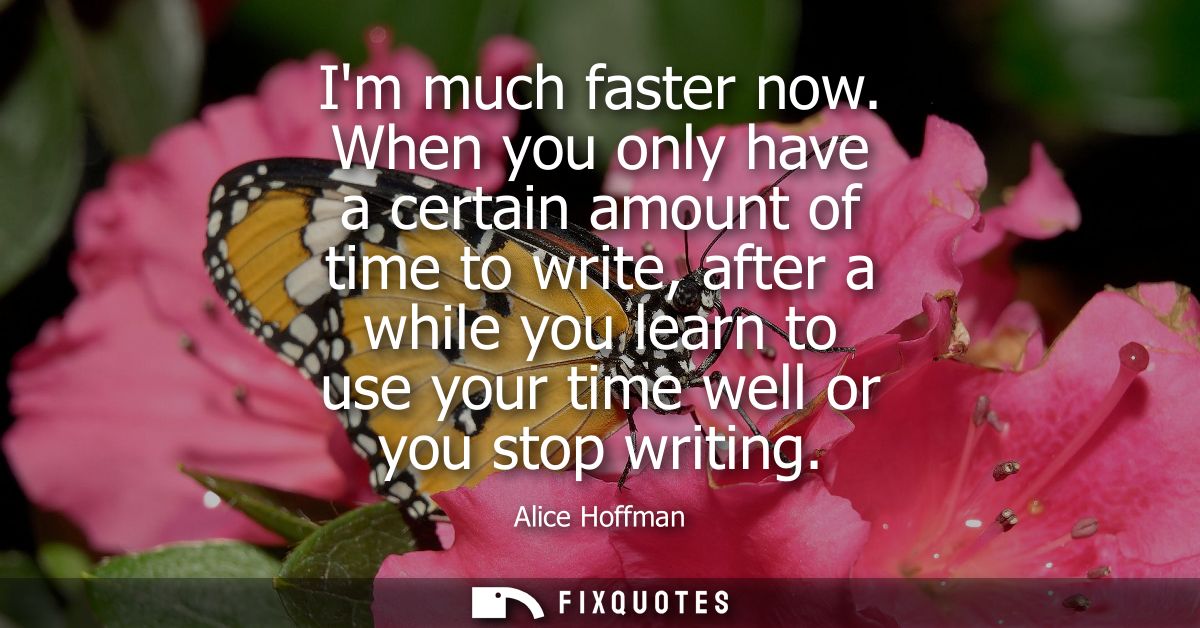
"I'm much faster now. When you only have a certain amount of time to write, after a while you learn to use your time well or you stop writing"
About this Quote
Speed, in Alice Hoffman’s telling, isn’t a flex. It’s a survival skill. “I’m much faster now” sounds like the kind of brag writers are supposed to resist, but she undercuts it immediately with the real engine: constraint. The line turns productivity into a blunt evolutionary rule: adapt or disappear.
The intent is practical and quietly defiant. Hoffman isn’t romanticizing the muse; she’s talking about the working life of a novelist who’s lived through deadlines, domestic obligations, and the slow creep of time itself. “A certain amount of time” reads like a nod to the realities that accumulate as you age: family, caregiving, health, the sheer administrative drag of adulthood. The subtext is that writing isn’t primarily threatened by lack of talent; it’s threatened by the erosion of available attention.
What makes the quote work is its ruthless binary: “you learn… or you stop writing.” No delicate middle path, no aspirational talk about “finding balance.” Hoffman implies that discipline isn’t a moral virtue, it’s a mechanism. The writer who waits for spaciousness, for the perfect uninterrupted morning, is essentially betting against their own life getting messier. Her speed is the byproduct of compression: fewer detours, less second-guessing, a sharper sense of what matters on the page.
There’s also a bracing democratization here. She’s not claiming inspiration is constant; she’s claiming craft can be trained by pressure. Time becomes both the antagonist and the teacher, and the lesson is unsentimental: if writing matters, you make it fit the life you actually have.
The intent is practical and quietly defiant. Hoffman isn’t romanticizing the muse; she’s talking about the working life of a novelist who’s lived through deadlines, domestic obligations, and the slow creep of time itself. “A certain amount of time” reads like a nod to the realities that accumulate as you age: family, caregiving, health, the sheer administrative drag of adulthood. The subtext is that writing isn’t primarily threatened by lack of talent; it’s threatened by the erosion of available attention.
What makes the quote work is its ruthless binary: “you learn… or you stop writing.” No delicate middle path, no aspirational talk about “finding balance.” Hoffman implies that discipline isn’t a moral virtue, it’s a mechanism. The writer who waits for spaciousness, for the perfect uninterrupted morning, is essentially betting against their own life getting messier. Her speed is the byproduct of compression: fewer detours, less second-guessing, a sharper sense of what matters on the page.
There’s also a bracing democratization here. She’s not claiming inspiration is constant; she’s claiming craft can be trained by pressure. Time becomes both the antagonist and the teacher, and the lesson is unsentimental: if writing matters, you make it fit the life you actually have.
Quote Details
| Topic | Writing |
|---|
More Quotes by Alice
Add to List