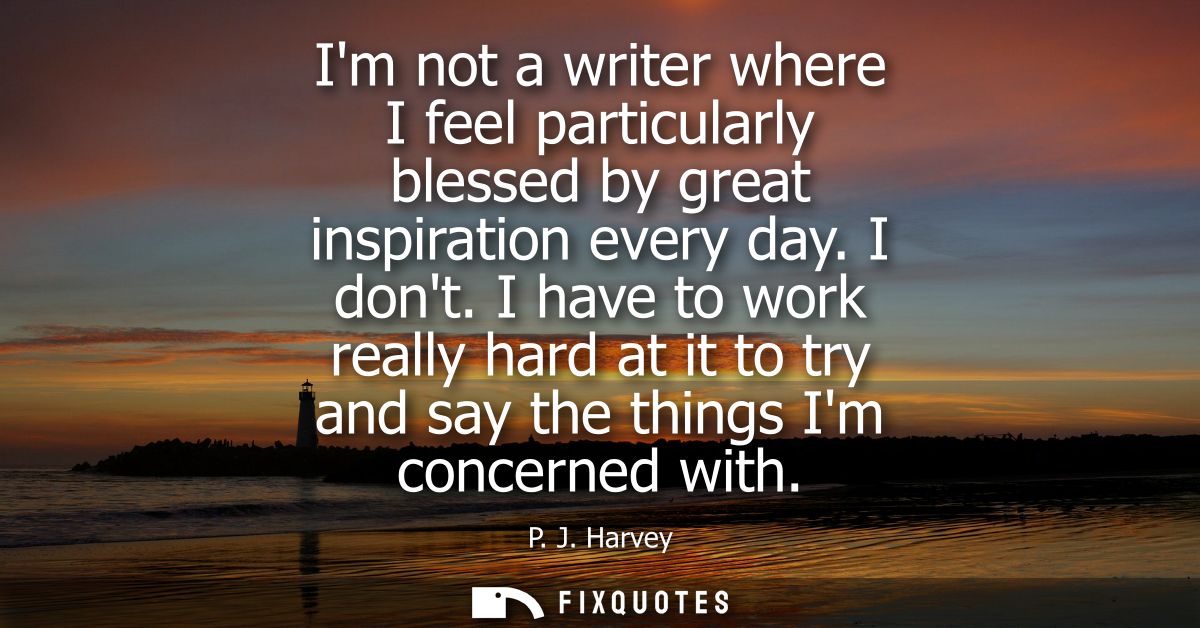
"I'm not a writer where I feel particularly blessed by great inspiration every day. I don't. I have to work really hard at it to try and say the things I'm concerned with"
About this Quote
There is something quietly defiant in P. J. Harvey refusing the myth of the “blessed” artist. Pop culture loves inspiration as a lightning bolt: the genius who wakes up gifted, scribbles a masterpiece, and strolls away untouched. Harvey drags that fantasy back to the rehearsal room, where the work is repetitive, stubborn, sometimes joyless, and still completely necessary.
The first move is rhetorical self-denial: “I’m not a writer where…” isn’t false modesty so much as a boundary. She’s protecting the process from romanticization, and protecting herself from the expectation that she should constantly be “on.” By saying “I don’t” twice, she shuts the door on the glamorous version of creativity and replaces it with a discipline narrative: you earn the song. That matters coming from a musician whose catalog often sounds elemental and instinctive; she’s reminding you that rawness can be constructed.
Then she pivots to intent: “say the things I’m concerned with.” Not “express myself,” not “entertain,” but “concerned” - a word with moral weight. The subtext is that writing isn’t therapy or vibes; it’s an attempt to articulate a pressure she feels from the world, whether it’s politics, gender, violence, desire, or place. Work isn’t just craft here, it’s responsibility.
In the broader context of how women artists get framed - as intuitive, emotional, naturally gifted - Harvey’s insistence on labor reads like a refusal to be reduced. She’s claiming authorship in the most practical sense: what you hear is the sound of someone building meaning, line by line, until it holds.
The first move is rhetorical self-denial: “I’m not a writer where…” isn’t false modesty so much as a boundary. She’s protecting the process from romanticization, and protecting herself from the expectation that she should constantly be “on.” By saying “I don’t” twice, she shuts the door on the glamorous version of creativity and replaces it with a discipline narrative: you earn the song. That matters coming from a musician whose catalog often sounds elemental and instinctive; she’s reminding you that rawness can be constructed.
Then she pivots to intent: “say the things I’m concerned with.” Not “express myself,” not “entertain,” but “concerned” - a word with moral weight. The subtext is that writing isn’t therapy or vibes; it’s an attempt to articulate a pressure she feels from the world, whether it’s politics, gender, violence, desire, or place. Work isn’t just craft here, it’s responsibility.
In the broader context of how women artists get framed - as intuitive, emotional, naturally gifted - Harvey’s insistence on labor reads like a refusal to be reduced. She’s claiming authorship in the most practical sense: what you hear is the sound of someone building meaning, line by line, until it holds.
Quote Details
| Topic | Writing |
|---|
More Quotes by J. Harvey
Add to List