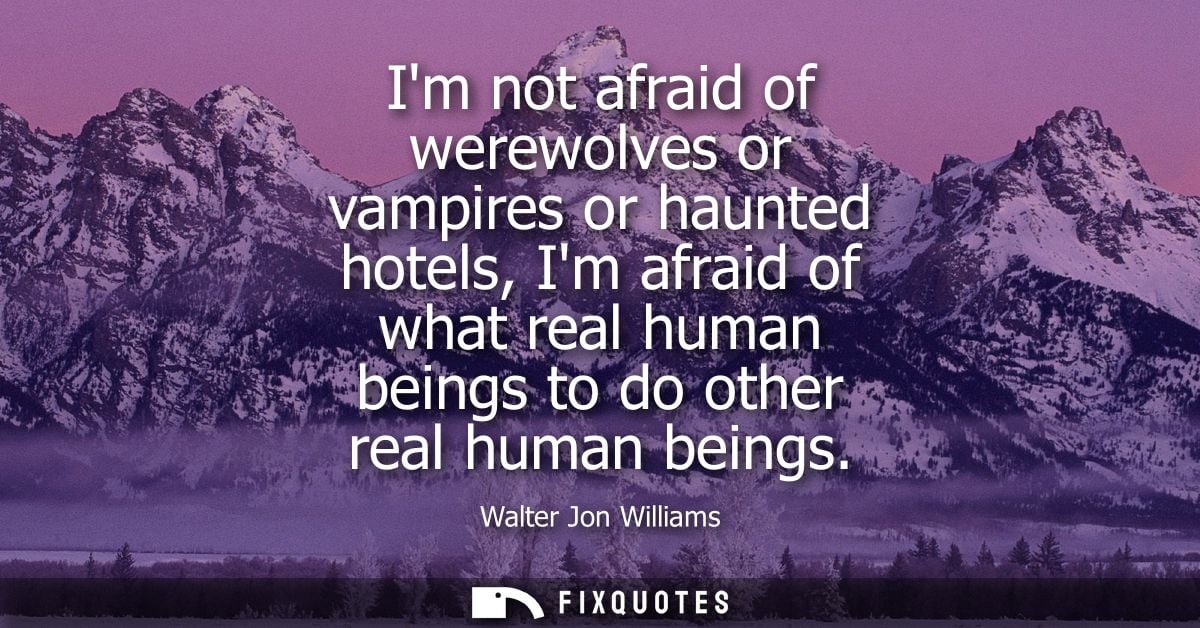
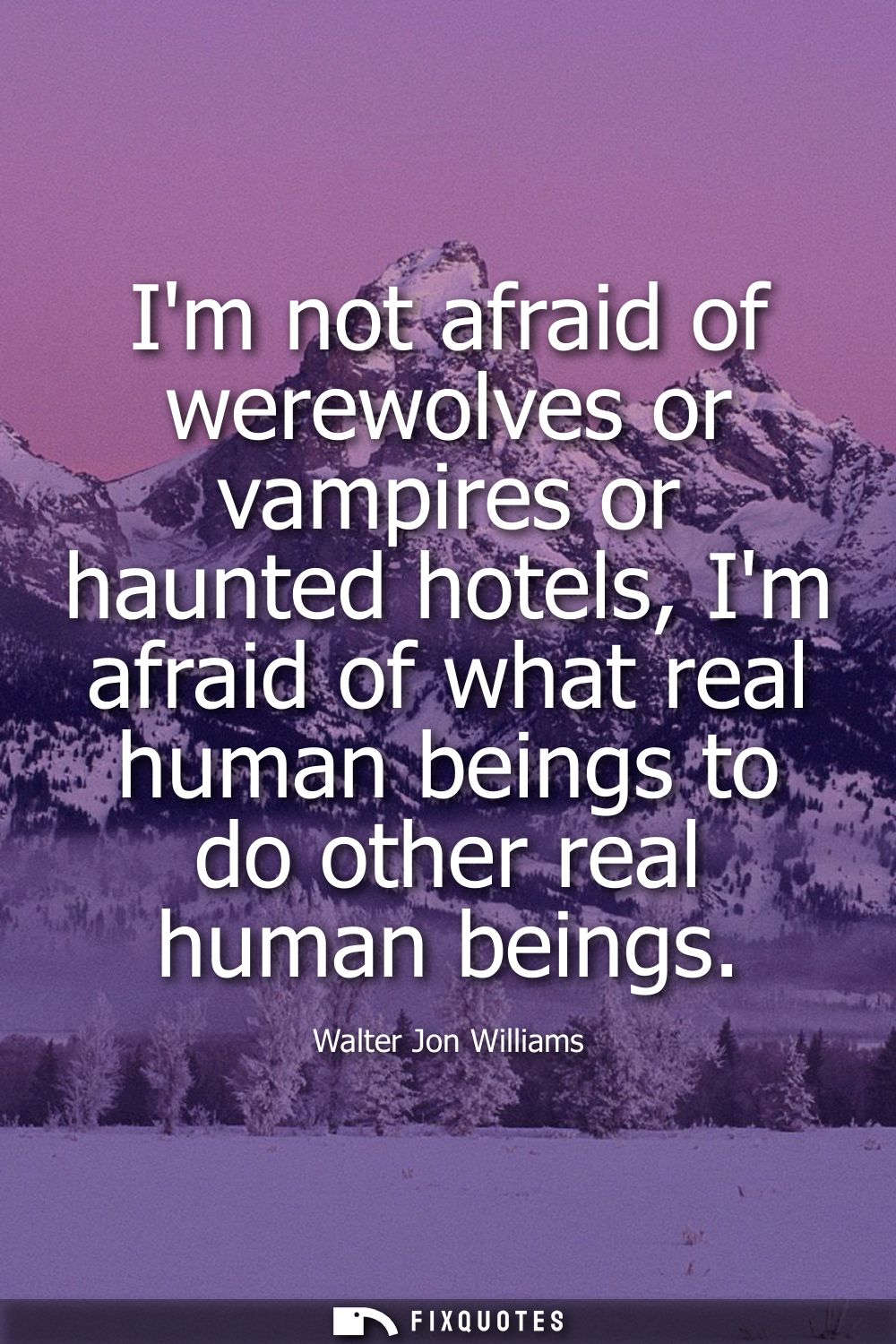
"I'm not afraid of werewolves or vampires or haunted hotels, I'm afraid of what real human beings to do other real human beings"
About this Quote
The line lands like a bait-and-switch: it namechecks the gaudy inventory of genre fear (werewolves, vampires, haunted hotels) only to dismiss them as comforting props. Those monsters are legible. They come with rules, silver bullets, sunrise. The real terror, Walter Jon Williams suggests, is that human cruelty has no folklore boundaries, no tidy weakness, and no requirement to be supernatural to be catastrophic.
The slightly clumsy phrasing ("what real human beings to do other real human beings") almost helps; it reads less like a polished bon mot than a blunt admission, as if the speaker is moving faster than grammar because the point is urgent. "Real" gets repeated for emphasis, a verbal finger jab: stop looking at the mask, look at the face underneath. In horror, monsters are often metaphors for social violence. Here the metaphor is stripped away. Williams is making a claim about scale and plausibility: the atrocities we can document outpace the ones we can imagine.
Context matters: a contemporary science fiction writer, Williams is steeped in speculative frameworks where the point is not escapism but heightened realism through exaggeration. His quote is an argument for why certain horror stories hit harder: they mirror domestic abuse, war, bureaucratic indifference, mob sadism, the everyday mechanisms that let ordinary people rationalize harm. The subtext is bleakly democratic. You do not need a curse to become frightening. You just need permission, pressure, or power.
The slightly clumsy phrasing ("what real human beings to do other real human beings") almost helps; it reads less like a polished bon mot than a blunt admission, as if the speaker is moving faster than grammar because the point is urgent. "Real" gets repeated for emphasis, a verbal finger jab: stop looking at the mask, look at the face underneath. In horror, monsters are often metaphors for social violence. Here the metaphor is stripped away. Williams is making a claim about scale and plausibility: the atrocities we can document outpace the ones we can imagine.
Context matters: a contemporary science fiction writer, Williams is steeped in speculative frameworks where the point is not escapism but heightened realism through exaggeration. His quote is an argument for why certain horror stories hit harder: they mirror domestic abuse, war, bureaucratic indifference, mob sadism, the everyday mechanisms that let ordinary people rationalize harm. The subtext is bleakly democratic. You do not need a curse to become frightening. You just need permission, pressure, or power.
Quote Details
| Topic | Human Rights |
|---|
More Quotes by Walter
Add to List