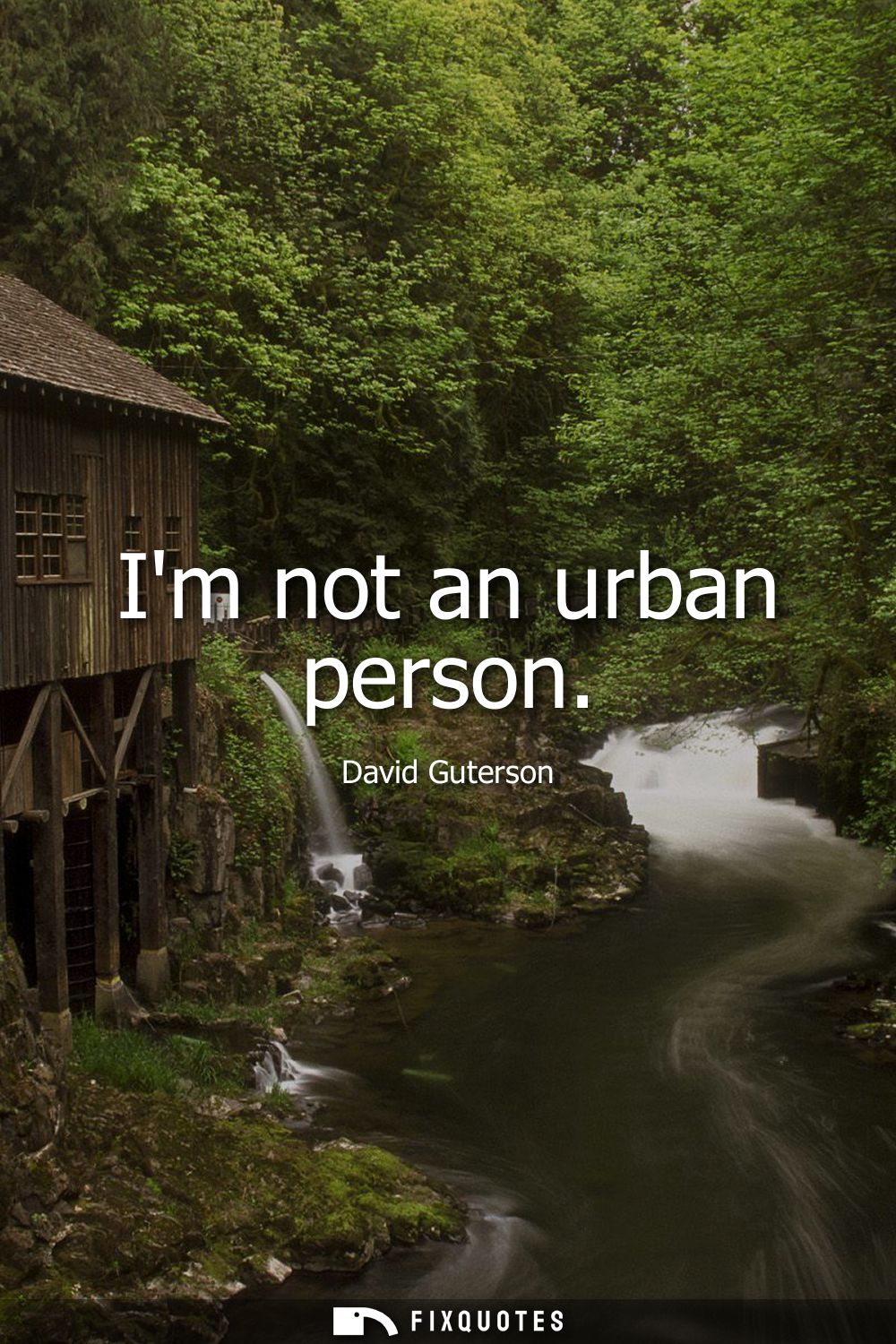
"I'm not an urban person"
About this Quote
A line this bare is doing more work than it admits. "I'm not an urban person" reads like a simple self-description, but it’s really a boundary marker: a refusal of a certain tempo, a certain social script, a certain way of being watched. Guterson has built a career out of landscapes that aren’t just backdrops but moral weather. So the phrase isn’t primarily about geography; it’s about allegiance. He’s staking out the conditions under which he can think, notice, and write.
The subtext carries a quiet critique. "Urban" here implies congestion, churn, professionalized culture, the hum of networks and status. Saying he’s not that kind of person suggests the city’s values are not neutral: they pressure you to optimize, to perform sophistication, to trade solitude for proximity. Guterson’s phrasing avoids the romantic trap of declaring himself anti-city; it’s softer, more defensible, almost modest. That modesty is strategic. It turns a potentially ideological statement into temperament, which is harder to argue with and easier to live inside.
Context matters because American literary identity is still haunted by the city-country divide: the metropolis as taste-maker, the periphery as either authenticity or resentment. Guterson’s work, steeped in the Pacific Northwest, leans into the dignity of the non-metropolitan without turning it into a costume. The intent, then, is self-positioning: don’t read me through the lens of urban irony. Read me through attention, slowness, and the kind of quiet that lets consequences show up.
The subtext carries a quiet critique. "Urban" here implies congestion, churn, professionalized culture, the hum of networks and status. Saying he’s not that kind of person suggests the city’s values are not neutral: they pressure you to optimize, to perform sophistication, to trade solitude for proximity. Guterson’s phrasing avoids the romantic trap of declaring himself anti-city; it’s softer, more defensible, almost modest. That modesty is strategic. It turns a potentially ideological statement into temperament, which is harder to argue with and easier to live inside.
Context matters because American literary identity is still haunted by the city-country divide: the metropolis as taste-maker, the periphery as either authenticity or resentment. Guterson’s work, steeped in the Pacific Northwest, leans into the dignity of the non-metropolitan without turning it into a costume. The intent, then, is self-positioning: don’t read me through the lens of urban irony. Read me through attention, slowness, and the kind of quiet that lets consequences show up.
Quote Details
| Topic | Nature |
|---|
More Quotes by David
Add to List