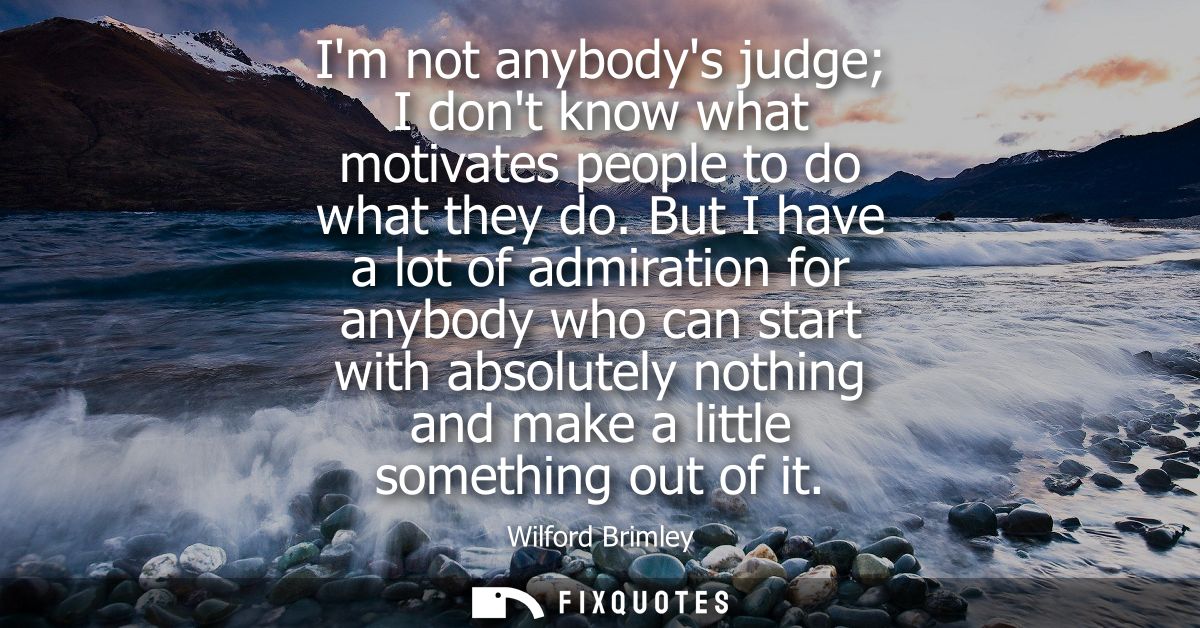
"I'm not anybody's judge; I don't know what motivates people to do what they do. But I have a lot of admiration for anybody who can start with absolutely nothing and make a little something out of it"
About this Quote
The middle clause - “I don’t know what motivates people” - functions as both confession and critique. It recognizes how little outsiders can actually see of someone’s private calculus: desperation, pride, hunger, trauma, sheer luck. That’s a subtle pushback against the tidy narratives we demand from success stories and scandals alike. Brimley doesn’t romanticize struggle, but he won’t reduce people to a single motive, either.
Then he pivots to admiration, and it’s admiration with strict parameters: not for fame, not for genius, not for winning, but for making “a little something” from “absolutely nothing.” The modesty of “a little” is doing heavy lifting. It rejects the American addiction to the grand triumph and makes room for incremental survival, small enterprises, second acts. Coming from a performer associated with rugged, working-class authority, it reads less like a motivational poster and more like a cultural stance: don’t ask me to condemn strangers; show me someone who built a foothold, and I’ll tip my hat.
Quote Details
| Topic | Motivational |
|---|---|
| Source | Help us find the source |
| Cite |
Citation Formats
APA Style (7th ed.)
Brimley, Wilford. (2026, January 16). I'm not anybody's judge; I don't know what motivates people to do what they do. But I have a lot of admiration for anybody who can start with absolutely nothing and make a little something out of it. FixQuotes. https://fixquotes.com/quotes/im-not-anybodys-judge-i-dont-know-what-motivates-130506/
Chicago Style
Brimley, Wilford. "I'm not anybody's judge; I don't know what motivates people to do what they do. But I have a lot of admiration for anybody who can start with absolutely nothing and make a little something out of it." FixQuotes. January 16, 2026. https://fixquotes.com/quotes/im-not-anybodys-judge-i-dont-know-what-motivates-130506/.
MLA Style (9th ed.)
"I'm not anybody's judge; I don't know what motivates people to do what they do. But I have a lot of admiration for anybody who can start with absolutely nothing and make a little something out of it." FixQuotes, 16 Jan. 2026, https://fixquotes.com/quotes/im-not-anybodys-judge-i-dont-know-what-motivates-130506/. Accessed 21 Mar. 2026.