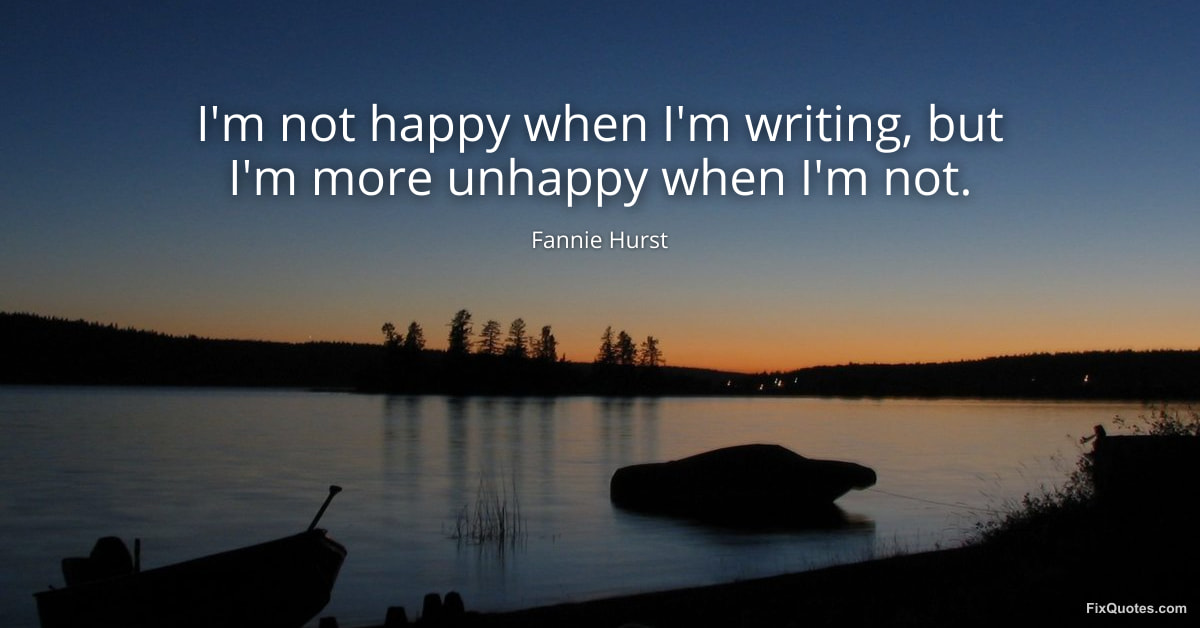
"I'm not happy when I'm writing, but I'm more unhappy when I'm not"
About this Quote
There is no romance in this admission, and that is the point. Hurst strips the writer’s life of its sentimental varnish and replaces it with a blunt calculus of discomfort: writing doesn’t deliver happiness; it merely keeps a worse unhappiness at bay. The line lands because it refuses the modern expectation that creative work should feel like “alignment” or self-care. For Hurst, writing is closer to an ache you treat so it doesn’t spread.
The subtext is a quiet indictment of the myth that art is fueled by inspiration alone. She’s describing compulsion, not passion: a nervous system that settles only when it’s making something, even if the act itself is tense, lonely, or punishing. The phrasing is deliberately comparative - “not happy” versus “more unhappy” - which frames writing as necessity rather than choice. It’s also a subtle power move. By admitting misery, she claims authority: she’s not dabbling; she’s bound to the work.
Context matters. Hurst built a wildly successful career in early 20th-century American publishing, a period that rewarded productivity, public persona, and market-savvy storytelling. As a woman writing at scale in a male-dominated literary ecosystem, she would have felt pressure to justify her seriousness. This line does that without pleading. It acknowledges the grind while implying that the alternative - silence, idleness, maybe domestic containment - is intolerable.
What makes it stick is its honesty about the bargain: writing won’t save you, but not writing will undo you.
The subtext is a quiet indictment of the myth that art is fueled by inspiration alone. She’s describing compulsion, not passion: a nervous system that settles only when it’s making something, even if the act itself is tense, lonely, or punishing. The phrasing is deliberately comparative - “not happy” versus “more unhappy” - which frames writing as necessity rather than choice. It’s also a subtle power move. By admitting misery, she claims authority: she’s not dabbling; she’s bound to the work.
Context matters. Hurst built a wildly successful career in early 20th-century American publishing, a period that rewarded productivity, public persona, and market-savvy storytelling. As a woman writing at scale in a male-dominated literary ecosystem, she would have felt pressure to justify her seriousness. This line does that without pleading. It acknowledges the grind while implying that the alternative - silence, idleness, maybe domestic containment - is intolerable.
What makes it stick is its honesty about the bargain: writing won’t save you, but not writing will undo you.
Quote Details
| Topic | Writing |
|---|---|
| Source | Help us find the source |
| Cite |
Citation Formats
APA Style (7th ed.)
Hurst, Fannie. (2026, January 16). I'm not happy when I'm writing, but I'm more unhappy when I'm not. FixQuotes. https://fixquotes.com/quotes/im-not-happy-when-im-writing-but-im-more-unhappy-124099/
Chicago Style
Hurst, Fannie. "I'm not happy when I'm writing, but I'm more unhappy when I'm not." FixQuotes. January 16, 2026. https://fixquotes.com/quotes/im-not-happy-when-im-writing-but-im-more-unhappy-124099/.
MLA Style (9th ed.)
"I'm not happy when I'm writing, but I'm more unhappy when I'm not." FixQuotes, 16 Jan. 2026, https://fixquotes.com/quotes/im-not-happy-when-im-writing-but-im-more-unhappy-124099/. Accessed 3 Apr. 2026.
More Quotes by Fannie
Add to List