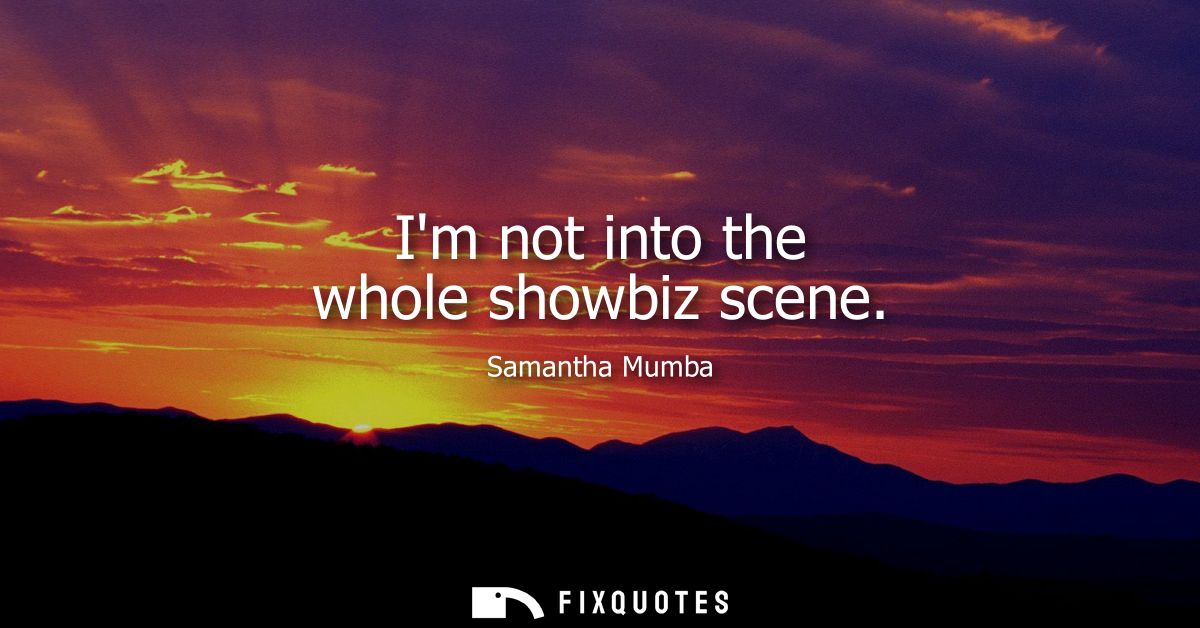
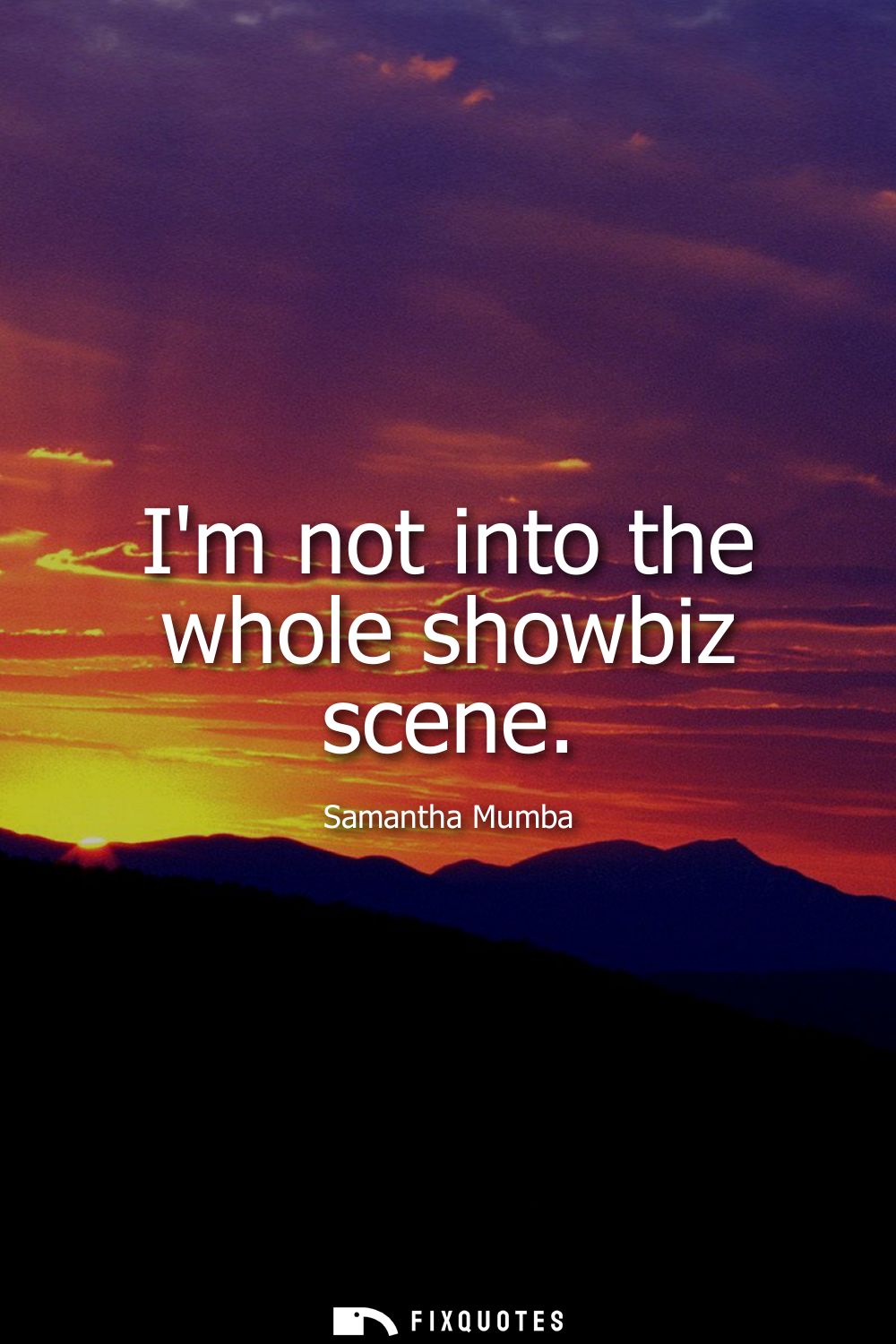
"I'm not into the whole showbiz scene"
About this Quote
There is a quiet power move in the understatement: a pop musician calling the “showbiz scene” a “whole” thing she’s simply “not into.” Samantha Mumba’s phrasing does two jobs at once. On the surface it’s casual, even shruggy, the kind of line you drop in an interview to dodge gossip. Underneath, it’s brand architecture. Pop stardom sells intimacy and spectacle, and she’s drawing a boundary around the spectacle while keeping the music credible.
The key word is “scene.” It’s not “the industry” (work) or “fame” (visibility), but a social ecosystem: parties, networking, cameras, the choreographed proximity to tastemakers. By rejecting the scene rather than the craft, she claims seriousness without sounding sanctimonious. “Whole” adds a hint of exhaustion, like she’s seen enough of the machine to know how it chews people up. “Not into” keeps it light; she’s not declaring war, she’s refusing to audition for the role of celebrity.
Context matters: Mumba arrived in the early-2000s pop era when young women were marketed as 24/7 content before we even had the language for it. This kind of statement reads as preemptive self-defense against being flattened into tabloid narrative, a way to protect private life and artistic control. It also signals to fans: you can like me without buying the circus. In a culture that treats visibility as gratitude, opting out becomes its own form of leverage.
The key word is “scene.” It’s not “the industry” (work) or “fame” (visibility), but a social ecosystem: parties, networking, cameras, the choreographed proximity to tastemakers. By rejecting the scene rather than the craft, she claims seriousness without sounding sanctimonious. “Whole” adds a hint of exhaustion, like she’s seen enough of the machine to know how it chews people up. “Not into” keeps it light; she’s not declaring war, she’s refusing to audition for the role of celebrity.
Context matters: Mumba arrived in the early-2000s pop era when young women were marketed as 24/7 content before we even had the language for it. This kind of statement reads as preemptive self-defense against being flattened into tabloid narrative, a way to protect private life and artistic control. It also signals to fans: you can like me without buying the circus. In a culture that treats visibility as gratitude, opting out becomes its own form of leverage.
Quote Details
| Topic | Music |
|---|---|
| Source | Help us find the source |
| Cite |
Citation Formats
APA Style (7th ed.)
Mumba, Samantha. (2026, January 16). I'm not into the whole showbiz scene. FixQuotes. https://fixquotes.com/quotes/im-not-into-the-whole-showbiz-scene-95070/
Chicago Style
Mumba, Samantha. "I'm not into the whole showbiz scene." FixQuotes. January 16, 2026. https://fixquotes.com/quotes/im-not-into-the-whole-showbiz-scene-95070/.
MLA Style (9th ed.)
"I'm not into the whole showbiz scene." FixQuotes, 16 Jan. 2026, https://fixquotes.com/quotes/im-not-into-the-whole-showbiz-scene-95070/. Accessed 26 Mar. 2026.
More Quotes by Samantha
Add to List