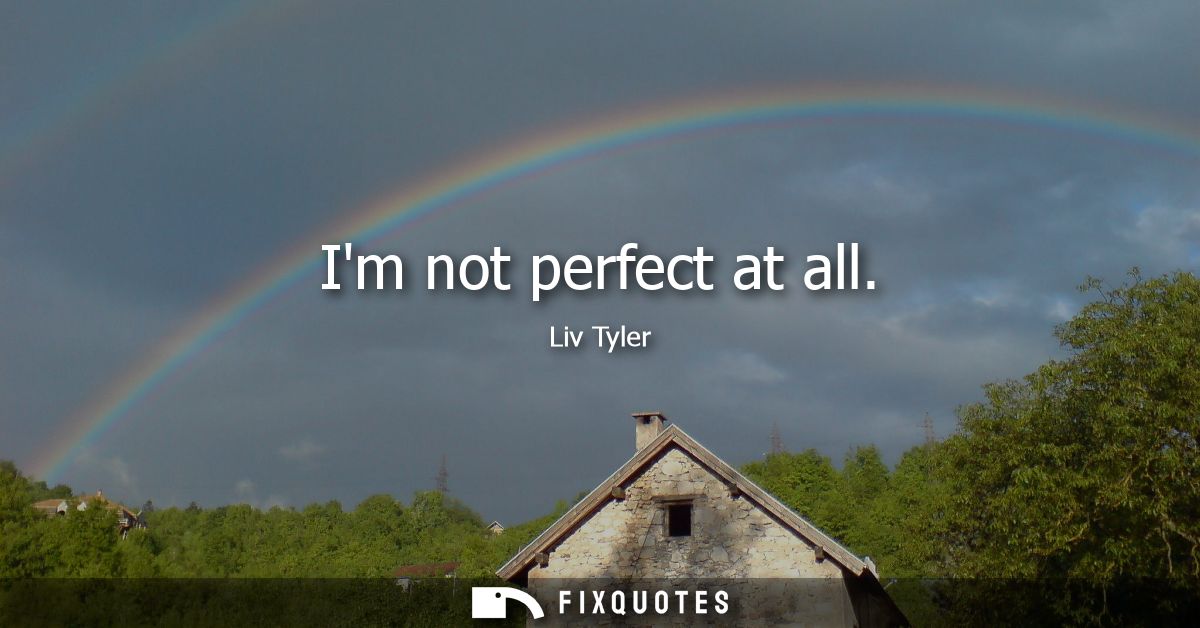
"I'm not perfect at all"
About this Quote
There is a quiet power move in Liv Tyler’s “I’m not perfect at all”: it sounds like humility, but it’s also reputation management in an industry that sells women as polished objects and then punishes them for looking manufactured. The phrasing is almost disarmingly plain. No clever metaphor, no self-mythologizing. Just a small, human sentence that sidesteps the whole machinery of celebrity branding.
The intent reads as preemptive deflation. Tyler came of age in a late-’90s/early-2000s celebrity ecosystem obsessed with flawless skin, “effortless” beauty, and tabloid moral scoring. Saying “not perfect” is a way to reclaim the narrative before someone else defines her as too privileged, too pretty, too connected (she’s long been shadowed by the fame of her family). It’s less confession than boundary-setting: don’t project a fantasy onto me, and don’t hold me hostage to it later.
The subtext is also gendered. Male stars can lean into arrogance as charisma; women are expected to perform likability, gratitude, and relatability on command. “At all” doubles the effect, pushing past the standard, PR-safe “nobody’s perfect” into something more personal, almost defensive: I know what you’re thinking, and I’m getting there first.
Culturally, the line lands as an early version of what would later be called authenticity. Before “no-makeup makeup” became a marketing vertical, Tyler’s bluntness offered a low-drama refusal to play the flawless heroine in public, even if she was cast as one onscreen.
The intent reads as preemptive deflation. Tyler came of age in a late-’90s/early-2000s celebrity ecosystem obsessed with flawless skin, “effortless” beauty, and tabloid moral scoring. Saying “not perfect” is a way to reclaim the narrative before someone else defines her as too privileged, too pretty, too connected (she’s long been shadowed by the fame of her family). It’s less confession than boundary-setting: don’t project a fantasy onto me, and don’t hold me hostage to it later.
The subtext is also gendered. Male stars can lean into arrogance as charisma; women are expected to perform likability, gratitude, and relatability on command. “At all” doubles the effect, pushing past the standard, PR-safe “nobody’s perfect” into something more personal, almost defensive: I know what you’re thinking, and I’m getting there first.
Culturally, the line lands as an early version of what would later be called authenticity. Before “no-makeup makeup” became a marketing vertical, Tyler’s bluntness offered a low-drama refusal to play the flawless heroine in public, even if she was cast as one onscreen.
Quote Details
| Topic | Humility |
|---|---|
| Source | Help us find the source |
| Cite |
Citation Formats
APA Style (7th ed.)
Tyler, Liv. (2026, January 16). I'm not perfect at all. FixQuotes. https://fixquotes.com/quotes/im-not-perfect-at-all-112463/
Chicago Style
Tyler, Liv. "I'm not perfect at all." FixQuotes. January 16, 2026. https://fixquotes.com/quotes/im-not-perfect-at-all-112463/.
MLA Style (9th ed.)
"I'm not perfect at all." FixQuotes, 16 Jan. 2026, https://fixquotes.com/quotes/im-not-perfect-at-all-112463/. Accessed 5 Mar. 2026.
More Quotes by Liv
Add to List