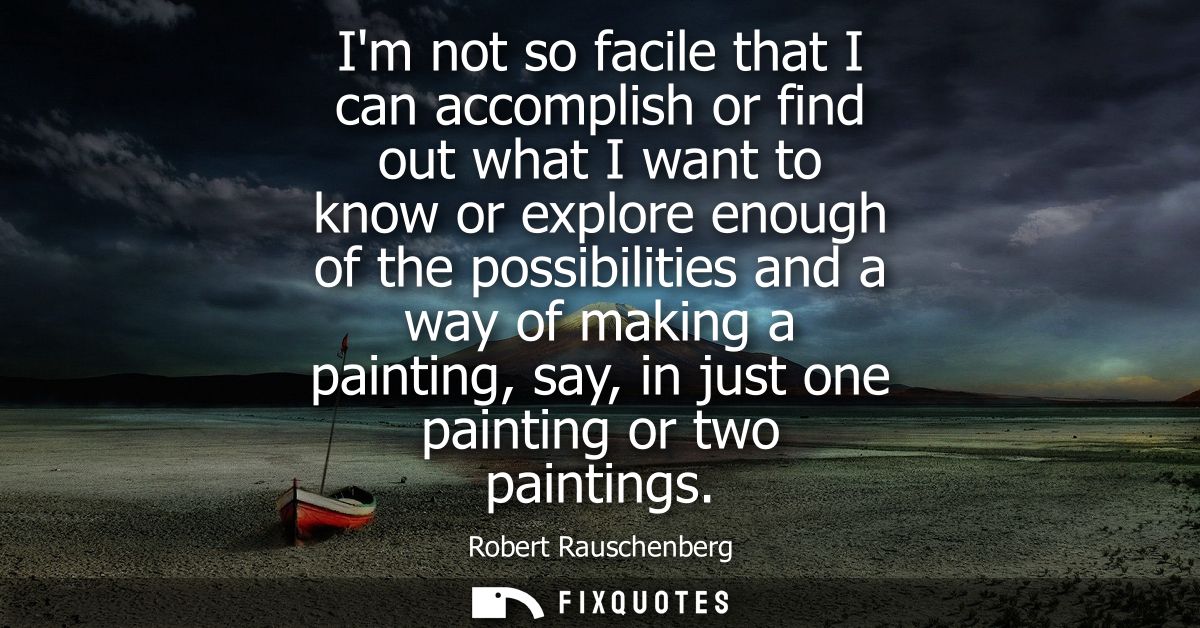
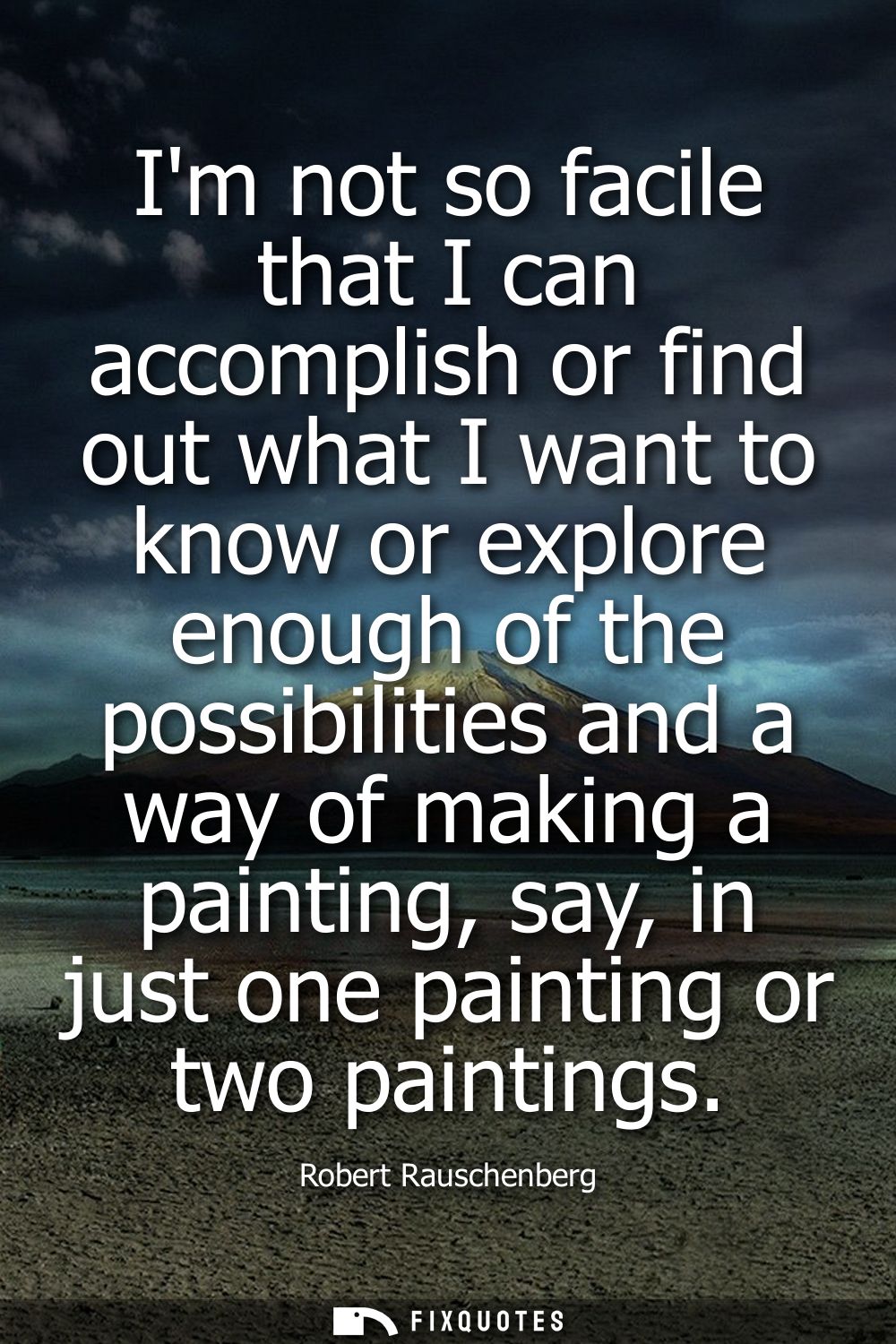
"I'm not so facile that I can accomplish or find out what I want to know, or explore enough of the possibilities and a way of making a painting, say, in just one painting or two paintings"
About this Quote
That stance sits squarely in the postwar moment Rauschenberg helped define, when American art was prying itself loose from the heroic, singular gesture of Abstract Expressionism. His Combines, silkscreens, and scavenged materials weren’t just stylistic mash-ups; they were methods for staying unfinished, for keeping the world’s mess inside the frame. The quote’s quiet resistance is to the market and the museum alike: they want signature clarity, a recognizable “Rauschenberg.” He insists on process over brand, sequences over icons, curiosity over fluency.
Subtextually, he’s arguing that “finding out” matters more than “finding.” Knowledge here is experimental and cumulative; failure is baked in, even useful. If one or two paintings can’t contain the search, that’s not a weakness - it’s a demand that art remain a living practice rather than a neatly solved product.
Quote Details
| Topic | Art |
|---|---|
| Source | Help us find the source |
| Cite |
Citation Formats
APA Style (7th ed.)
Rauschenberg, Robert. (2026, February 16). I'm not so facile that I can accomplish or find out what I want to know, or explore enough of the possibilities and a way of making a painting, say, in just one painting or two paintings. FixQuotes. https://fixquotes.com/quotes/im-not-so-facile-that-i-can-accomplish-or-find-153212/
Chicago Style
Rauschenberg, Robert. "I'm not so facile that I can accomplish or find out what I want to know, or explore enough of the possibilities and a way of making a painting, say, in just one painting or two paintings." FixQuotes. February 16, 2026. https://fixquotes.com/quotes/im-not-so-facile-that-i-can-accomplish-or-find-153212/.
MLA Style (9th ed.)
"I'm not so facile that I can accomplish or find out what I want to know, or explore enough of the possibilities and a way of making a painting, say, in just one painting or two paintings." FixQuotes, 16 Feb. 2026, https://fixquotes.com/quotes/im-not-so-facile-that-i-can-accomplish-or-find-153212/. Accessed 31 Mar. 2026.