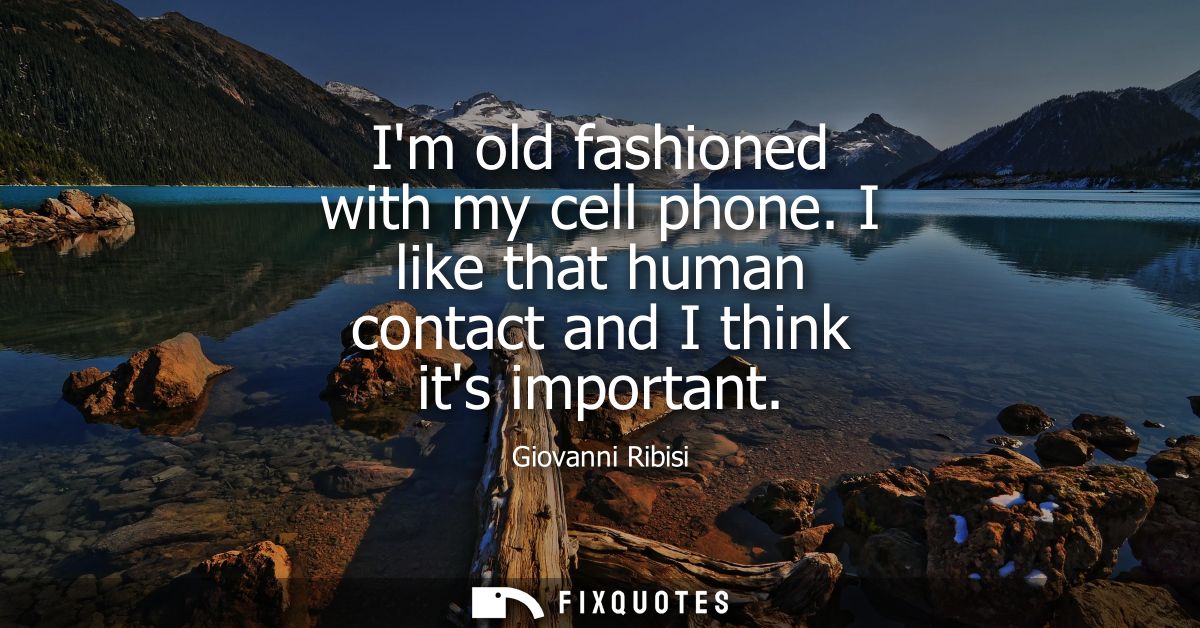
"I'm old fashioned with my cell phone. I like that human contact and I think it's important"
About this Quote
The subtext is less anti-technology than anti-frictionlessness. Cell phones promise convenience, but they also flatten social life into pings, read receipts, and half-attention. Ribisi’s emphasis on “human contact” invokes the stuff that can’t be optimized: awkward pauses, eye contact, the emotional labor of showing up. It’s a subtle rebuke of the idea that communication is just information transfer, as if a text and a conversation are interchangeable products.
Context matters because celebrities are both beneficiaries and casualties of mediated connection. Their work is promoted through platforms that reward intimacy at scale, yet that intimacy is often synthetic: parasocial, performative, monitored. Ribisi’s comment taps into a broader 2010s-and-beyond fatigue with being always on. It’s not a manifesto; it’s a boundary-setting statement, the kind that signals, “You don’t automatically get access to me.” In a culture that confuses connectivity with closeness, the quote works because it’s a modest sounding line with a surprisingly sharp edge.
Quote Details
| Topic | Technology |
|---|---|
| Source | Help us find the source |
| Cite |
Citation Formats
APA Style (7th ed.)
Ribisi, Giovanni. (2026, January 17). I'm old fashioned with my cell phone. I like that human contact and I think it's important. FixQuotes. https://fixquotes.com/quotes/im-old-fashioned-with-my-cell-phone-i-like-that-55359/
Chicago Style
Ribisi, Giovanni. "I'm old fashioned with my cell phone. I like that human contact and I think it's important." FixQuotes. January 17, 2026. https://fixquotes.com/quotes/im-old-fashioned-with-my-cell-phone-i-like-that-55359/.
MLA Style (9th ed.)
"I'm old fashioned with my cell phone. I like that human contact and I think it's important." FixQuotes, 17 Jan. 2026, https://fixquotes.com/quotes/im-old-fashioned-with-my-cell-phone-i-like-that-55359/. Accessed 11 Mar. 2026.