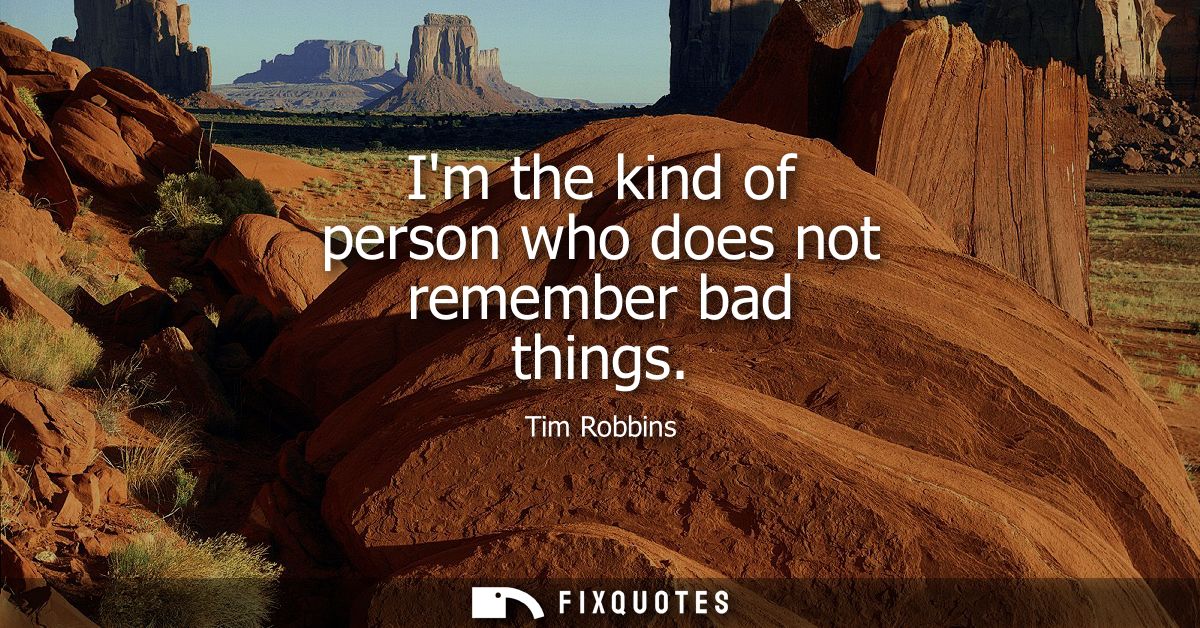
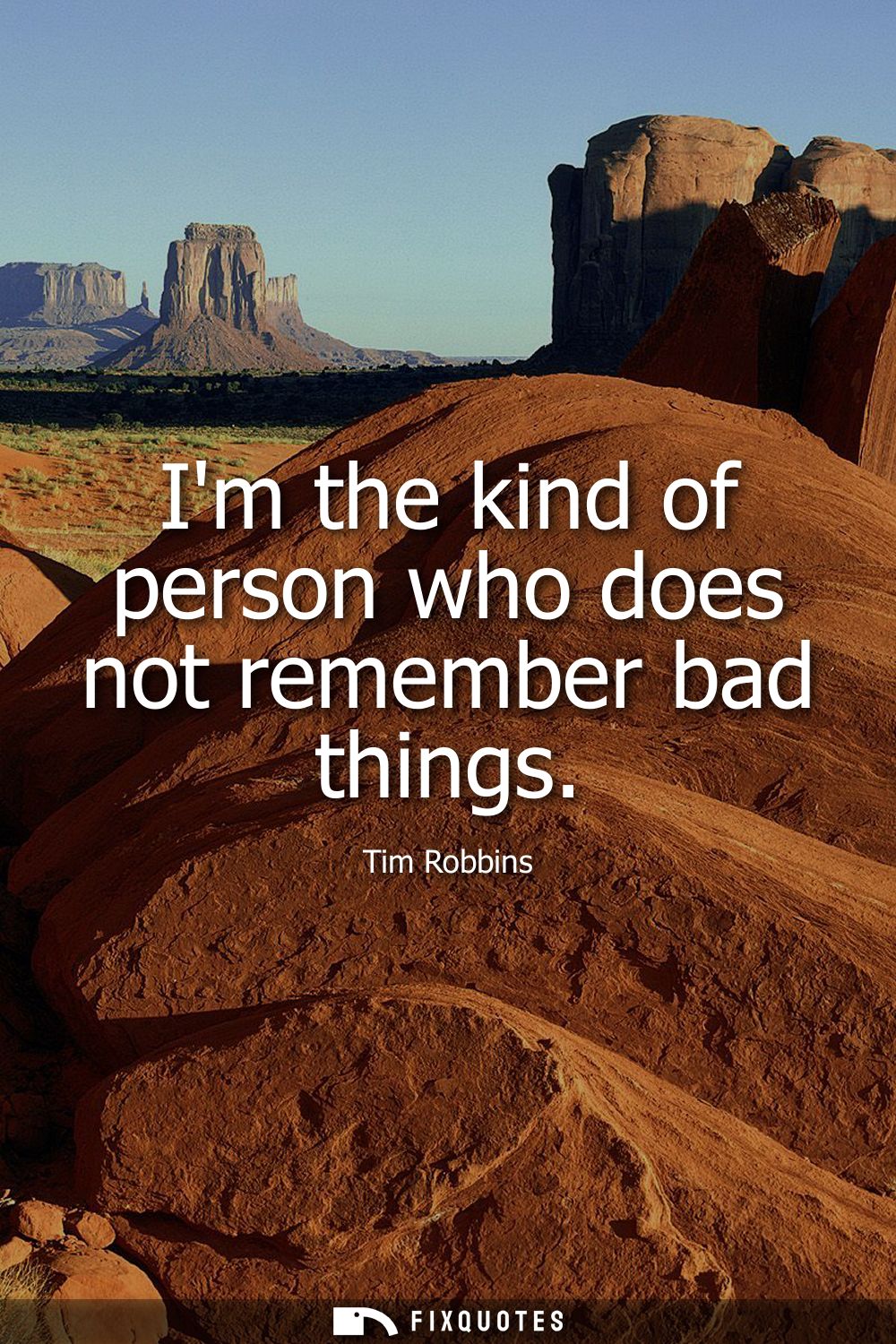
"I'm the kind of person who does not remember bad things"
About this Quote
Tim Robbins’ line plays like a small act of self-mythology: a breezy claim that turns memory into a personal brand. Coming from an actor with a public history of political engagement and a career built on intensity, “I do not remember bad things” reads less like denial and more like a chosen posture. It’s the kind of statement that sounds simple until you notice how much work it’s doing.
The intent is aspirational, almost tactical. Robbins frames forgetting as character, not accident: “the kind of person” signals identity rather than circumstance. That phrasing smuggles in control. Bad things happen, sure, but they don’t get to take up real estate in his head. In celebrity culture, where every disappointment can be recycled into a headline or a grievance narrative, selective memory becomes a survival skill. It’s not just positivity; it’s editing.
The subtext has a sharper edge. “Bad things” stays conveniently vague, letting listeners project: heartbreak, career setbacks, trauma, criticism. The ambiguity protects him from follow-up while inviting admiration for his supposed lightness. It also hints at a performer’s craft: actors learn to access pain on cue, then walk away from it. The quote flirts with that paradox, suggesting a person who can visit darkness professionally without letting it colonize the rest of life.
Contextually, it fits a cultural moment that rewards resilience aesthetics. Forgetting becomes a flex - not the absence of struggle, but the refusal to be publicly governed by it.
The intent is aspirational, almost tactical. Robbins frames forgetting as character, not accident: “the kind of person” signals identity rather than circumstance. That phrasing smuggles in control. Bad things happen, sure, but they don’t get to take up real estate in his head. In celebrity culture, where every disappointment can be recycled into a headline or a grievance narrative, selective memory becomes a survival skill. It’s not just positivity; it’s editing.
The subtext has a sharper edge. “Bad things” stays conveniently vague, letting listeners project: heartbreak, career setbacks, trauma, criticism. The ambiguity protects him from follow-up while inviting admiration for his supposed lightness. It also hints at a performer’s craft: actors learn to access pain on cue, then walk away from it. The quote flirts with that paradox, suggesting a person who can visit darkness professionally without letting it colonize the rest of life.
Contextually, it fits a cultural moment that rewards resilience aesthetics. Forgetting becomes a flex - not the absence of struggle, but the refusal to be publicly governed by it.
Quote Details
| Topic | Letting Go |
|---|---|
| Source | Help us find the source |
| Cite |
Citation Formats
APA Style (7th ed.)
Robbins, Tim. (2026, January 16). I'm the kind of person who does not remember bad things. FixQuotes. https://fixquotes.com/quotes/im-the-kind-of-person-who-does-not-remember-bad-97708/
Chicago Style
Robbins, Tim. "I'm the kind of person who does not remember bad things." FixQuotes. January 16, 2026. https://fixquotes.com/quotes/im-the-kind-of-person-who-does-not-remember-bad-97708/.
MLA Style (9th ed.)
"I'm the kind of person who does not remember bad things." FixQuotes, 16 Jan. 2026, https://fixquotes.com/quotes/im-the-kind-of-person-who-does-not-remember-bad-97708/. Accessed 6 Mar. 2026.
More Quotes by Tim
Add to List