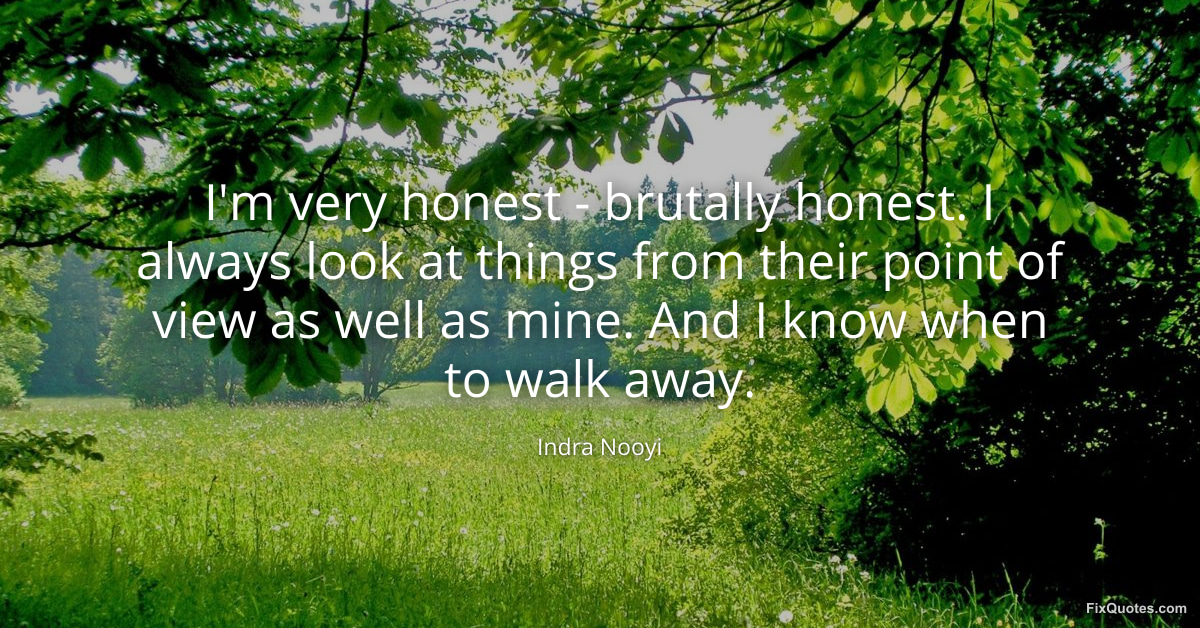
"I'm very honest - brutally honest. I always look at things from their point of view as well as mine. And I know when to walk away"
About this Quote
The next move is the real tell: "I always look at things from their point of view as well as mine". That clause softens the edge, but it is not an apology. It's a technique. Empathy here doubles as strategy, the classic executive skill of reading incentives, anticipating resistance, and negotiating outcomes without pretending everyone shares the same stakes. It's also a quiet rebuttal to the caricature of the hard-charging CEO as indifferent: she claims ruthlessness with a conscience, toughness with situational awareness.
"And I know when to walk away" lands like a closer because it shifts the power dynamic. Walking away is not retreat; it's leverage, boundary, and self-preservation rolled into one. In a leadership context, it hints at the unglamorous reality behind decisive careers: success often depends less on winning every argument than on refusing the wrong fights, the wrong partners, the wrong rooms. The subtext is control - over narrative, over negotiation, over what deserves her time.
Quote Details
| Topic | Honesty & Integrity |
|---|---|
| Source | Help us find the source |
| Cite |
Citation Formats
APA Style (7th ed.)
Nooyi, Indra. (2026, January 15). I'm very honest - brutally honest. I always look at things from their point of view as well as mine. And I know when to walk away. FixQuotes. https://fixquotes.com/quotes/im-very-honest-brutally-honest-i-always-look-at-142805/
Chicago Style
Nooyi, Indra. "I'm very honest - brutally honest. I always look at things from their point of view as well as mine. And I know when to walk away." FixQuotes. January 15, 2026. https://fixquotes.com/quotes/im-very-honest-brutally-honest-i-always-look-at-142805/.
MLA Style (9th ed.)
"I'm very honest - brutally honest. I always look at things from their point of view as well as mine. And I know when to walk away." FixQuotes, 15 Jan. 2026, https://fixquotes.com/quotes/im-very-honest-brutally-honest-i-always-look-at-142805/. Accessed 28 Mar. 2026.