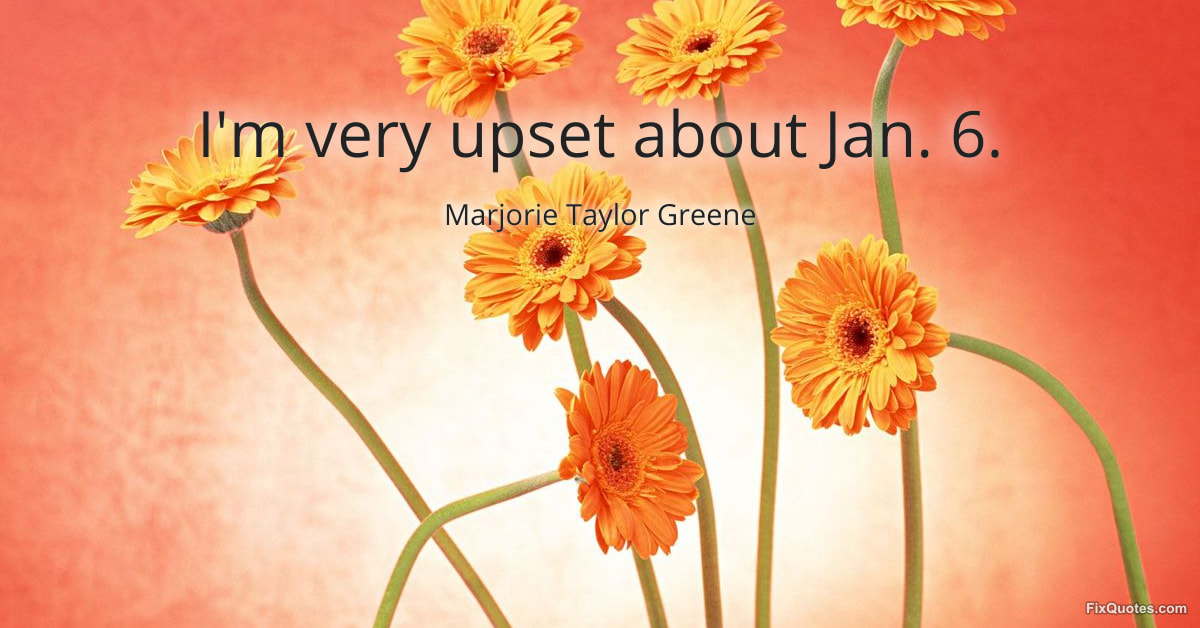
"I'm very upset about Jan. 6"
About this Quote
For a politician who has spent years treating outrage as both currency and cudgel, "I'm very upset about Jan. 6" lands less as revelation than as calibration. The line is conspicuously plain, almost therapeutically vague. No agents, no verbs beyond feeling, no naming of rioters, Trump, the false-election narrative, or the institutional targets. That grammatical minimalism is the point: it lets the speaker occupy the posture of moral seriousness without staking out responsibility or endorsing the implications that seriousness would normally demand.
The intent reads as strategic repositioning in a post-attack political environment where Jan. 6 has become a litmus test for donors, leadership, and suburban swing voters. Greene can signal that she recognizes the event as a reputational hazard while keeping her rhetorical escape routes open. "Upset" is an emotion word that requires no policy commitment, no apology, no break with the ecosystem that fueled the day. It's the language of personal discomfort, not civic diagnosis.
Subtextually, it offers two audiences two different products. To mainstream listeners, it can sound like belated condemnation. To her base, it can be heard as lament about fallout: prosecutions, media narratives, and the sense that "they" used the riot to crack down on "us". The brilliance - and the cynicism - is in the ambiguity. It treats a constitutional rupture as a mood, converting a collective trauma into a private feeling, which is exactly how you minimize consequence while appearing to acknowledge it.
The intent reads as strategic repositioning in a post-attack political environment where Jan. 6 has become a litmus test for donors, leadership, and suburban swing voters. Greene can signal that she recognizes the event as a reputational hazard while keeping her rhetorical escape routes open. "Upset" is an emotion word that requires no policy commitment, no apology, no break with the ecosystem that fueled the day. It's the language of personal discomfort, not civic diagnosis.
Subtextually, it offers two audiences two different products. To mainstream listeners, it can sound like belated condemnation. To her base, it can be heard as lament about fallout: prosecutions, media narratives, and the sense that "they" used the riot to crack down on "us". The brilliance - and the cynicism - is in the ambiguity. It treats a constitutional rupture as a mood, converting a collective trauma into a private feeling, which is exactly how you minimize consequence while appearing to acknowledge it.
Quote Details
| Topic | Justice |
|---|---|
| Source | Help us find the source |
| Cite |
Citation Formats
APA Style (7th ed.)
Greene, Marjorie Taylor. (2026, January 15). I'm very upset about Jan. 6. FixQuotes. https://fixquotes.com/quotes/im-very-upset-about-jan-6-173554/
Chicago Style
Greene, Marjorie Taylor. "I'm very upset about Jan. 6." FixQuotes. January 15, 2026. https://fixquotes.com/quotes/im-very-upset-about-jan-6-173554/.
MLA Style (9th ed.)
"I'm very upset about Jan. 6." FixQuotes, 15 Jan. 2026, https://fixquotes.com/quotes/im-very-upset-about-jan-6-173554/. Accessed 4 Apr. 2026.
More Quotes by Marjorie
Add to List