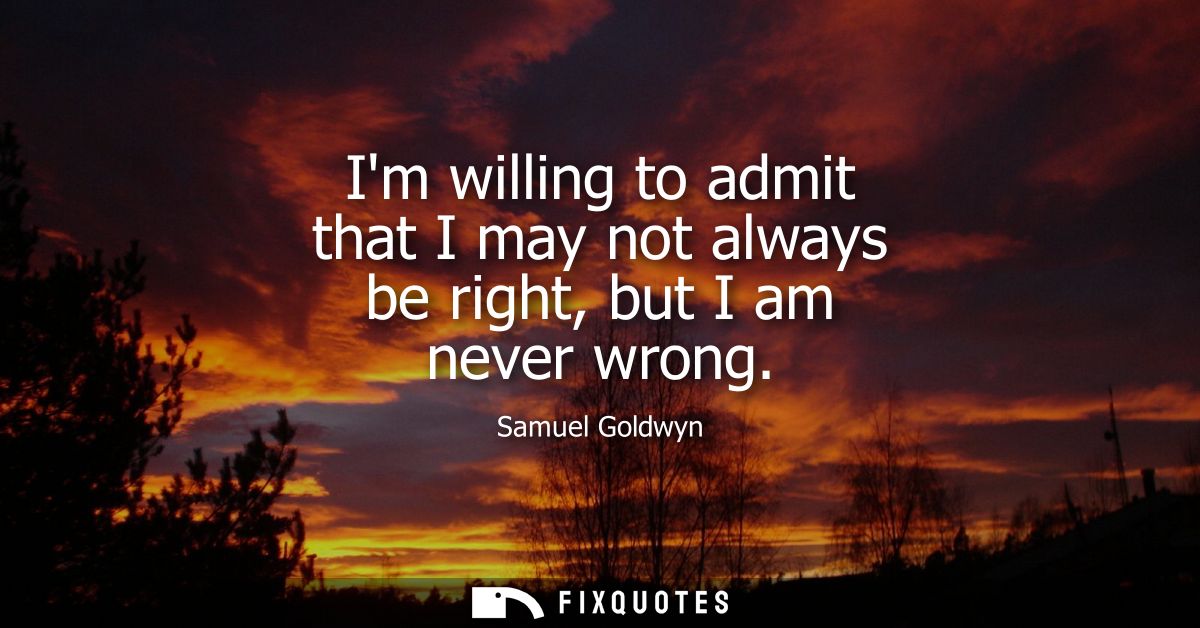
"I'm willing to admit that I may not always be right, but I am never wrong"
About this Quote
Goldwyn, the Hollywood producer who helped industrialize American dreams, understood that authority in a studio system isn’t just enforced by contracts; it’s performed through language. The line works because it compresses the executive mindset into a paradox you can repeat at lunch. It’s funny, yes, but the humor is a control mechanism: laugh along and you’ve already accepted his premise that the argument is over. If you object, you become the humorless one, the person who “doesn’t get it,” which is another kind of losing in Hollywood.
There’s also a cultural snapshot here: the mogul era’s confidence, when taste and money were treated as interchangeable and certainty was a brand. The subtext is less “I’m infallible” than “I decide what counts as wrong.” Goldwyn’s genius was turning that raw dominance into a quotable aphorism, a little verbal product placement for the myth of the all-knowing producer.
Quote Details
| Topic | Witty One-Liners |
|---|---|
| Source | Later attribution: Quotes: The Famous and Not so Famous (Terence M. Dorn Ph.D., 2021) modern compilationISBN: 9781662447952 · ID: ptZSEAAAQBAJ
Evidence:
... Samuel Goldwyn, movie pioneer I'm willing to admit that I may not always be right, but I am never wrong.—Samuel Goldwyn God makes stars. I just produce them.—Samuel Goldwyn The harder I work, the luckier I get.—Samuel Goldwyn Adversity ... |
| Cite |
Citation Formats
APA Style (7th ed.)
Goldwyn, Samuel. (2026, February 14). I'm willing to admit that I may not always be right, but I am never wrong. FixQuotes. https://fixquotes.com/quotes/im-willing-to-admit-that-i-may-not-always-be-81142/
Chicago Style
Goldwyn, Samuel. "I'm willing to admit that I may not always be right, but I am never wrong." FixQuotes. February 14, 2026. https://fixquotes.com/quotes/im-willing-to-admit-that-i-may-not-always-be-81142/.
MLA Style (9th ed.)
"I'm willing to admit that I may not always be right, but I am never wrong." FixQuotes, 14 Feb. 2026, https://fixquotes.com/quotes/im-willing-to-admit-that-i-may-not-always-be-81142/. Accessed 30 Mar. 2026.