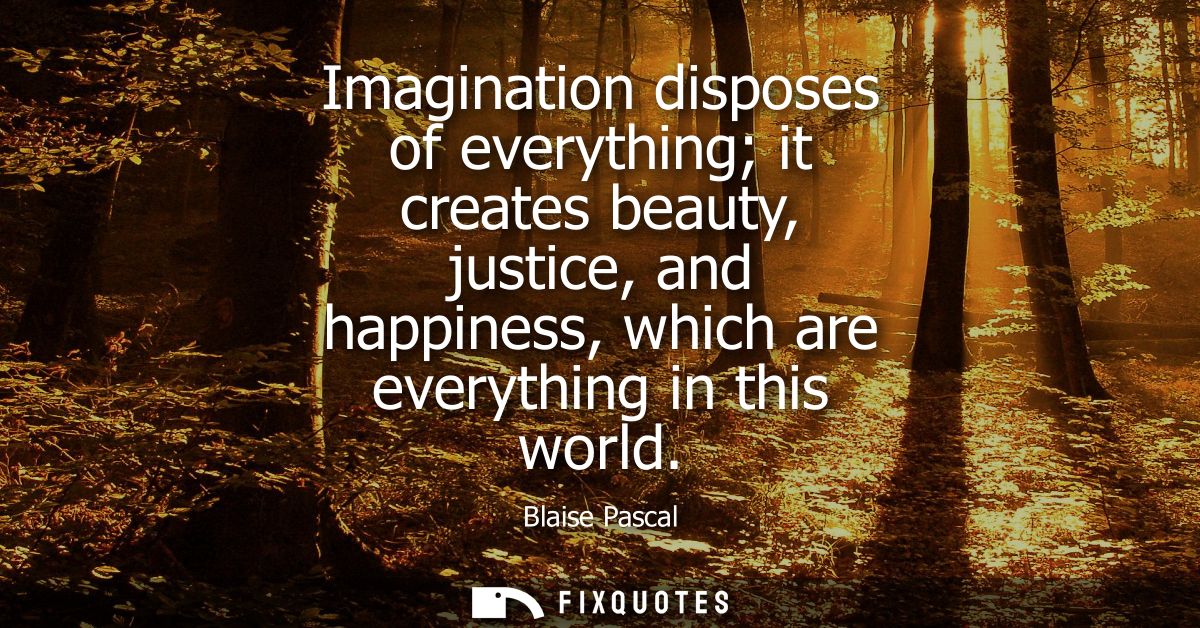
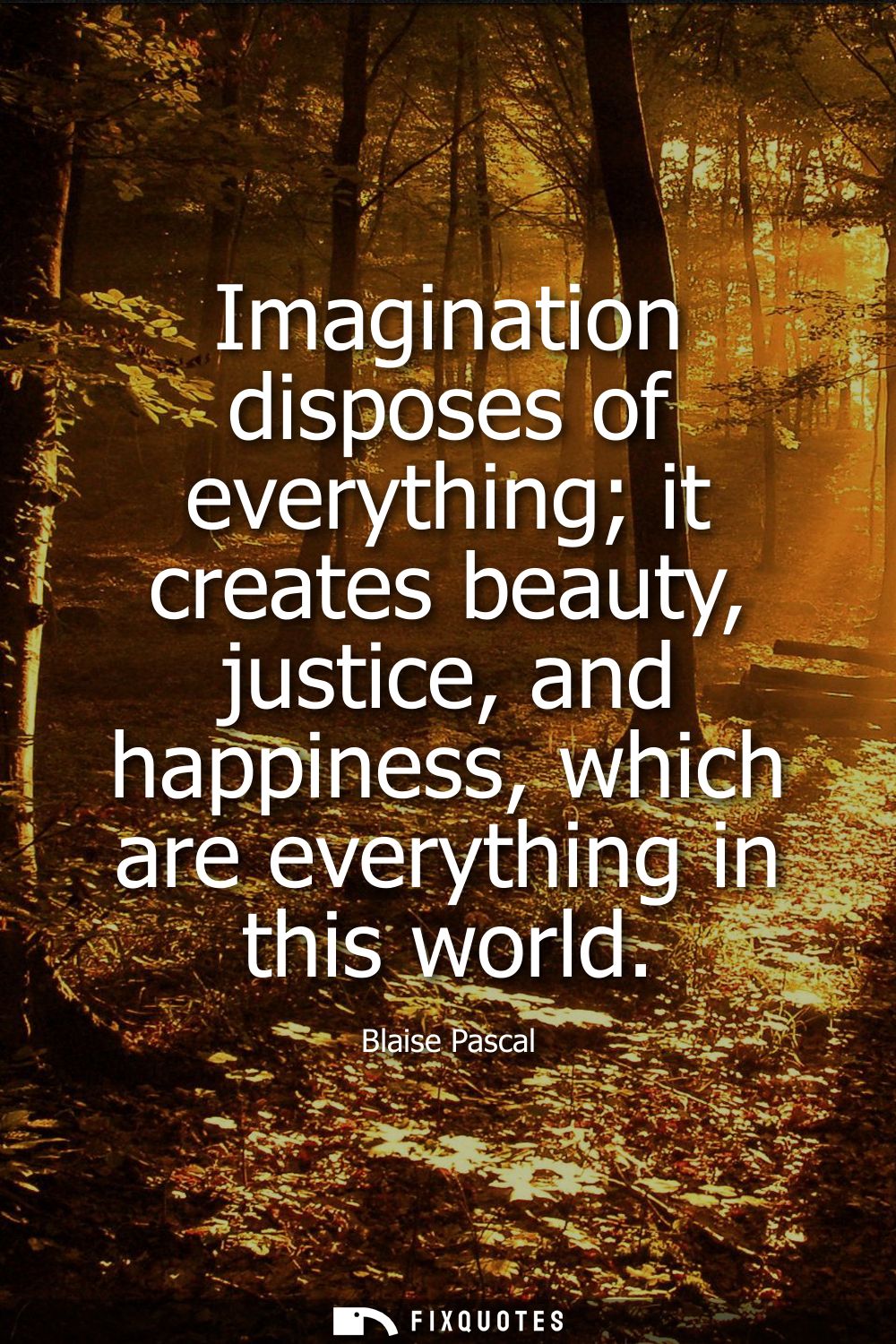
"Imagination disposes of everything; it creates beauty, justice, and happiness, which are everything in this world"
About this Quote
The line works because it flatters the modern reader's favorite premise - that meaning is made, not found - while quietly implying that what we call "everything" is terrifyingly unstable. Beauty, justice, happiness: Pascal picks the holy trinity of human reassurance, the stuff we lean on to justify our suffering and organize our politics. By attributing them to imagination, he demotes them from eternal truths to psychological and cultural achievements, held together by shared belief, habit, and appetite. The subtext is not "dream big". It's "look how easily you're persuaded."
Context sharpens the cynicism. Pascal is a mathematician-turned-Jansenist moralist, writing in a France where monarchy, church authority, and class hierarchy all depend on ritual, spectacle, and deference - in other words, on collective imagination. If justice can be "created", it can also be redesigned by whoever controls the story. If happiness is imagined, it can be sold. If beauty is imagined, it can be weaponized into status.
Pascal's brilliance is to make imagination sound like liberation and indictment at once: the engine of our highest ideals and the reason those ideals so often collapse into vanity, fashion, and power.
Quote Details
| Topic | Wisdom |
|---|---|
| Source | Attributed to Blaise Pascal, Pensées (posthumous collection; English translation commonly quoted). See Wikiquote for the translation and attributions. |
| Cite |
Citation Formats
APA Style (7th ed.)
Pascal, Blaise. (2026, January 15). Imagination disposes of everything; it creates beauty, justice, and happiness, which are everything in this world. FixQuotes. https://fixquotes.com/quotes/imagination-disposes-of-everything-it-creates-5055/
Chicago Style
Pascal, Blaise. "Imagination disposes of everything; it creates beauty, justice, and happiness, which are everything in this world." FixQuotes. January 15, 2026. https://fixquotes.com/quotes/imagination-disposes-of-everything-it-creates-5055/.
MLA Style (9th ed.)
"Imagination disposes of everything; it creates beauty, justice, and happiness, which are everything in this world." FixQuotes, 15 Jan. 2026, https://fixquotes.com/quotes/imagination-disposes-of-everything-it-creates-5055/. Accessed 31 Mar. 2026.