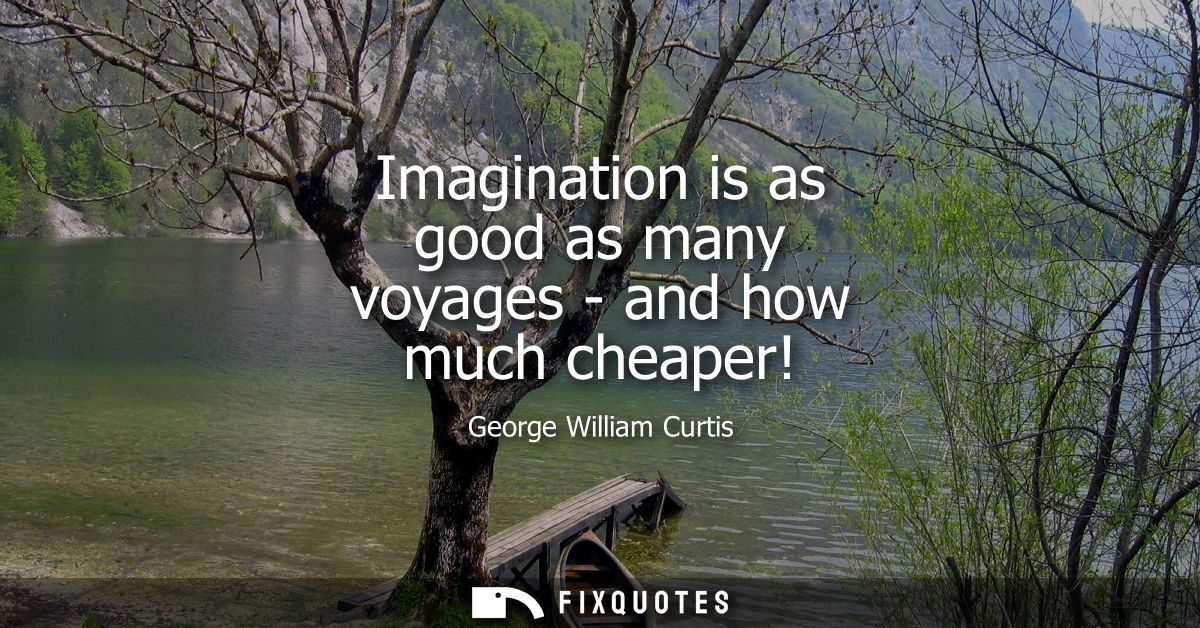
"Imagination is as good as many voyages - and how much cheaper!"
About this Quote
Curtis is selling thrift as a kind of romantic insurgency. In an era when “voyages” meant steamships, Grand Tours, and the slow prestige of being able to leave, he slips a quiet barb into the compliment: the world has been gated by money and time, so the mind becomes the contraband route. The dash does a lot of work. It opens the sentence into a wink, turning lofty praise of imagination into a practical accounting. He doesn’t just claim imagination can match travel; he frames it as a better bargain, a democratizing technology.
The intent is partly moral, partly cultural. Curtis wrote in a 19th-century America obsessed with self-improvement, lectures, and the dignity of the inner life. Imagination here isn’t daydreaming; it’s a disciplined instrument, the same one that makes novels, reform movements, and personal reinvention possible. He’s also defending the legitimacy of secondhand experience - reading, listening, picturing - at a time when authenticity was already being policed by who had “been” somewhere.
The subtext is modern in its skepticism about consumer status. Travel promises transformation, but Curtis suggests the transformation we pay for often comes from narrative: the stories we tell about elsewhere and who we become there. By calling imagination “as good as” voyages, he flirts with heresy against the cult of the itinerary. By adding “and how much cheaper,” he punctures that cult with a joke that doubles as advice: cultivate an interior passport, because the outside world isn’t equally priced.
The intent is partly moral, partly cultural. Curtis wrote in a 19th-century America obsessed with self-improvement, lectures, and the dignity of the inner life. Imagination here isn’t daydreaming; it’s a disciplined instrument, the same one that makes novels, reform movements, and personal reinvention possible. He’s also defending the legitimacy of secondhand experience - reading, listening, picturing - at a time when authenticity was already being policed by who had “been” somewhere.
The subtext is modern in its skepticism about consumer status. Travel promises transformation, but Curtis suggests the transformation we pay for often comes from narrative: the stories we tell about elsewhere and who we become there. By calling imagination “as good as” voyages, he flirts with heresy against the cult of the itinerary. By adding “and how much cheaper,” he punctures that cult with a joke that doubles as advice: cultivate an interior passport, because the outside world isn’t equally priced.
Quote Details
| Topic | Travel |
|---|---|
| Source | Unverified source: Prue and I (George William Curtis, 1856)
Evidence: But, if that be true, imagination is as good as many voyages–and how much cheaper!–a consideration which an old book-keeper can never afford to forget.. This line appears in George William Curtis’s own text in Prue and I (published as a book in 1856 by Dix, Edwards & Co.). I have not, in this sea... Other candidates (1) Mathematical Journeys (Peter D. Schumer, 2004) compilation95.0% ... Imagination is as good as many voyages - and how much cheaper . -George William Curtis ( 1824-1892 ) For as long ... |
| Cite |
Citation Formats
APA Style (7th ed.)
Curtis, George William. (2026, February 24). Imagination is as good as many voyages - and how much cheaper! FixQuotes. https://fixquotes.com/quotes/imagination-is-as-good-as-many-voyages-and-how-74301/
Chicago Style
Curtis, George William. "Imagination is as good as many voyages - and how much cheaper!" FixQuotes. February 24, 2026. https://fixquotes.com/quotes/imagination-is-as-good-as-many-voyages-and-how-74301/.
MLA Style (9th ed.)
"Imagination is as good as many voyages - and how much cheaper!" FixQuotes, 24 Feb. 2026, https://fixquotes.com/quotes/imagination-is-as-good-as-many-voyages-and-how-74301/. Accessed 5 Apr. 2026.
More Quotes by George
Add to List