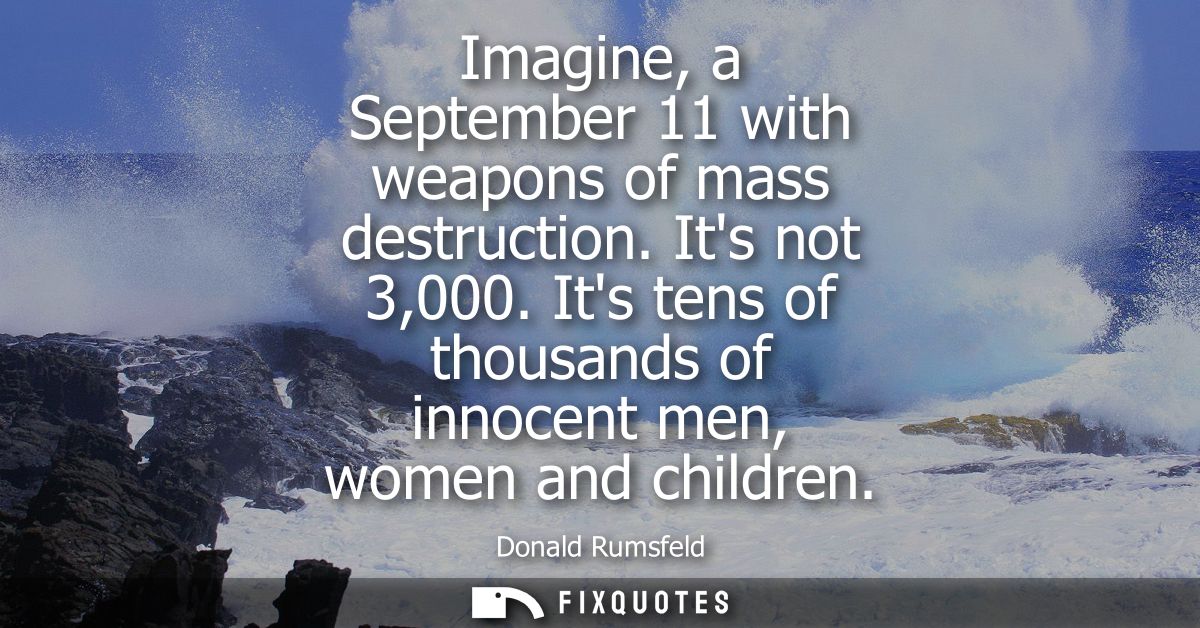
"Imagine a September 11 with weapons of mass destruction. It's not 3,000. It's tens of thousands of innocent men, women and children"
About this Quote
The arithmetic is the rhetorical punch: "It's not 3,000. It's tens of thousands". Numbers here aren’t forensic; they’re cinematic. He scales the death toll to scale the mandate, converting uncertainty about capability into certainty about consequence. The phrase "innocent men, women and children" is a well-worn triad, but in this context it functions as a prophylactic against dissent: oppose the policy and you can be recast as indifferent to innocence.
The subtext is preventative war made emotionally legible. Post-9/11, the U.S. public mood was primed for a doctrine of anticipatory action; this quote tightens that doctrine into a single, portable image. It also smuggles in a crucial assumption: that the risk is not only real but imminent enough to justify extraordinary measures. In hindsight, the line reads as a case study in how power narrates uncertainty. When intelligence is murky, the story becomes the evidence, and the fear becomes the timetable.
Quote Details
| Topic | War |
|---|---|
| Source | Help us find the source |
| Cite |
Citation Formats
APA Style (7th ed.)
Rumsfeld, Donald. (2026, February 16). Imagine a September 11 with weapons of mass destruction. It's not 3,000. It's tens of thousands of innocent men, women and children. FixQuotes. https://fixquotes.com/quotes/imagine-a-september-11-with-weapons-of-mass-144735/
Chicago Style
Rumsfeld, Donald. "Imagine a September 11 with weapons of mass destruction. It's not 3,000. It's tens of thousands of innocent men, women and children." FixQuotes. February 16, 2026. https://fixquotes.com/quotes/imagine-a-september-11-with-weapons-of-mass-144735/.
MLA Style (9th ed.)
"Imagine a September 11 with weapons of mass destruction. It's not 3,000. It's tens of thousands of innocent men, women and children." FixQuotes, 16 Feb. 2026, https://fixquotes.com/quotes/imagine-a-september-11-with-weapons-of-mass-144735/. Accessed 3 Apr. 2026.