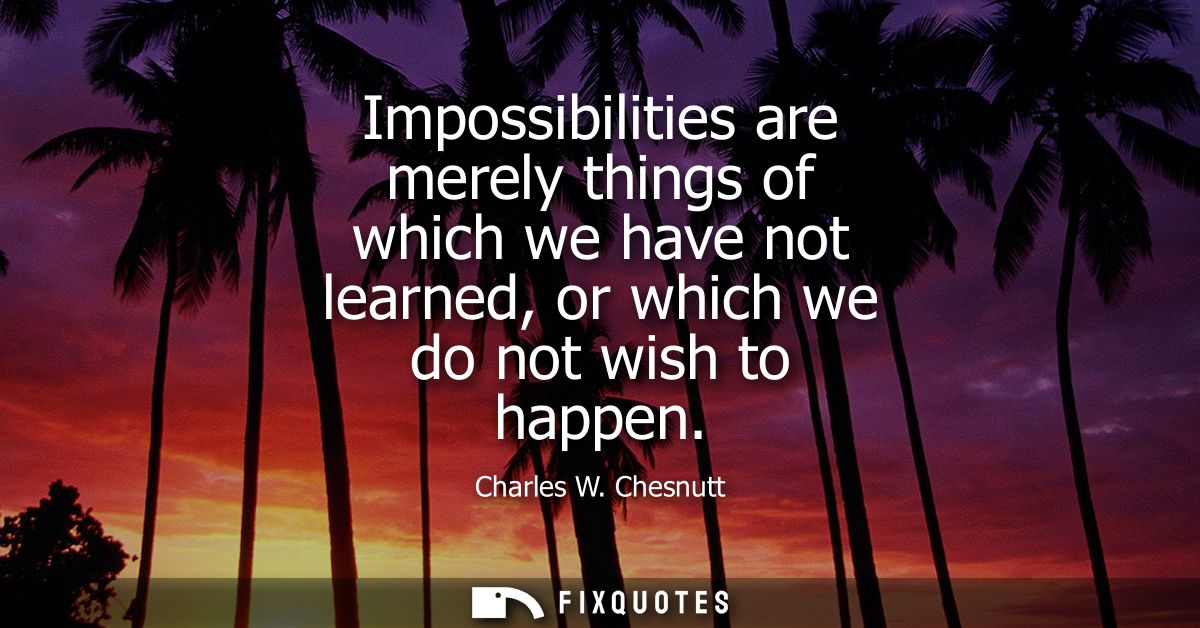
"Impossibilities are merely things of which we have not learned, or which we do not wish to happen"
About this Quote
Then comes the knife turn: “or which we do not wish to happen.” Here Chesnutt indicts willful obstruction, the kind that masquerades as realism. It’s not that change can’t occur; it’s that someone powerful enough would rather it didn’t. In the context of Chesnutt’s career - chronicling the color line, racial passing, and the legal fictions of equality - “impossibility” reads like a euphemism for entrenched interests. Integration, justice, even basic citizenship were routinely framed as impractical dreams, not because the mechanisms were unknowable, but because the consequences threatened existing hierarchies.
The line works because it exposes “common sense” as a curated emotion: fear dressed up as logic. Chesnutt doesn’t romanticize progress; he anatomizes resistance. By making the impossible a choice as much as a condition, he hands responsibility back to the speaker. If you’re calling something impossible, he suggests, we should ask what you’re protecting - and what you’re refusing to learn.
Quote Details
| Topic | Wisdom |
|---|---|
| Source | Help us find the source |
| Cite |
Citation Formats
APA Style (7th ed.)
Chesnutt, Charles W. (2026, January 17). Impossibilities are merely things of which we have not learned, or which we do not wish to happen. FixQuotes. https://fixquotes.com/quotes/impossibilities-are-merely-things-of-which-we-45822/
Chicago Style
Chesnutt, Charles W. "Impossibilities are merely things of which we have not learned, or which we do not wish to happen." FixQuotes. January 17, 2026. https://fixquotes.com/quotes/impossibilities-are-merely-things-of-which-we-45822/.
MLA Style (9th ed.)
"Impossibilities are merely things of which we have not learned, or which we do not wish to happen." FixQuotes, 17 Jan. 2026, https://fixquotes.com/quotes/impossibilities-are-merely-things-of-which-we-45822/. Accessed 12 Feb. 2026.