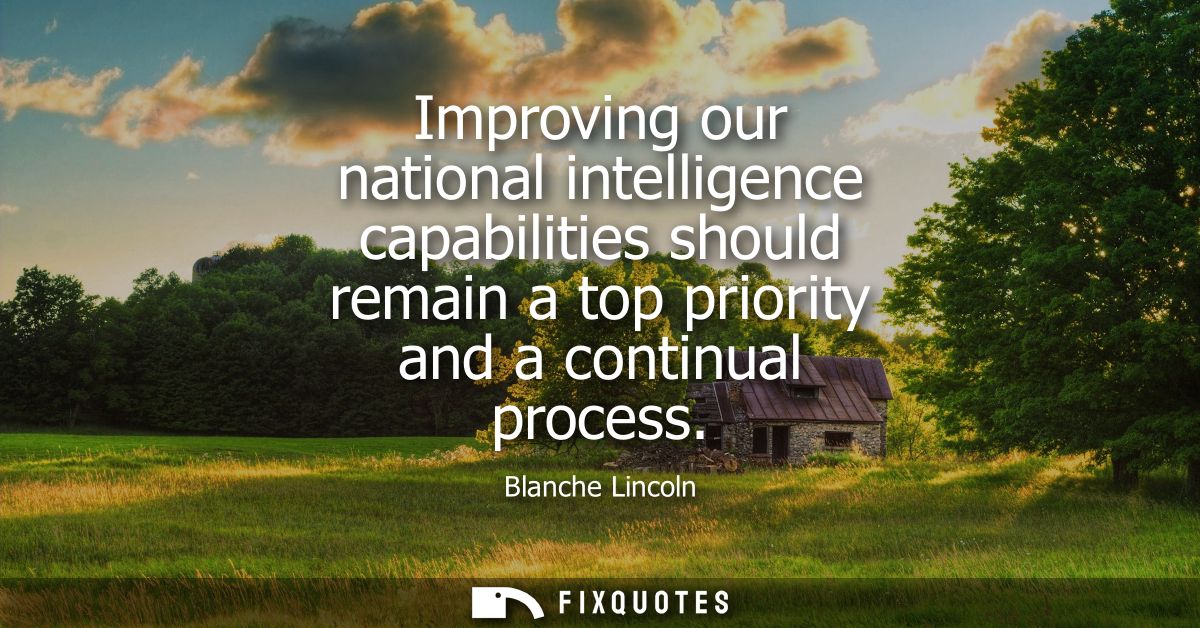
"Improving our national intelligence capabilities should remain a top priority and a continual process"
About this Quote
That “continual” is the tell. It converts a policy choice into an ongoing necessity, making budget increases, new authorities, and institutional growth feel like maintenance rather than escalation. The word “capabilities” is similarly elastic: it can mean better human intelligence, sharper analysis, cybersecurity defenses, surveillance tools, or deeper information-sharing with allies - a broad umbrella that avoids naming the trade-offs (privacy, oversight, mission creep) that make intelligence reform politically combustible.
Placed in the post-9/11 era of commission reports, reorganizations, and anxiety about “connecting the dots,” the line reads as an attempt to sound serious without sounding extreme. It signals alignment with national security consensus while leaving room to reassure constituents across the spectrum: hawks hear resolve; moderates hear process; skeptics hear improvement rather than aggression. The craft is in its vagueness: it’s a commitment designed to be hard to oppose, and even harder to measure.
Quote Details
| Topic | Vision & Strategy |
|---|---|
| Source | Help us find the source |
| Cite |
Citation Formats
APA Style (7th ed.)
Lincoln, Blanche. (2026, January 17). Improving our national intelligence capabilities should remain a top priority and a continual process. FixQuotes. https://fixquotes.com/quotes/improving-our-national-intelligence-capabilities-46974/
Chicago Style
Lincoln, Blanche. "Improving our national intelligence capabilities should remain a top priority and a continual process." FixQuotes. January 17, 2026. https://fixquotes.com/quotes/improving-our-national-intelligence-capabilities-46974/.
MLA Style (9th ed.)
"Improving our national intelligence capabilities should remain a top priority and a continual process." FixQuotes, 17 Jan. 2026, https://fixquotes.com/quotes/improving-our-national-intelligence-capabilities-46974/. Accessed 26 Mar. 2026.