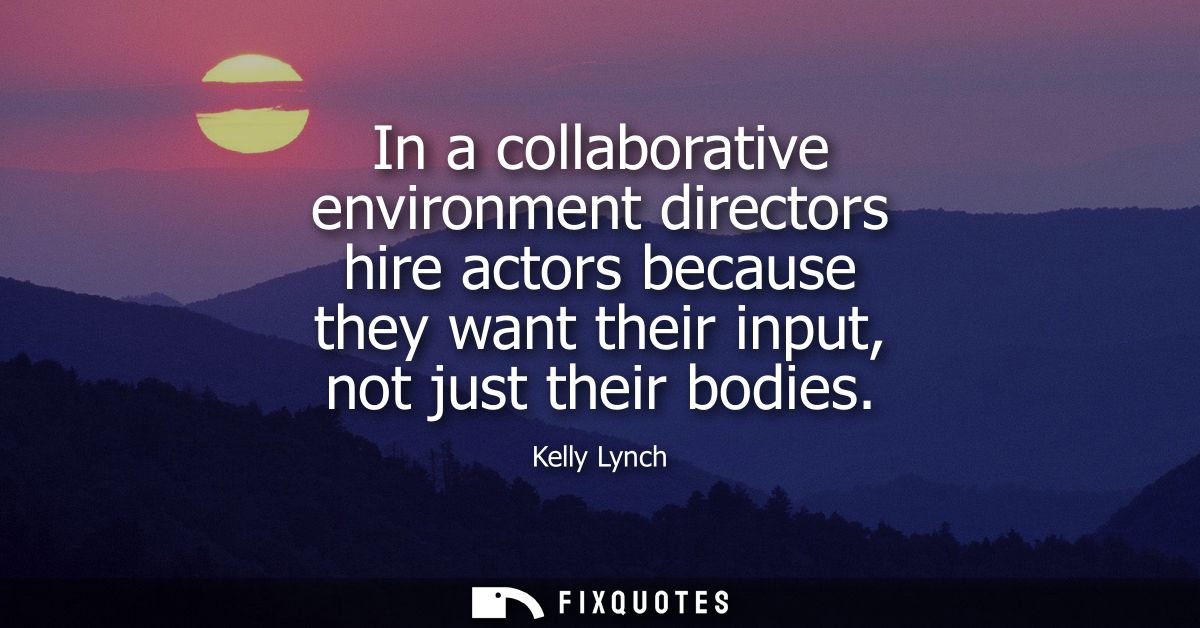
"In a collaborative environment directors hire actors because they want their input, not just their bodies"
About this Quote
Lynch draws a hard line against the oldest trick in the industry: treating actors as furniture with faces. The phrasing is telling. “Collaborative environment” isn’t a kumbaya buzzword here; it’s a litmus test. She’s quietly indicting sets where “direction” means control, where an actor is expected to hit marks, look available, and stop there. By contrast, her ideal director hires a performer for mind as much as for presence, which reframes acting from obedient execution to creative authorship.
The sting lands in the blunt contrast of “input” versus “bodies.” She’s not talking about physicality as craft (which acting obviously includes); she’s talking about objectification and extraction. The line reads as a defense of agency, especially for women, who have long been hired on a sliding scale of desirability and compliance. “Not just their bodies” carries the cultural residue of casting couch mythology, camera gaze politics, and the way “chemistry” can become a euphemism for commodifying someone’s look.
Contextually, it also pushes back on the auteur myth that the director is the sole artist and everyone else is an instrument. Lynch’s point: great work is negotiated. Actors bring lived experience, instinct, contradiction, and surprise - the stuff that can’t be storyboarded. A director who truly wants that input is admitting vulnerability: the film might get better by not fully obeying the plan. That’s a professional ethic disguised as a simple sentence, and it stakes a claim that performance is not decoration; it’s co-creation.
The sting lands in the blunt contrast of “input” versus “bodies.” She’s not talking about physicality as craft (which acting obviously includes); she’s talking about objectification and extraction. The line reads as a defense of agency, especially for women, who have long been hired on a sliding scale of desirability and compliance. “Not just their bodies” carries the cultural residue of casting couch mythology, camera gaze politics, and the way “chemistry” can become a euphemism for commodifying someone’s look.
Contextually, it also pushes back on the auteur myth that the director is the sole artist and everyone else is an instrument. Lynch’s point: great work is negotiated. Actors bring lived experience, instinct, contradiction, and surprise - the stuff that can’t be storyboarded. A director who truly wants that input is admitting vulnerability: the film might get better by not fully obeying the plan. That’s a professional ethic disguised as a simple sentence, and it stakes a claim that performance is not decoration; it’s co-creation.
Quote Details
| Topic | Movie |
|---|
More Quotes by Kelly
Add to List