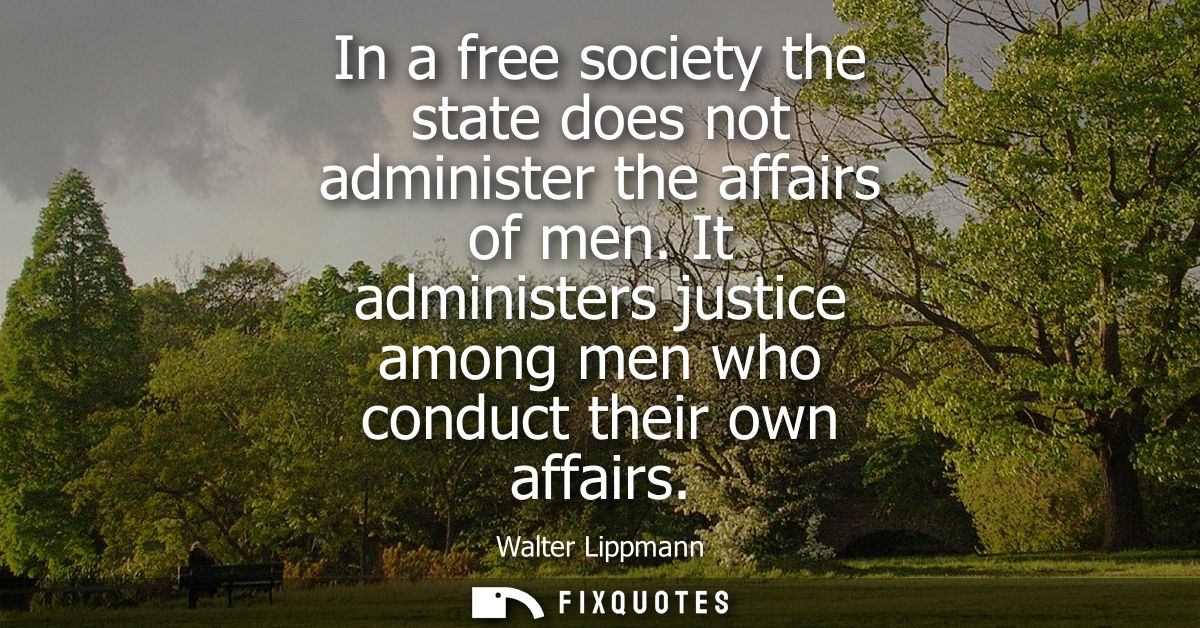
"In a free society, the state does not administer the affairs of men. It administers justice among men who conduct their own affairs"
About this Quote
The phrasing does a lot of ideological work. “Administers” implies a machinery that can be pointed either at life itself or at disputes arising within life; Lippmann insists the machine should touch only the latter. “Affairs of men” sounds expansive enough to include labor, family, speech, commerce, even conscience. “Conduct their own affairs” turns autonomy into a civic duty, not just a right. Freedom becomes less a vibe than a burden: you’re on the hook for your choices, and the state’s restraint depends on citizens practicing competence.
Context matters. Lippmann wrote amid the 20th century’s great argument about planning versus liberalism: progressives and New Dealers expanding administrative capacity, fascist and communist regimes offering total management, and American liberals trying to defend regulation without sliding into tutelage. The subtext is a warning to reformers and reactionaries alike: government can be strong without being intrusive, but once it starts “administering” lives, it stops being the referee and starts being a player.
Quote Details
| Topic | Freedom |
|---|---|
| Source | Later attribution: Ideological Heritage Vol 2 (William Howard Greenleaf, 2013) modern compilationISBN: 9781136501524 · ID: 5X1HAQAAQBAJ
Evidence:
... Walter Lippmann : ' in a free society the state does not administer the affairs of men . It administers justice among men who conduct their own affairs . '88 There must thus be a reasonably clear understanding of the limits of the ... |
| Cite |
Citation Formats
APA Style (7th ed.)
Lippmann, Walter. (2026, March 26). In a free society, the state does not administer the affairs of men. It administers justice among men who conduct their own affairs. FixQuotes. https://fixquotes.com/quotes/in-a-free-society-the-state-does-not-administer-98413/
Chicago Style
Lippmann, Walter. "In a free society, the state does not administer the affairs of men. It administers justice among men who conduct their own affairs." FixQuotes. March 26, 2026. https://fixquotes.com/quotes/in-a-free-society-the-state-does-not-administer-98413/.
MLA Style (9th ed.)
"In a free society, the state does not administer the affairs of men. It administers justice among men who conduct their own affairs." FixQuotes, 26 Mar. 2026, https://fixquotes.com/quotes/in-a-free-society-the-state-does-not-administer-98413/. Accessed 28 Mar. 2026.