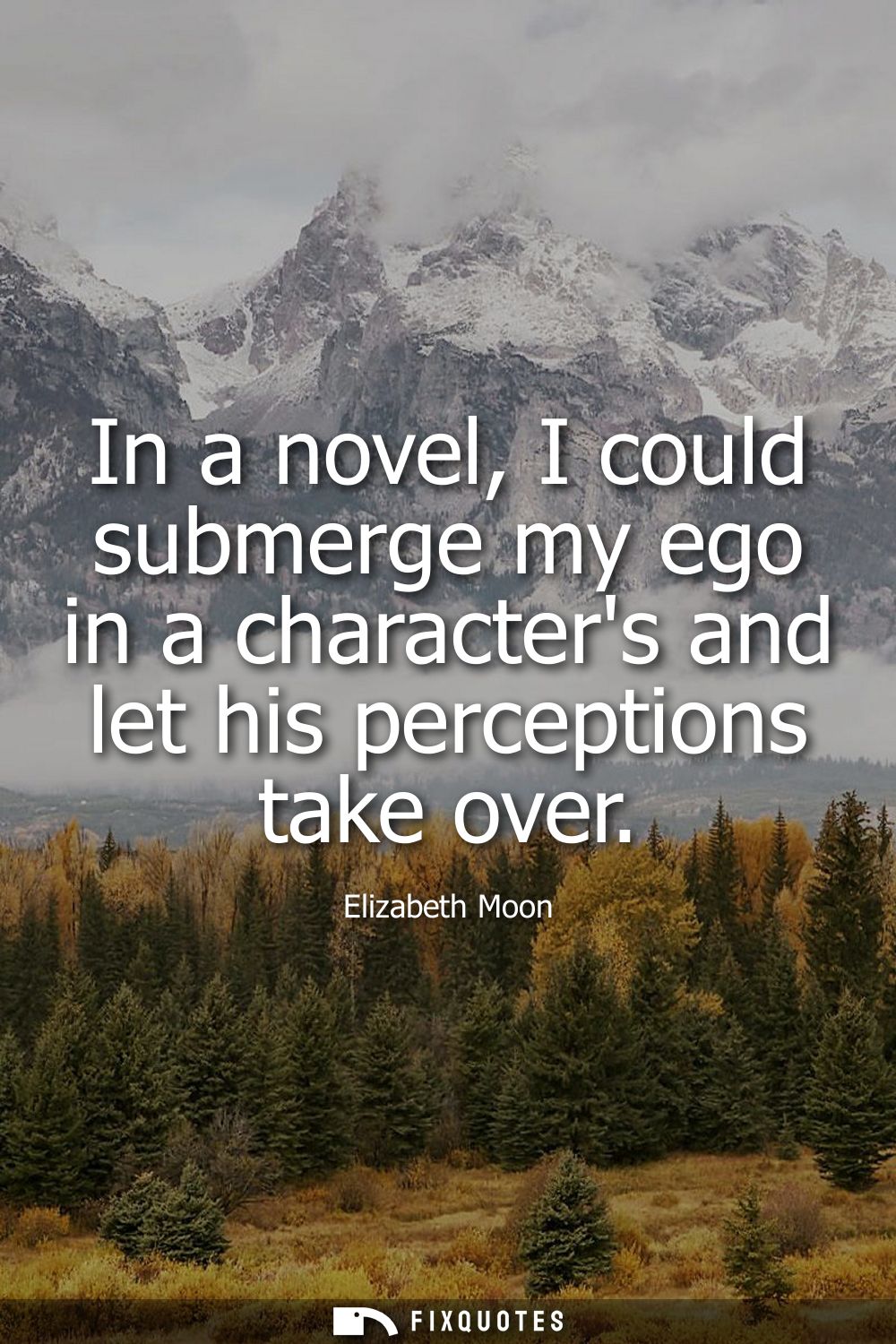
"In a novel, I could submerge my ego in a character's and let his perceptions take over"
About this Quote
The gendered pronoun matters. Moon, a woman writing in genres historically dominated by male protagonists and male readerships (especially in military-inflected science fiction where she became influential), signals a deliberate crossing of identity lines. It's not "a character's perceptions", but "his". Subtext: the self is not the default center, and authorship isn't permission to moralize from above. It's permission to ventriloquize convincingly.
Contextually, Moon's work often treats competence, duty, and institutional power with a soldier's eye for procedure and consequence. That sensibility shows up here as craft talk, not mysticism. "Could" is doing work, too: a novel offers the space to sustain that possession over time, to let a consciousness accumulate and harden into worldview. The quote is a defense of fiction's distinctive power: not to argue, but to induce temporary conversion.
Quote Details
| Topic | Writing |
|---|---|
| Source | Help us find the source |
| Cite |
Citation Formats
APA Style (7th ed.)
Moon, Elizabeth. (2026, January 17). In a novel, I could submerge my ego in a character's and let his perceptions take over. FixQuotes. https://fixquotes.com/quotes/in-a-novel-i-could-submerge-my-ego-in-a-65782/
Chicago Style
Moon, Elizabeth. "In a novel, I could submerge my ego in a character's and let his perceptions take over." FixQuotes. January 17, 2026. https://fixquotes.com/quotes/in-a-novel-i-could-submerge-my-ego-in-a-65782/.
MLA Style (9th ed.)
"In a novel, I could submerge my ego in a character's and let his perceptions take over." FixQuotes, 17 Jan. 2026, https://fixquotes.com/quotes/in-a-novel-i-could-submerge-my-ego-in-a-65782/. Accessed 14 Mar. 2026.