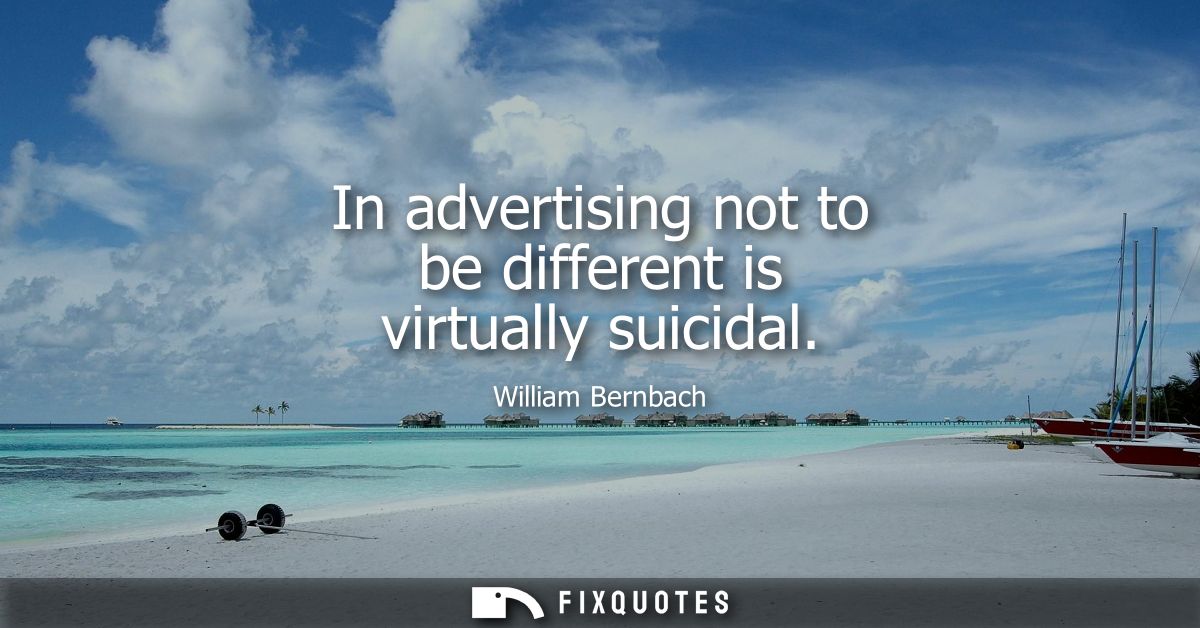
"In advertising, not to be different is virtually suicidal"
About this Quote
Safety is rarely the danger in advertising; invisibility is. Bernbach's line lands like a threat because it’s meant to be one: a warning that the market punishes sameness more ruthlessly than it punishes risk. “Virtually suicidal” isn’t hyperbole for effect so much as an executive translation of a brutal reality - if you sound like everyone else, you disappear into the noise, and disappearance is death when attention is the currency.
The intent is practical, not poetic. Bernbach helped invent modern creative advertising in the 1950s and 60s, when mass media (especially television) turned brands into national characters and agencies into cultural factories. In that environment, difference wasn’t a nice-to-have aesthetic; it was a survival strategy. His own work at Doyle Dane Bernbach proved the point: Volkswagen’s “Think Small” and Avis’s “We try harder” didn’t just sell products, they flipped the script on what car ads were supposed to sound like. They used honesty, self-deprecation, and design restraint as weapons against the puffed-up bravado of the era.
The subtext is a critique of corporate cowardice. Bernbach is calling out the default business instinct to copy the category leader, to “benchmark” your way into mediocrity. He’s also defending creativity as a business discipline, not a decorative department. Difference, in his view, is not eccentricity for its own sake; it’s clarity. The goal isn’t to be weird. It’s to be unmistakable.
The intent is practical, not poetic. Bernbach helped invent modern creative advertising in the 1950s and 60s, when mass media (especially television) turned brands into national characters and agencies into cultural factories. In that environment, difference wasn’t a nice-to-have aesthetic; it was a survival strategy. His own work at Doyle Dane Bernbach proved the point: Volkswagen’s “Think Small” and Avis’s “We try harder” didn’t just sell products, they flipped the script on what car ads were supposed to sound like. They used honesty, self-deprecation, and design restraint as weapons against the puffed-up bravado of the era.
The subtext is a critique of corporate cowardice. Bernbach is calling out the default business instinct to copy the category leader, to “benchmark” your way into mediocrity. He’s also defending creativity as a business discipline, not a decorative department. Difference, in his view, is not eccentricity for its own sake; it’s clarity. The goal isn’t to be weird. It’s to be unmistakable.
Quote Details
| Topic | Marketing |
|---|---|
| Source | Help us find the source |
| Cite |
Citation Formats
APA Style (7th ed.)
Bernbach, William. (2026, February 17). In advertising, not to be different is virtually suicidal. FixQuotes. https://fixquotes.com/quotes/in-advertising-not-to-be-different-is-virtually-108285/
Chicago Style
Bernbach, William. "In advertising, not to be different is virtually suicidal." FixQuotes. February 17, 2026. https://fixquotes.com/quotes/in-advertising-not-to-be-different-is-virtually-108285/.
MLA Style (9th ed.)
"In advertising, not to be different is virtually suicidal." FixQuotes, 17 Feb. 2026, https://fixquotes.com/quotes/in-advertising-not-to-be-different-is-virtually-108285/. Accessed 30 Mar. 2026.
More Quotes by William
Add to List