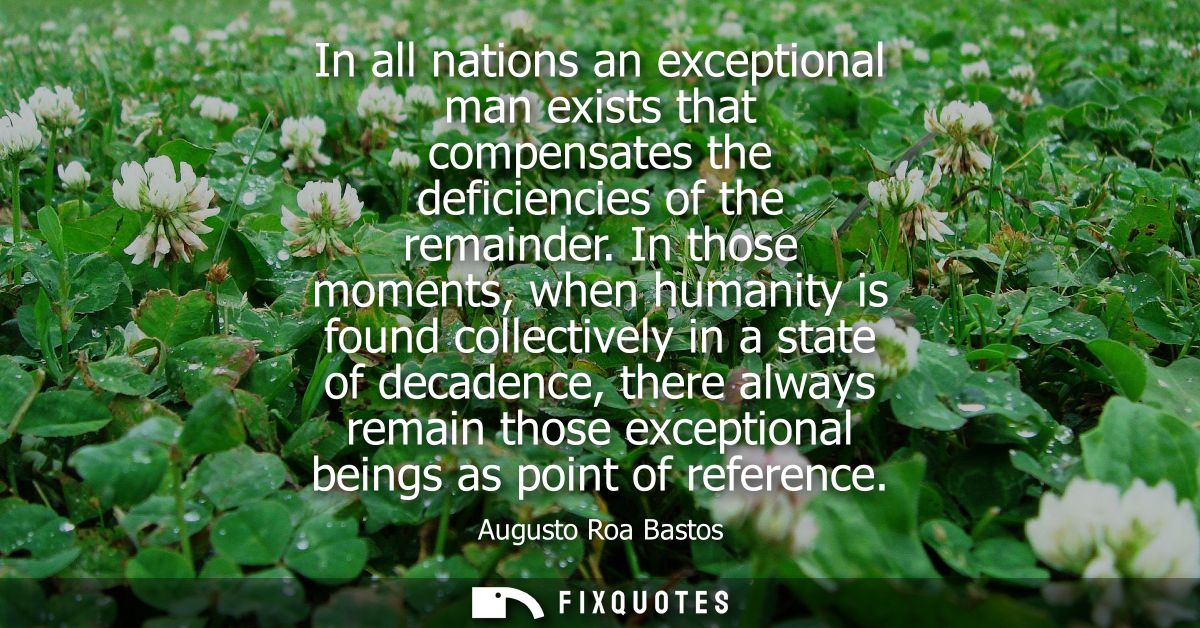
"In all nations an exceptional man exists that compensates the deficiencies of the remainder. In those moments, when humanity is found collectively in a state of decadence, there always remain those exceptional beings as point of reference"
About this Quote
Roa Bastos is flirting with a seductive political myth: the idea that a single “exceptional man” can redeem a nation’s mediocrity, even its rot. The phrasing is deliberately sweeping - “in all nations,” “always” - because he’s not describing a statistic; he’s describing a story people tell themselves when institutions feel hollow. The line flatters the reader’s hunger for rescue. If “humanity” is in decadence, then decline stops being a shared responsibility and becomes a waiting room for a savior.
But Roa Bastos, a Paraguayan novelist shaped by dictatorship and exile, knows how dangerous that myth can be. In Latin America’s 20th century, “exceptional men” often arrived as caudillos: strongmen who marketed themselves as moral compensation for a weak public and then made that weakness permanent. The quote’s subtext carries that double edge. It can be read as faith in conscience - the rare person who refuses the collective slide - yet its vocabulary (“compensates,” “point of reference”) also sounds like a culture outsourcing ethics to a hero, reducing the rest to “deficiencies.”
What makes it work is its tension between admiration and indictment. “Exceptional beings” are invoked less as celebrities than as moral yardsticks. They don’t fix decadence; they expose it. In that sense, Roa Bastos isn’t comforting you with greatness. He’s warning that when a society needs exceptions to remember what decency looks like, the real scandal isn’t the lack of heroes - it’s the normalization of collapse.
But Roa Bastos, a Paraguayan novelist shaped by dictatorship and exile, knows how dangerous that myth can be. In Latin America’s 20th century, “exceptional men” often arrived as caudillos: strongmen who marketed themselves as moral compensation for a weak public and then made that weakness permanent. The quote’s subtext carries that double edge. It can be read as faith in conscience - the rare person who refuses the collective slide - yet its vocabulary (“compensates,” “point of reference”) also sounds like a culture outsourcing ethics to a hero, reducing the rest to “deficiencies.”
What makes it work is its tension between admiration and indictment. “Exceptional beings” are invoked less as celebrities than as moral yardsticks. They don’t fix decadence; they expose it. In that sense, Roa Bastos isn’t comforting you with greatness. He’s warning that when a society needs exceptions to remember what decency looks like, the real scandal isn’t the lack of heroes - it’s the normalization of collapse.
Quote Details
| Topic | Wisdom |
|---|
More Quotes by Augusto
Add to List