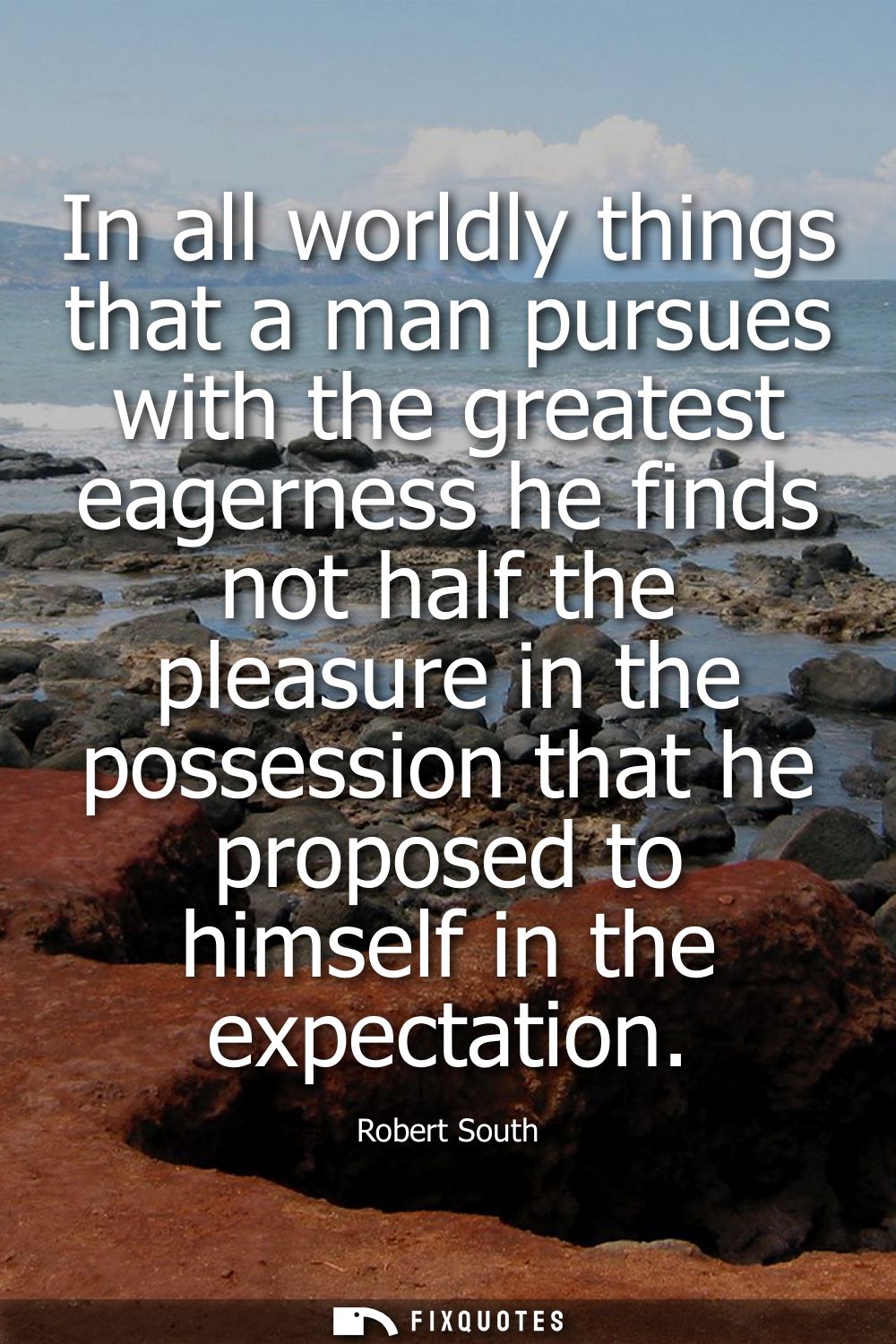
"In all worldly things that a man pursues with the greatest eagerness, he finds not half the pleasure in the possession that he proposed to himself in the expectation"
About this Quote
The intent is pastoral but unsentimental. South aims at the subtle self-deception embedded in “expectation”: we don’t merely want things, we pre-enjoy them in imagination, inflating their capacity to satisfy. Possession can only be literal, finite, and quickly normalized; expectation is unlimited and can be edited to taste. The subtext is a theological critique of misplaced ends. If you hitch your happiness to “worldly things,” you’re not just morally off-course; you’re strategically foolish, investing your soul in an asset designed to depreciate the moment it’s acquired.
What makes the sentence work is its rhetorical trap. It flatters the listener’s self-knowledge - everyone recognizes the post-purchase letdown - then turns that recognition into an argument for spiritual realism. South doesn’t have to name vanity, sin, or salvation explicitly; the ratio does the moral work. You can almost hear a sermon audience nodding, then squirming, as everyday experience gets conscripted into a larger claim: the world’s promises are structurally unable to deliver what they advertise.
Quote Details
| Topic | Wisdom |
|---|---|
| Source | Help us find the source |
| Cite |
Citation Formats
APA Style (7th ed.)
South, Robert. (2026, February 16). In all worldly things that a man pursues with the greatest eagerness, he finds not half the pleasure in the possession that he proposed to himself in the expectation. FixQuotes. https://fixquotes.com/quotes/in-all-worldly-things-that-a-man-pursues-with-the-166558/
Chicago Style
South, Robert. "In all worldly things that a man pursues with the greatest eagerness, he finds not half the pleasure in the possession that he proposed to himself in the expectation." FixQuotes. February 16, 2026. https://fixquotes.com/quotes/in-all-worldly-things-that-a-man-pursues-with-the-166558/.
MLA Style (9th ed.)
"In all worldly things that a man pursues with the greatest eagerness, he finds not half the pleasure in the possession that he proposed to himself in the expectation." FixQuotes, 16 Feb. 2026, https://fixquotes.com/quotes/in-all-worldly-things-that-a-man-pursues-with-the-166558/. Accessed 9 Mar. 2026.