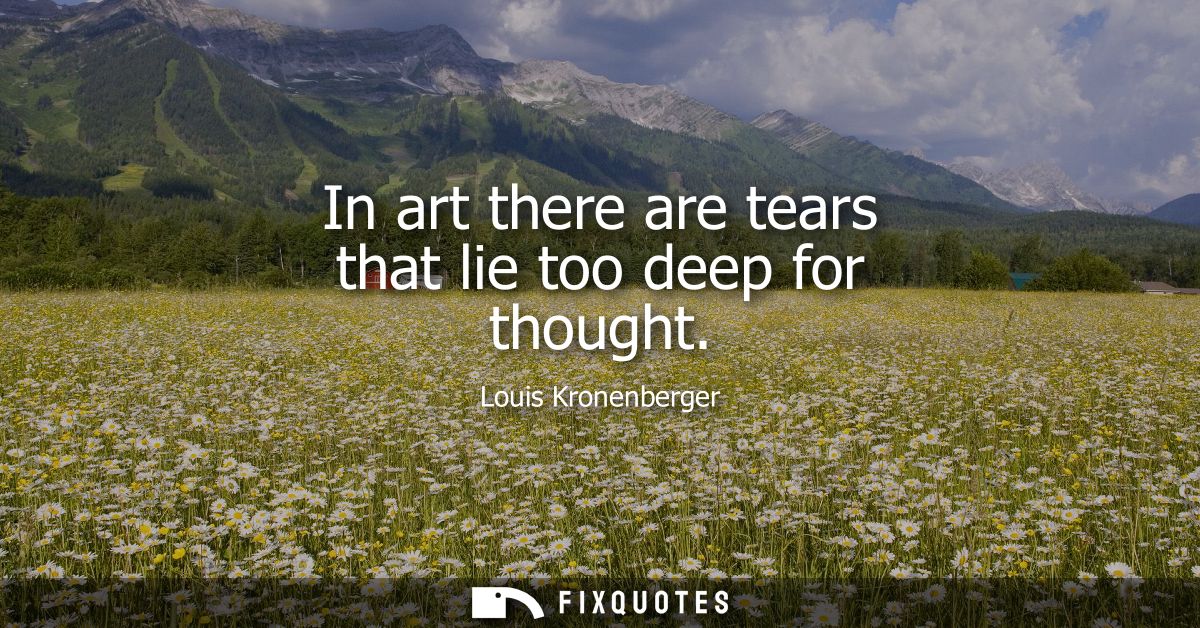
"In art, there are tears that lie too deep for thought"
About this Quote
Kronenberger’s line lands like a quiet rebuke to the critic’s own profession. “Tears” in art aren’t just sentiment; they’re evidence of an experience that refuses to be tidied up into interpretation. By insisting they “lie too deep for thought,” he draws a boundary around the parts of aesthetic response that happen before language shows up with its clipboard. It’s a defense of the irrational not as anti-intellectualism, but as a recognition that some truths arrive as sensation: a tightening throat, a flash of shame, a childhood memory you didn’t know you still carried.
The phrasing does sly work. “Lie” suggests both location and concealment: these tears are buried, but also inert, waiting. “Too deep” implies that thought isn’t the deepest tool we have, only the most prestigious one. Kronenberger, writing in a 20th-century critical culture increasingly enamored of systems and readings, is staking out room for the pre-analytic. It’s the kind of sentence you write when you’ve watched art get flattened into “themes” and “messages” and want to restore the private, bodily charge that makes art worth arguing about in the first place.
Subtextually, it’s also a warning: when criticism overreaches, it risks missing the point by explaining it. The intent isn’t to ban analysis, but to remind us that the best art leaves a residue that interpretation can circle, even illuminate, without fully dissolving.
The phrasing does sly work. “Lie” suggests both location and concealment: these tears are buried, but also inert, waiting. “Too deep” implies that thought isn’t the deepest tool we have, only the most prestigious one. Kronenberger, writing in a 20th-century critical culture increasingly enamored of systems and readings, is staking out room for the pre-analytic. It’s the kind of sentence you write when you’ve watched art get flattened into “themes” and “messages” and want to restore the private, bodily charge that makes art worth arguing about in the first place.
Subtextually, it’s also a warning: when criticism overreaches, it risks missing the point by explaining it. The intent isn’t to ban analysis, but to remind us that the best art leaves a residue that interpretation can circle, even illuminate, without fully dissolving.
Quote Details
| Topic | Art |
|---|---|
| Source | Help us find the source |
| Cite |
Citation Formats
APA Style (7th ed.)
Kronenberger, Louis. (2026, February 18). In art, there are tears that lie too deep for thought. FixQuotes. https://fixquotes.com/quotes/in-art-there-are-tears-that-lie-too-deep-for-84670/
Chicago Style
Kronenberger, Louis. "In art, there are tears that lie too deep for thought." FixQuotes. February 18, 2026. https://fixquotes.com/quotes/in-art-there-are-tears-that-lie-too-deep-for-84670/.
MLA Style (9th ed.)
"In art, there are tears that lie too deep for thought." FixQuotes, 18 Feb. 2026, https://fixquotes.com/quotes/in-art-there-are-tears-that-lie-too-deep-for-84670/. Accessed 1 Apr. 2026.
More Quotes by Louis
Add to List